 Blaine Siding
 Exteriors Built for Life on Birch Bay
Birch Bay sits right where the wind comes off the water, and any homeowner who's lived there through a few winters knows exactly what that means for the outside of a house. Salt air works its way into anything that isn't sealed properly. Driving rain off the Strait finds every gap and weak seam. And the shaded, damp stretches of the year turn north-facing walls, decks, and rooflines into prime real estate for moss and algae. It's a beautiful place to live, but it is not a gentle place for exterior materials, and homes here show the wear a lot faster than homes twenty miles inland.
We work throughout Blaine and the surrounding Whatcom County shoreline, and Birch Bay is one of the areas where we see the clearest pattern: houses built or sided with materials that weren't chosen with this specific climate in mind tend to fail early — cupping, swelling, peeling paint, soft trim, moss-stained shakes, corroded fasteners. Houses sided and built correctly for coastal exposure hold up for decades with reasonable upkeep. The difference almost always comes down to material choice and installation quality, not luck.
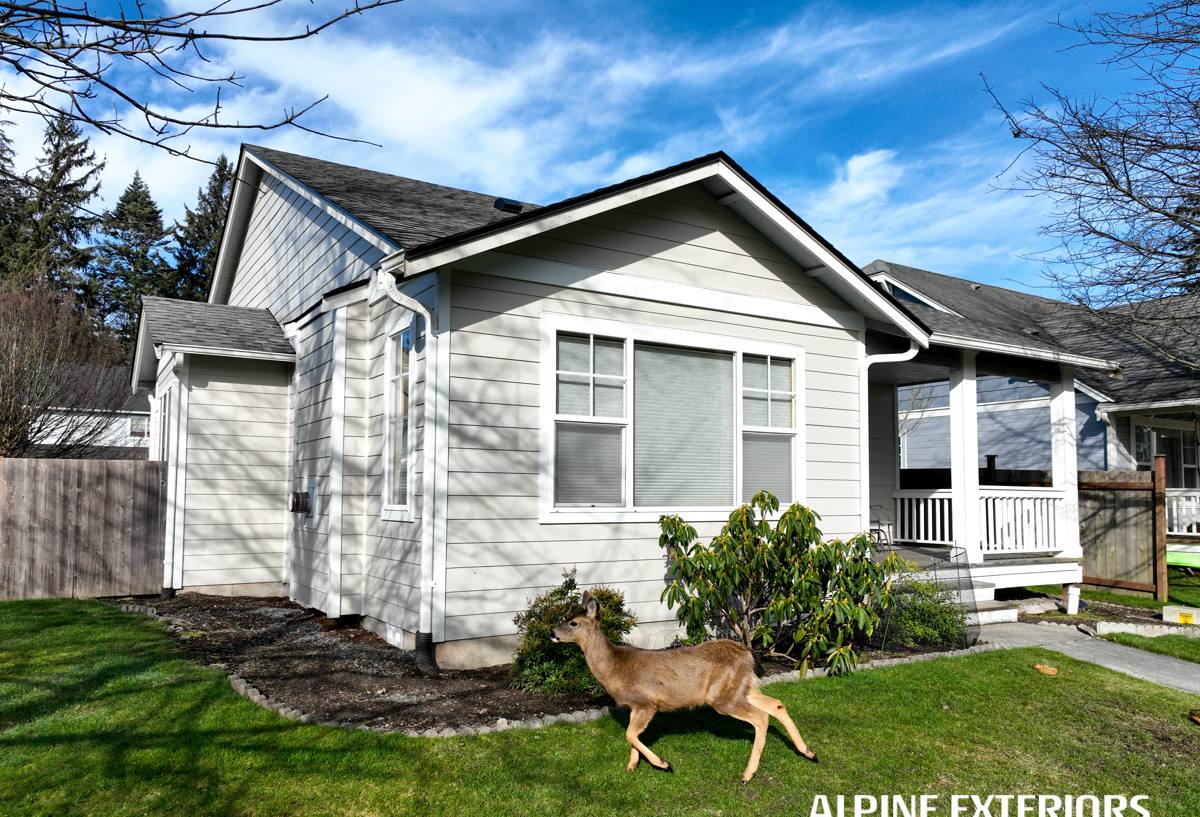
What Salt Air, Rain, and Moss Actually Do to a Home
Salt Air
Airborne salt is corrosive and it doesn't need a direct ocean view to reach your house — wind carries it well inland from the bay. Over years, it accelerates the breakdown of unprotected wood fibers, degrades cheap paint films faster than the label promises, and corrodes fasteners, flashing, and hardware that isn't rated for coastal use. Siding, roofing, and even deck hardware all take this hit differently, but none of it is immune.
Driving Rain
Storms off the water don't just fall straight down — wind-driven rain gets pushed sideways into walls, under laps, and around window and door openings. Any weakness in the water-management system behind the siding (house wrap, flashing, caulking, drainage gaps) becomes a slow leak that rots sheathing long before anyone sees a stain on the interior wall. This is why installation detail matters as much as the siding product itself.
Moss and Algae Season
Birch Bay gets long stretches of overcast, damp weather, and shaded north and east elevations rarely get enough sun to dry out fully between rains. That's exactly what moss and algae need to take hold — on roofs, on decking, and on siding surfaces that hold moisture instead of shedding it. Left unaddressed, moss growth traps water against the surface underneath it, which shortens the life of whatever material it's growing on.
Siding: Why We Only Install James Hardie
We install James Hardie fiber cement siding exclusively. We don't install vinyl, LP SmartSide, Cemplank, Allura, primed spruce, or cedar, and that's a deliberate standard, not a limitation on what we're capable of installing. Here's the honest reasoning, product by product:
- Vinyl is affordable and low-maintenance in mild climates, but it becomes brittle in cold snaps, can warp under heat or reflected sunlight, and offers little protection in wind-driven storms — panels can lift or crack at the fasteners over time.
- LP SmartSide and other engineered wood products perform reasonably where moisture exposure is controlled, but they're wood-based, and wood-based siding in a salt-air, high-rain environment needs near-perfect caulking and paint maintenance to avoid edge swelling and eventual rot. Miss a maintenance cycle in a place like Birch Bay and the clock starts ticking faster than it would inland.
- Cemplank and Allura are also fiber cement and share some of Hardie's core advantages, but we've standardized on one manufacturer so we can guarantee consistent installation training, matched trim systems, and warranty support across every job we do.
- Primed spruce and cedar are traditional, attractive choices, but raw wood siding demands the most upkeep of any option on this list — regular repainting or restaining, vigilant caulk inspection, and real vulnerability to moisture, insects, and rot if maintenance slips even one season.
James Hardie fiber cement is non-combustible, dimensionally stable, and manufactured in climate-engineered HZ product lines specifically formulated for different regions — the Pacific Northwest falls under a moisture-and-freeze profile that Hardie's HZ5 formulation is built around. The factory-applied ColorPlus finish is baked on under controlled conditions, which gives it far better fade and moisture resistance than field-applied paint, and it comes with a strong, transferable limited warranty. It won't rot, it resists pests, and it holds up to wind-driven rain and salt exposure better than the alternatives above when installed to spec — which is the other half of the equation. Fiber cement installed with poor flashing and caulking details will still let water in; the product only performs as well as the crew installing it.
Siding Material Comparison for a Coastal Whatcom County Home
| Material | Moisture Resistance | Maintenance Burden | Typical Lifespan (well-maintained) |
|---|---|---|---|
| James Hardie Fiber Cement | High — factory finish, engineered for climate | Low — periodic wash, caulk checks | 30-50 years |
| Vinyl | Moderate — can warp/crack at fasteners | Low, but repairs are visible/patchy | 20-30 years |
| LP SmartSide / Engineered Wood | Moderate — needs sealed edges | Moderate — repaint/reseal cycles | 20-30 years with upkeep |
| Primed Spruce / Cedar | Lower without diligent upkeep | High — regular refinishing | 15-30 years, highly upkeep-dependent |
Roofing for the Bay: Wind, Rain, and Moss
A roof over a Birch Bay home works harder than the same roof would ten miles inland. Beyond shedding regular rain, it needs to handle wind uplift during winter storms and resist the moss and algae growth that shaded, damp roof planes are prone to here. We look at underlayment quality, proper ventilation (which reduces the trapped moisture that feeds moss), and flashing details around every penetration — chimneys, vents, valleys — since that's where the vast majority of roof leaks actually start, not in the open field of shingles.
Windows: Sealing Out Wind-Driven Rain
Window failures in this climate are rarely about the glass — they're about the flashing and sealant details around the frame. Wind-driven rain will find a poorly flashed window opening and push water behind the trim, where it can sit against sheathing for months before anyone notices a soft spot or a stain. When we replace windows, we treat proper flashing and integration with the surrounding siding as the priority, not just the window unit itself. We also talk with homeowners about energy performance, since older single-pane or poorly sealed units in a house exposed to constant wind lose a lot of heat through infiltration alone.
Decks: Built to Handle Standing Water and Shade
Decks in Birch Bay face their own version of the same problem — standing water, shaded corners that never fully dry, and salt air accelerating fastener corrosion. Ledger board attachment and proper flashing where the deck meets the house are the details that matter most for long-term structural safety, and they're also the details that are easiest to get wrong. Decking material choice matters too: some composite and wood options handle damp, shaded exposure far better than others, and we'll walk through the honest trade-offs for your specific site — sun exposure, drainage, and how the deck ties into your home's siding and roofline.
Homeowner Maintenance Checklist for Coastal Whatcom County
- Rinse siding and decking surfaces periodically to remove salt residue and organic buildup before it sets in.
- Inspect caulking around windows, doors, and trim each fall, before the heavy rain season starts.
- Check roof valleys and gutters for moss buildup and debris, especially on shaded north-facing slopes.
- Keep gutters and downspouts clear so wind-driven rain has somewhere to go besides your walls.
- Look at deck ledger boards and fasteners annually for early signs of corrosion or softening wood.
- Trim back vegetation that keeps siding or roof sections shaded and slow to dry.
What Working With a Local Crew Means
A crew based in Blaine and familiar with Birch Bay's exposure knows which elevations of a house take the worst of the weather before they ever put a level on the wall. That local knowledge shapes real decisions — where extra flashing attention goes, which product lines make sense for a shoreline lot versus a more sheltered inland property, and how to sequence a project around the wetter months of the year. It also means someone who stands behind the work is reachable, not a name on a truck that drove in from out of the area for one job.
Cost Factors to Expect
| Factor | Why It Matters |
|---|---|
| Home size and wall complexity | More corners, gables, and trim details mean more labor and material |
| Extent of moisture damage found | Rotted sheathing or framing discovered during tear-off adds repair scope |
| Siding profile and color | Hardie offers multiple plank widths, textures, and ColorPlus finishes at different price points |
| Roofing/window/deck bundling | Combining exterior work in one project can reduce overall mobilization and scheduling costs |
| Site access and shoreline exposure | Waterfront or hard-to-access lots can affect staging and scheduling |
We don't quote a job without seeing the house — every roofline, wall condition, and site layout is different, and a real number requires a real look.
Get a Free, No-Pressure Estimate
If you're weighing siding, roofing, windows, or a deck project for a Birch Bay home, we're glad to come take a look and give you an honest assessment of what your house actually needs. Use the form below to request a free estimate — no pressure, no obligation.