 Blaine Siding
 Why Birch Bay Siding Takes More Punishment Than You'd Think
Birch Bay sits right on the water, and that changes what a house needs from its siding. Homes a few miles inland in Whatcom County deal with rain and moisture cycling. Birch Bay homes deal with that plus salt-laden air coming straight off the bay, near-constant onshore wind, and a moss season that can run from fall through spring. Put those together and you get a building envelope under more sustained stress than most siding products were ever designed to handle.
Salt air is the piece homeowners moving from inland areas often underestimate. Airborne salt is mildly corrosive to fasteners, trim hardware, and unprotected wood fiber. It also holds moisture against a wall surface longer than dry inland air does, which matters when you're talking about a material that has to survive fifteen, twenty, thirty years of Pacific Northwest weather without cupping, swelling, or rotting at the seams.
We install exclusively James Hardie fiber cement siding, and on a project like Birch Bay, the reasons aren't abstract. Hardie's engineered-for-climate product lines and factory-applied ColorPlus finish are built to hold up under exactly this kind of exposure — sustained moisture, salt, wind-driven rain, and the kind of shaded, damp microclimates that let moss and algae take hold on a wall that never fully dries out.
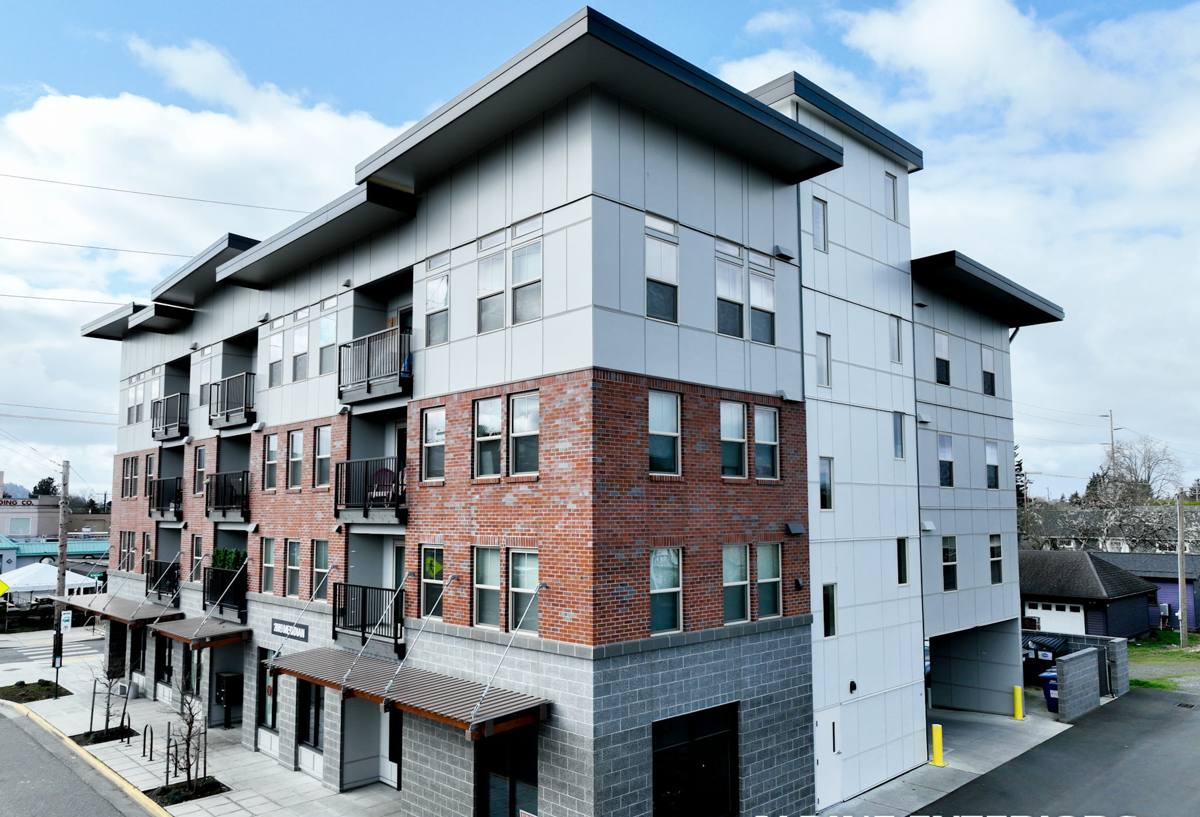
What "Correct" Looks Like on a Birch Bay Home
A James Hardie installation that's going to earn its keep on the water isn't just about nailing up planks. Correct installation in this environment means paying close attention to a handful of details that matter far more here than they would on a dry inland lot:
Moisture Management Behind the Siding
Fiber cement siding is not a waterproofing system by itself — it's the outer layer of a larger water-management assembly. Behind every board there needs to be a properly lapped weather-resistant barrier, correctly flashed windows and doors, and in most cases a drainage plane or rainscreen gap so that any moisture that gets behind the cladding has somewhere to go besides straight into your wall sheathing. Skip this step and you can install the best siding on the market and still end up with rot underneath it within a decade.
Fastener and Trim Choices
In a salt-air environment, fastener corrosion resistance isn't optional. We use corrosion-resistant fasteners rated for the exposure, and we're careful about galvanic reactions between dissimilar metals at trim, flashing, and hardware connections — a detail that gets skipped more often than it should on coastal jobs.
Caulking and Sealant Discipline
Every joint, seam, and penetration is a potential entry point for wind-driven rain. On an exposed Birch Bay lot, we treat sealant joints as a system, not an afterthought — using products rated for the movement and exposure the wall will actually see, not just whatever's on the truck.
Salt Air, Driving Rain, and Moss: Three Problems, One Product
It's worth breaking down why these three regional stressors matter separately, because they attack a home in different ways.
| Local Stressor | What It Does to a Home | How Hardie Siding Responds |
|---|---|---|
| Salt air | Corrodes exposed metal, holds moisture on surfaces longer, accelerates finish breakdown on unprotected substrates | Fiber cement core doesn't corrode; ColorPlus factory finish is engineered to resist fading and moisture intrusion better than field-applied paint |
| Driving rain / wind exposure | Drives water horizontally into seams, laps, and fastener penetrations that vertical-rain assumptions don't account for | Proper lap, flashing, and rainscreen detailing (installer-dependent) paired with a dimensionally stable board that doesn't warp under wet-dry cycling |
| Extended moss/algae season | Holds moisture against shaded or north-facing walls for months, accelerates surface staining and, on the wrong substrate, rot | Non-combustible, non-organic fiber cement core doesn't feed fungal growth the way wood-based products can; factory finish resists staining better than field paint |
No siding product makes moss and algae stains disappear on their own — anything sitting in a shaded, damp spot near the water will need occasional washing. But there's a real difference between a surface that sheds and cleans and one that absorbs moisture into the substrate itself.
Why We Don't Install Vinyl, LP SmartSide, or Cedar Here
We get asked why we don't offer other siding options, especially since some are cheaper up front. On a project this close to the water, the trade-offs get magnified:
- Vinyl can warp and become brittle under repeated wet-dry and temperature cycling, and its seams and J-channels give wind-driven rain more opportunities to find a way in.
- LP SmartSide and other engineered wood products rely on an intact factory coating and careful field sealing at every cut edge to keep moisture out of the wood-strand core — a maintenance burden that's harder to stay ahead of in a salt-air, high-moisture environment.
- Cedar and primed spruce are natural wood products that need ongoing refinishing and are more susceptible to moisture absorption, checking, and rot, especially on shaded or wind-exposed elevations near the bay.
Every one of those products has a place somewhere. We just don't think that place is a Birch Bay elevation facing directly into salt spray and driving rain, and we'd rather stand behind one product system we trust in this climate than sell something we know needs babying.
Our Process for a Birch Bay Project
The steps are the same ones any responsible siding job should follow — the difference on a coastal project is how much attention gets paid at each stage.
- On-site assessment. We look at wall orientation relative to prevailing wind and moisture exposure, existing sheathing and water damage, current flashing details, and any shaded or vegetation-heavy zones prone to moss buildup.
- Tear-off and substrate check. Old siding comes off and we inspect the sheathing underneath. On older Birch Bay homes, this is often where hidden moisture damage from a previous installation shows up — better to find it now than five years into a new siding job.
- Water-resistive barrier and drainage plane. Properly lapped house wrap, correctly integrated window and door flashing, and a drainage gap where the wall assembly calls for it.
- Hardie installation to manufacturer spec. Correct fastener spacing, clearances from grade and roof lines, and butt-joint treatment — all details that affect long-term water performance, not just appearance.
- Trim, caulking, and final detailing. This is where wind-driven rain either gets stopped or gets in. We treat it as a final quality-control pass, not an afterthought.
- Walkthrough. We go over the finished job with you, including simple maintenance expectations for a coastal property.
Living With Hardie Siding on the Bay: What to Expect
Fiber cement siding is low-maintenance, not zero-maintenance, and coastal homeowners get the best results when they know what to watch for:
- Rinse the exterior periodically to clear salt residue and organic buildup, especially on shaded or north-facing walls.
- Keep an eye on caulked joints around windows, doors, and trim — sealant is the one component that ages faster than the siding itself and is easy to touch up before it becomes a leak.
- Trim back vegetation that shades walls and traps moisture, which slows drying time and encourages moss growth.
- Watch gutters and downspouts near siding terminations — overflow and splashback are a common source of localized moisture problems that have nothing to do with the siding itself.
None of this is unusual maintenance for a coastal home — it's the same kind of upkeep any exterior surface needs near saltwater. The point of a correctly installed Hardie system is that it gives you a wide margin for error if that maintenance occasionally slips.
Why Hiring Local Experience Matters for This Job
Siding crews who mostly work inland don't always think about rainscreen gaps, fastener corrosion resistance, or flashing details the same way a crew that works Birch Bay and the surrounding Whatcom County shoreline does. It's not that inland installation is wrong — it's that a coastal wall assembly has less room for shortcuts before those shortcuts show up as a problem. A crew that's done this specific work, in this specific microclimate, catches the details that matter here because they've seen what happens when those details get missed on a house down the road.
That local pattern-recognition — knowing which elevations catch the worst of the wind, which yards hold moisture longest into spring, which older homes in the area tend to have hidden flashing issues — is difficult to substitute for. It's part of why we focus our work in this region rather than spreading thin across unfamiliar climates.
Get a Straight Answer for Your Home
Every Birch Bay lot is a little different — sun exposure, wind direction, tree cover, and the age and condition of the existing siding all change what your project actually needs. We're happy to take a look at your home, walk you through what we'd do differently on a water-exposed elevation, and give you a clear, no-pressure estimate for James Hardie siding done right the first time. Use the form below to get started.