 Blaine Siding
 Exterior Contractor Serving Cherry Point
Cherry Point sits along the Salish Sea in northern Whatcom County, between Ferndale and Blaine, in a stretch of Washington coastline that takes weather seriously. Homes and outbuildings here are spread out, often on larger parcels with more exposed elevations than you'd find in a denser subdivision, and many sit close enough to open water to catch the full brunt of onshore wind and salt spray. That combination shapes what we recommend for siding, roofing, windows, and decks in this part of the county, and it's why we don't treat a Cherry Point job the same way we'd treat a job tucked into a sheltered inland lot.
We're a local exterior contractor, not a regional call-center operation dispatching whichever crew is free that week. We install siding, roofing, windows, and decks, and we've built our siding program around one material because we've seen what holds up in this climate and what doesn't.
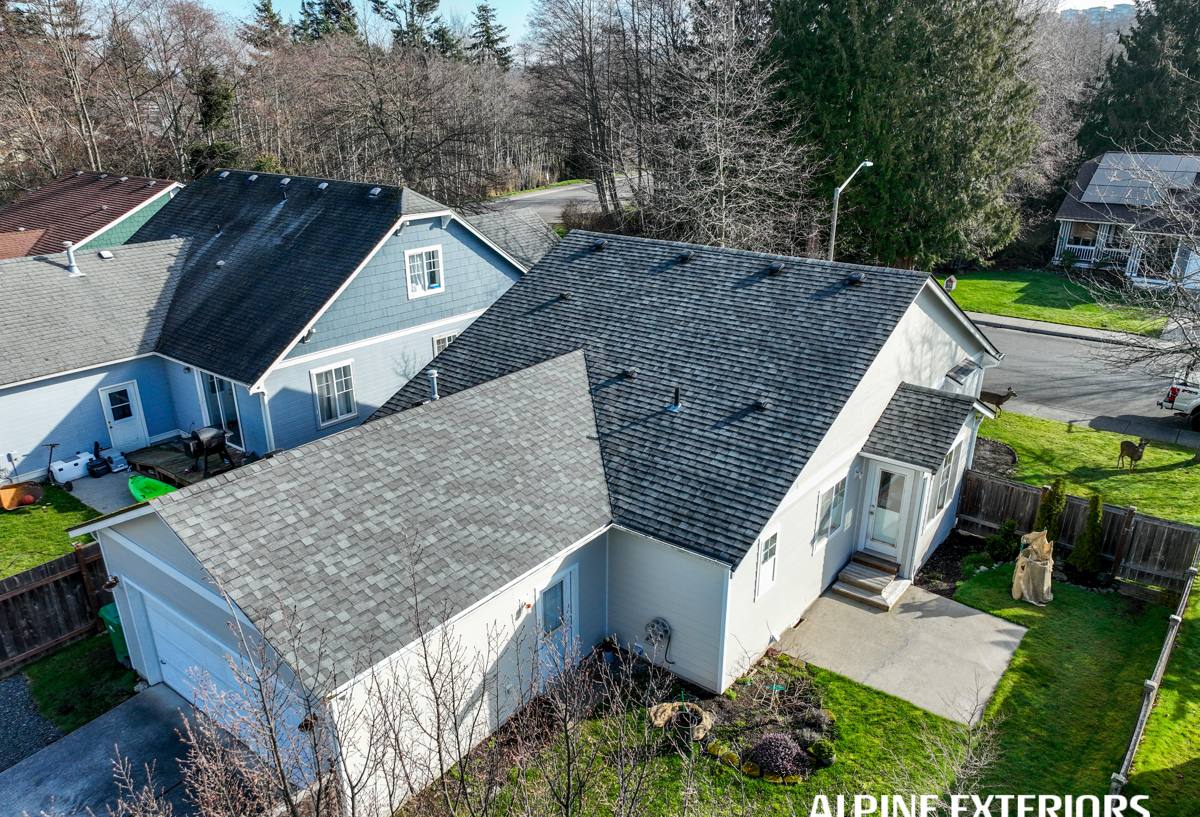
What Cherry Point's Climate Does to a House
Three things drive most of the exterior wear we see out this way, and they compound each other.
Salt Air
Proximity to the water means airborne salt settles on siding, trim, fasteners, and window hardware year-round. Salt is hygroscopic — it pulls moisture out of the air and holds it against whatever surface it's sitting on. On uncoated or poorly coated materials, that means accelerated corrosion of metal fasteners and flashing, and a steady chemical assault on paint films and factory finishes that weren't engineered for a marine environment.
Driving Rain
Whatcom County's weather doesn't just rain straight down; wind off the water pushes rain sideways into wall assemblies, especially on west- and south-facing elevations. Wind-driven rain finds every gap in flashing, every unsealed seam, and every spot where caulk has failed. It's a bigger factor in how a siding system performs than total annual rainfall, because it's testing the water-shedding details, not just the material's ability to get wet.
Long Moss Season
Cool, damp, and often shaded conditions for much of the year give moss and algae a long window to establish on roofs, siding, decking, and anywhere organic debris collects — under eaves, behind vegetation, in north-facing corners that don't get much sun or airflow. Moss holds moisture against the surface it's growing on, which is a problem for wood-based products in particular, and it's a maintenance issue on roofing and decking that never fully goes away in a climate like this.
None of this is unique to Cherry Point specifically, but this stretch of coastline gets a more concentrated dose of it than inland Whatcom County neighborhoods, which is why product choice and installation detailing matter more here, not less.
Why We Only Install James Hardie Siding
We install James Hardie fiber cement siding exclusively. We don't install vinyl, LP SmartSide, Cemplank, Allura, or primed wood species like spruce or cedar, and that's a deliberate standard, not a lack of options.
Fiber cement from James Hardie is non-combustible and dimensionally stable, meaning it doesn't expand and contract with moisture the way wood-based siding does. That matters in a climate where the material is wet more often than it's dry for a good chunk of the year. Hardie's ColorPlus factory finish is baked on under controlled conditions and backed by its own finish warranty, which holds up better against salt exposure and UV than field-applied paint, and it means fewer repaint cycles over the life of the siding.
Climate-Engineered Product Lines
James Hardie makes region-specific formulations (their HZ5 line is engineered for wetter, harsher climates like ours) rather than a single one-size-fits-all product. That's a meaningful distinction in a marine-influenced area like Cherry Point, where the siding is dealing with salt, moisture, and temperature swings simultaneously.
Warranty Structure
Hardie backs its products with a long, transferable limited warranty, which matters both for how long you own the home and for resale value if you sell it. A transferable warranty is a selling point buyers and their inspectors notice.
We're not going to tell you every alternative product is worthless — vinyl and engineered wood sidings each have legitimate uses and reasonable arguments in their favor elsewhere. But for this climate, with this much moisture and salt exposure, we've made a business decision to install the product we trust to perform, and stand behind that decision with every quote we write.
The Full Exterior Picture: Roofing, Windows, and Decks
Siding doesn't work in isolation. A wall assembly is only as good as its weakest component, and in a driving-rain, high-moss environment, the roofing, windows, and decking around it all affect how the siding performs and how long it lasts.
Roofing
Roof edges, valleys, and penetrations are common points where wind-driven rain gets pushed back up under shingles or flashing. Moss on a roof isn't just cosmetic — root structures and moisture retention shorten shingle life and can telegraph water down into wall cavities near the top of the siding. We look at roof condition as part of any siding conversation, because the two systems share flashing details at eaves, dormers, and wall intersections.
Windows
Window flashing and sealant are high-failure points in coastal wind. A window that isn't properly integrated with the water-resistive barrier and siding around it becomes the leak path, regardless of how good the siding itself is. When we replace siding around existing windows, we check that integration and flag it if it needs attention.
Decks
Decks facing open water or persistent shade deal with the same moss and moisture pressure as roofing, plus foot traffic and structural load. Ledger board flashing where a deck attaches to the house is another spot where water intrusion into the wall assembly commonly starts.
Handling all four trades under one roof means fewer finger-pointing situations when something at a system boundary — a window-to-siding transition, a deck ledger, a roof-to-wall flashing detail — needs coordinated work instead of a single-trade patch.
How a Cherry Point Siding Job Runs
- Site assessment — we look at exposure (which elevations take the worst wind and rain), existing moisture damage, and the condition of trim, flashing, and any wall sheathing we can access.
- Removal and inspection — old siding comes off and we inspect the sheathing and water-resistive barrier underneath for rot or prior water damage before anything new goes up.
- Weather barrier and flashing — this is the layer that actually stops bulk water, and it's where corners get cut on rushed jobs. We detail it properly around every window, door, and penetration.
- Hardie installation to manufacturer spec — correct fastener type and spacing, proper clearances, and manufacturer-specified caulking and gaps, all of which affect whether the warranty is actually valid.
- Trim, caulking, and final detail — the finish work that determines how the house looks and how well water sheds off it for the next several decades.
Installation quality is what determines whether any siding material — Hardie included — performs the way it's designed to. A premium product installed with shortcuts will fail faster than a mid-grade product installed correctly.
What Affects Siding Project Cost
Every home is different, and we won't quote a number without seeing the house, but these are the variables that move the price up or down on most Cherry Point siding projects.
| Factor | Why It Matters |
|---|---|
| Home size and elevation count | More square footage and more wall complexity (dormers, bump-outs, multiple stories) means more material and labor |
| Existing siding removal | Tear-off and disposal of old siding, especially if there are multiple layers, adds time and cost |
| Sheathing/moisture repair | Rot or water damage found underneath old siding has to be repaired before new siding goes on — this is common on older coastal-exposed homes |
| Siding profile (lap vs. panel vs. shingle) | Different Hardie profiles have different material and labor costs |
| Trim and detail work | Corner boards, window trim, and fascia detail add labor beyond the flat wall area |
| Site access | Rural or larger-lot properties with difficult staging or long carry distances can affect labor time |
Signs Your Siding Needs Attention
Coastal exposure tends to show up as specific, recognizable problems before they become structural ones. Worth checking for:
- Soft or spongy spots when you press on siding, especially near the bottom courses or window sills
- Paint that's bubbling, peeling, or chalking faster than a normal repaint cycle would suggest
- Visible gaps or separation at seams, corners, or trim joints
- Persistent moss or algae growth that keeps returning after cleaning, particularly on shaded or north-facing walls
- Rust streaking from fasteners, a sign the fastener material or coating wasn't right for this environment
- Warping, cupping, or delamination, common on wood-based and some engineered wood products in wet climates
- Interior signs like musty smells, staining, or bubbling drywall near exterior walls, which can point to water getting past the siding entirely
Choosing a Contractor for Coastal Whatcom County Work
Marine-exposed properties punish shortcuts faster than sheltered inland homes do, so the stakes on hiring the right crew are a little higher out here. A few things worth asking any contractor bidding a Cherry Point exterior job:
- Are they James Hardie certified or specifically trained on manufacturer installation requirements, not just generally experienced with siding?
- Will they inspect and address sheathing and moisture barrier condition, not just install over whatever's underneath?
- Do they carry proper licensing and insurance for work in Washington State, and can they show it without hesitation?
- Do they explain flashing and water-management details, or only talk about the visible finish product?
- Are they realistic about maintenance going forward, rather than promising a maintenance-free result no material actually delivers?
- Can they speak specifically to how coastal exposure changes the approach, rather than giving a generic answer they'd give anywhere in the county?
A contractor who's done real work along this stretch of coastline should be able to talk through salt exposure, wind-driven rain, and moss without you having to bring it up first.
Get a Local, No-Pressure Estimate
If you're dealing with aging or failing siding in Cherry Point, or you're planning ahead for a roof, window, or deck project alongside it, we're happy to take a look and walk you through what we're seeing and what it would take to fix it right. There's no cost and no pressure to move forward — just a straight answer from a local crew that works in this climate regularly. Use the form below to request a free estimate.