 Blaine Siding
 Siding in Ferndale: A Climate That Doesn't Forgive Shortcuts
Ferndale sits in Whatcom County close enough to salt water and the marine air that comes with it that exterior materials take a steady, year-round beating. It's not one dramatic storm that wears down a house here — it's the accumulation. Damp air off the water, long stretches of driving rain in the fall and winter, and a moss season that can run for months on shaded, north-facing walls and roof lines. Add in the temperature swings between a warm afternoon and a cool, wet evening, and you get a lot of expansion and contraction on anything nailed to the outside of a house.
Homes in this area show the wear in predictable places: siding seams that have opened up and let water behind the cladding, paint that's failed early on the shaded side of the house, trim that's soft to the touch, and green-black streaking on roofs and lower wall sections where moss and algae have had time to take hold. None of that is unusual for the Pacific Northwest. It's just the reality of building and maintaining a home in a wet, coastal-influenced climate, and it's the reason material choice and installation quality matter more here than they would in a drier region.
What We Do for Ferndale Homeowners
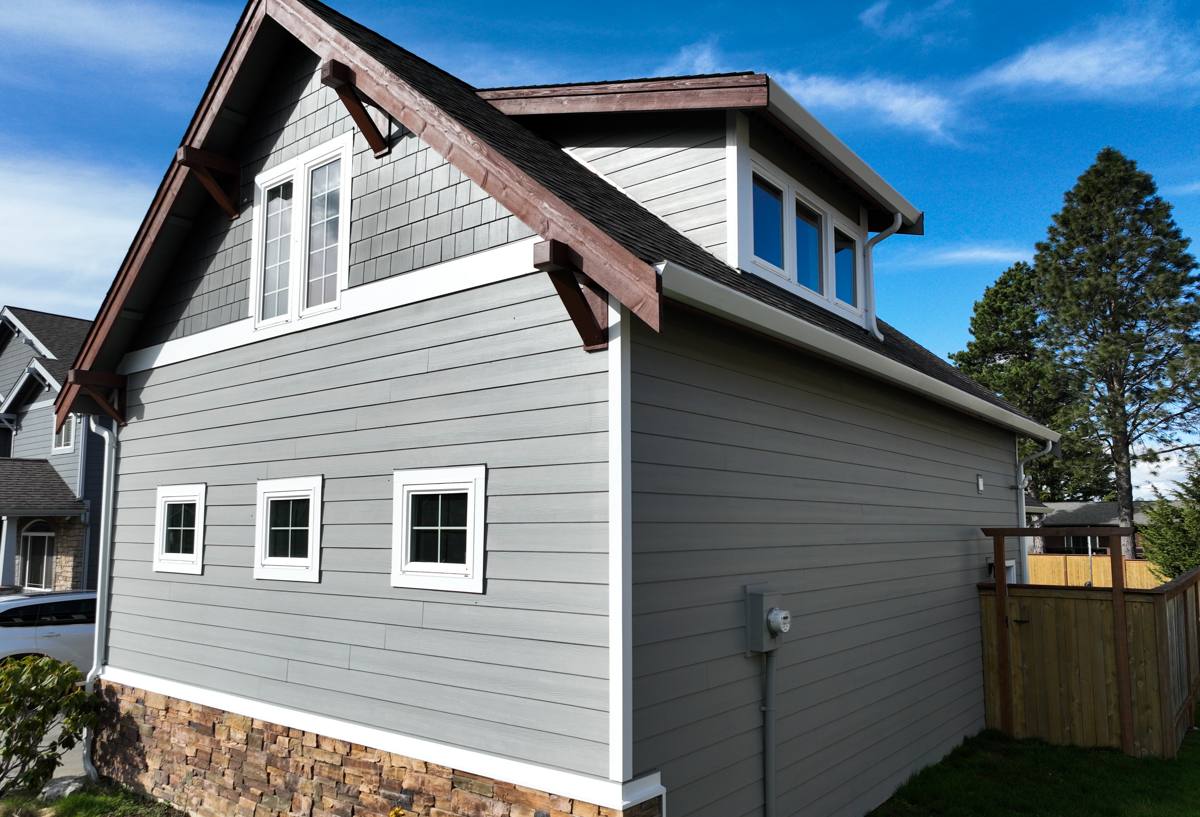
We're a full exterior contractor — siding, roofing, windows, and decks — because those four systems all have to work together to keep water out of a house. A new roof with bad flashing at the wall line, or new siding installed over old trim that's already rotting, doesn't actually solve the underlying problem. We look at the whole exterior envelope, not just the one thing a homeowner called about.
- Siding: James Hardie fiber cement only — installation, repair, and full replacement.
- Roofing: Roof replacement and repair, with attention to flashing details where the roof meets siding, chimneys, and walls.
- Windows: Replacement windows installed with proper flashing and integration into the surrounding siding, so the whole wall assembly sheds water correctly.
- Decks: Deck construction and replacement, including attention to ledger board flashing where the deck attaches to the house — a common source of hidden rot in this climate.
Why We Install Only James Hardie Fiber Cement
We made a deliberate decision as a company to install one siding system: James Hardie fiber cement. We don't install vinyl, LP SmartSide, Cemplank, Allura, primed spruce, or cedar. That's not because those products have no merit — some of them are reasonable choices in the right application — but because we'd rather stand fully behind one system we know inside and out than spread our crews thin across several products with different installation rules, different failure modes, and different warranty terms.
Fiber cement as a category holds up well in wet, coastal climates because it doesn't feed moss and algae growth the way wood-based products can, it doesn't warp or buckle the way vinyl can in temperature swings, and it's non-combustible. James Hardie specifically backs its product with a factory-applied ColorPlus finish (so the color and UV protection are baked on before the boards ever reach the job site) and offers climate-engineered HZ product lines suited to different regions, including the wetter conditions typical of western Washington. The warranty is also transferable to a subsequent homeowner, which matters to people planning to sell within the warranty period.
None of that means Hardie siding is maintenance-free or installer-proof. Fiber cement still needs to be installed with the correct clearances, fastening pattern, and flashing details to perform the way it's designed to. A lot of the siding failures we see on older homes in this area trace back to installation shortcuts, not the material itself.
How James Hardie Compares to Other Common Siding Choices
| Material | Moisture Behavior | Moss/Algae Resistance | Typical Lifespan | Why We Don't Install It |
|---|---|---|---|---|
| James Hardie Fiber Cement | Dimensionally stable, doesn't absorb and swell like wood | Resists moss/algae growth well | Multiple decades with proper care | This is what we install |
| Vinyl | Doesn't rot, but can warp or buckle with heat and cold cycling | Moderate; seams and J-channels can trap debris and moisture | Varies widely by product grade | Prone to cracking in impact/cold, limited repair options, appearance trade-offs |
| LP SmartSide (engineered wood) | Treated to resist moisture, but still wood-based at its core | Requires consistent paint/caulk maintenance to prevent moisture intrusion | Depends heavily on maintenance follow-through | Higher long-term maintenance burden in wet climates; edge/cut-end sealing is critical and easy to miss |
| Cedar | Absorbs moisture, prone to swelling, cupping, and rot over time | Susceptible to moss, mildew, and algae without regular treatment | Shorter without diligent upkeep | High maintenance demand in a wet, mossy climate; ongoing staining/sealing required |
| Primed Spruce / Other Wood Panels | Similar moisture concerns to cedar, often less naturally rot-resistant | Requires consistent paint maintenance | Shorter without diligent upkeep | Not built for sustained wet-climate exposure without heavy maintenance |
The James Hardie Product Lines We Work With
James Hardie makes several distinct product lines, and picking the right one depends on the look a homeowner wants and the specifics of the house:
- HardiePlank lap siding — the most common choice, available in several textures and exposure widths, made to look like traditional wood lap siding.
- HardiePanel vertical siding — used for board-and-batten style looks or as an accent alongside lap siding.
- HardieShingle — a shingle-style profile for homes that want that look without the maintenance of real wood shingles.
- HardieTrim — matching trim boards so the whole exterior, not just the field siding, is fiber cement.
All of these come with the factory ColorPlus finish in a range of standard colors, which is worth choosing over field-painted primed siding whenever it's an option — the factory finish is baked on under controlled conditions and carries its own finish warranty, which matters in a climate where field-applied paint can struggle to cure and adhere properly during our wetter months.
Correct Installation Matters As Much As the Material
A lot of what separates a siding job that lasts thirty years from one that starts failing in five to ten isn't the brand of siding — it's the details underneath it. In a climate like ours, we pay particular attention to:
- Proper clearance between the bottom of the siding and the ground, roof lines, and deck surfaces, so water has somewhere to go instead of wicking into the board ends.
- Correct fastening pattern and fastener type, since under- or over-driven fasteners are a common cause of premature siding problems.
- Flashing and house wrap integration at every window, door, and penetration — this is where the large majority of hidden water intrusion actually starts.
- Caulking only where James Hardie's installation instructions call for it, not as a blanket fix for gaps that should have been built out correctly in the first place.
These aren't exotic requirements. They're standard best practice — but they get skipped more often than homeowners realize, especially by crews moving fast on volume work rather than crews that specialize in one product and know its installation manual well.
Roofing, Windows, and Decks: The Rest of the Envelope
Siding doesn't work in isolation. A roof with deteriorating flashing at a wall intersection will send water behind even perfectly installed siding. Old windows without proper flashing integration do the same thing at every opening in the wall. And a deck ledger board attached without correct flashing is one of the most common sources of hidden rot we find on homes in wet regions like this one, often not discovered until the deck itself needs work. When we're on a property for a siding project, we look at these adjacent systems, because recommending new siding while ignoring a roofing or flashing problem underneath it doesn't serve the homeowner.
Why a Local Crew Matters in Ferndale
Working regularly in Whatcom County means we're used to the specific conditions here — the moisture load, the moss growth pattern on shaded elevations, the way homes near the water take on weather differently than homes further inland. That local familiarity shapes practical decisions: where extra flashing attention is worth it, which elevations of a house need the most protection, and how to sequence exterior work around our wetter months so materials and installation conditions line up. A crew that only occasionally works in this specific coastal climate is more likely to treat those details as optional rather than standard practice.
Questions Worth Asking Any Exterior Contractor in This Area
- Do you install one siding system you know thoroughly, or several — and why?
- What's your approach to flashing at windows, doors, and roof-to-wall intersections?
- How do you handle board clearances near grade, decks, and roof lines?
- Is the warranty on materials transferable if I sell the home?
- Can you walk me through what's underneath the old siding before we talk about what goes on top of it?
If you're weighing a siding project in Ferndale — or noticing early signs of trouble on your roof, windows, or deck — we're happy to take a look and put together a straightforward, no-pressure estimate. There's a form below to get started.