 Blaine Siding
 Grandview sits close enough to the water and the tree line that its homes take a steady, year-round beating from the same forces that shape exterior work all over Blaine and Whatcom County: salt-laden air rolling in off the Strait, driving rain that comes in sideways more often than straight down, and a moss season that seems to run about nine months longer than anyone would like. None of that is unusual for this part of Washington. What matters is whether the materials and workmanship on a house are actually built to handle it, or whether they're just holding on until the next wet winter finds the weak spot.
We work in and around Grandview regularly, and the patterns repeat from house to house. Homes here don't fail because people neglect them — they fail because the exterior was never matched to the climate in the first place. That's the problem we focus on solving, whether the job in front of us is a full siding replacement, a roof, new windows, or a deck rebuild.
What the Grandview Climate Actually Does to a House
It helps to be specific about the mechanisms, because "wet climate" undersells what's happening on an exterior wall over a decade or two.
Salt Air and Metal Fatigue
Proximity to the Strait of Georgia and Puget Sound means airborne salt is a constant, low-level presence — not just during storms. Salt accelerates corrosion on fasteners, flashing, and any exposed metal trim. It also interacts with certain siding coatings and caulks over time, causing them to break down faster than the manufacturer's climate data (usually modeled on a drier region) would predict. A house a half-mile from the water ages differently than the same house forty miles inland, even with identical materials.
Driving Rain and Wind-Driven Moisture
Blaine's storms frequently come with real wind behind the rain, which means water isn't just falling on a wall — it's being pushed into every seam, lap, and penetration. This is where installation quality matters as much as the product itself. A siding system with correct flashing, proper overlaps, and back-ventilation sheds that kind of moisture. One installed with shortcuts — caulk substituted for flashing, laps too tight, fasteners in the wrong spot — starts trapping it instead, and trapped moisture behind siding is how rot gets started long before anyone sees a stain on the outside.
Moss, Algae, and the Long Shoulder Seasons
Northwest Washington's mild, damp shoulder seasons are ideal growing conditions for moss and algae on any surface that stays shaded or damp — north-facing walls, areas under trees, roof valleys, and deck boards in particular. Beyond the cosmetic issue, sustained moisture retention from moss growth softens wood-based materials and can hold water against surfaces that should be drying out between rain events.
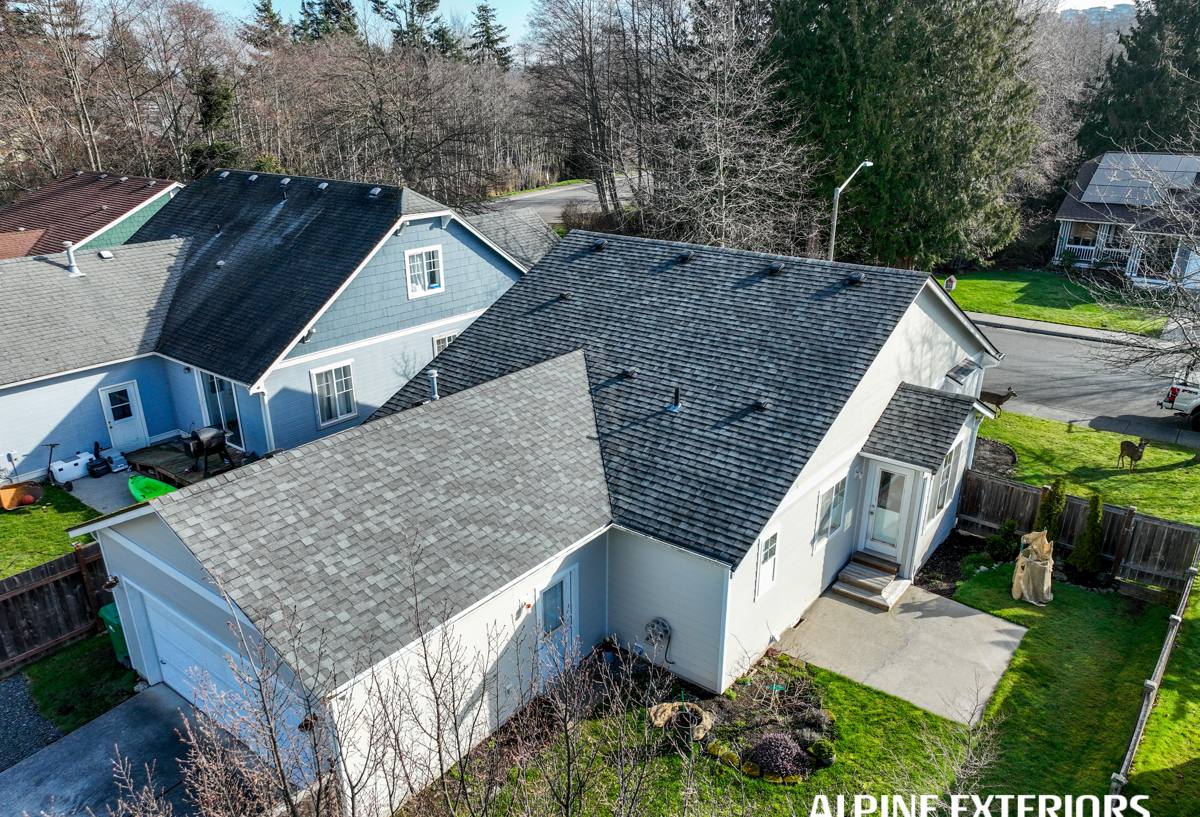
Siding Materials, Compared for This Climate
Homeowners in Grandview usually come to us having already seen several siding options quoted by other contractors. Here's how the common choices actually hold up against salt air, wind-driven rain, and moss — not in a lab, but in a coastal Whatcom County backyard.
| Material | Moisture Behavior | Maintenance in This Climate | Typical Lifespan Here |
|---|---|---|---|
| Vinyl siding | Doesn't rot, but panels can warp or crack in temperature swings and wind loading; seams are a moisture entry point | Low, but fading and brittleness show up faster near salt air | Variable — depends heavily on installation and sun/wind exposure |
| Primed spruce / cedar | Natural wood absorbs and releases moisture; performs only as well as its paint film | High — repainting and caulk maintenance on a recurring cycle | Shorter without diligent upkeep; moss and algae accelerate wear |
| Engineered wood (e.g., LP SmartSide) | Resin-treated to resist moisture, but edges and cut ends remain vulnerable if not fully sealed | Moderate — edge sealing and caulk checks matter more here than in drier climates | Solid when installed and maintained correctly |
| James Hardie fiber cement | Non-combustible, dimensionally stable, doesn't absorb moisture like wood and won't warp like vinyl | Low — factory ColorPlus finish resists fading and doesn't require repainting on the same cycle | Long-term durability backed by a strong transferable warranty |
We install James Hardie fiber cement siding exclusively, and this is a large part of why. It's not that the alternatives above are bad products in every setting — it's that in a coastal, high-moisture, salt-exposed environment like Grandview, the trade-offs on the other materials (edge sealing, repainting cycles, warping, seam integrity) become recurring maintenance obligations for the homeowner. Hardie's fiber cement composition and factory-applied finish were engineered specifically for climate resilience, and its HZ5 product line is built for exactly this kind of exposure — freeze-thaw cycles, moisture, and coastal wind.
Our Process for a Grandview Home
Every exterior job we take on in this area follows the same core sequence, adjusted for the specific house:
- Walk-through and assessment. We look at exposure — how much of the house faces prevailing wind and rain, where shade and moisture linger, and where existing moss, staining, or soft spots indicate a problem already underway.
- Moisture and substrate check. Before any new siding goes on, we check what's underneath. Covering up rot or trapped moisture with new material just delays the same failure.
- Flashing and water management plan. This is the step that determines whether the new exterior actually performs in driving rain. Window heads, deck ledgers, roof-to-wall transitions, and butt joints all get planned before installation starts, not improvised during it.
- Installation to manufacturer spec. James Hardie siding has specific fastening, clearance, and caulking requirements. Following them is what makes the warranty valid and the wall perform as engineered — skipping steps to save time is where most siding failures we're called to fix actually originated.
- Final inspection and walkthrough. We go over the finished exterior with the homeowner, including what maintenance (if any) it will need going forward.
It's Not Just Siding
Salt air, driving rain, and moss don't stop at the walls — they affect the roof, windows, and any exterior wood like a deck the same way, and a house is only as weather-tight as its weakest component. We handle all four as a single exterior scope when that's what a project calls for:
- Roofing — the first line of defense against wind-driven rain and the surface most exposed to moss and algae growth in shaded areas.
- Windows — flashing and sealing at window openings is one of the most common places we find water intrusion on older homes in this area.
- Siding — the largest surface area on the house and the one most affected by long-term moisture cycling.
- Decks — exposed to standing water, shade-driven moss, and ledger-board rot where the deck meets the house.
Addressing these together, rather than one at a time with different contractors over several years, means the flashing and water management at every transition point — roof to wall, wall to deck, window to siding — gets planned as one system instead of stitched together by whoever happened to be on-site that year.
Why a Local Crew Matters Here
Exterior work in Whatcom County isn't generic. A crew that mostly works drier inland regions doesn't have the same instinct for where Grandview homes actually take on water, how far salt exposure reaches from the shoreline, or which north-facing walls will need extra attention to moss. Being local means we've seen how houses in this specific area age — which details hold up and which ones consistently don't — and we build that into every estimate and every install, not just the sales pitch.
Maintenance Checklist for Grandview Homeowners
Whatever your current siding material, a few habits go a long way in this climate:
- Rinse siding and roof surfaces of visible moss or algae buildup before it spreads, especially on north- and east-facing walls
- Check caulking around windows, doors, and trim annually — coastal salt air breaks it down faster than inland conditions
- Keep gutters and downspouts clear so water isn't overflowing onto siding or pooling near the foundation
- Trim back vegetation that keeps walls or deck boards shaded and damp
- Inspect deck ledger boards and any wood-to-house connections yearly, since that's a common spot for hidden moisture damage
- Have flashing at roof-wall and window transitions checked periodically — most leaks start at a transition, not in the middle of a flat surface
What Drives the Cost of a Siding Project Here
| Factor | Why It Matters in Grandview |
|---|---|
| House size and wall complexity | More corners, gables, and transitions mean more flashing detail and labor time |
| Existing damage or rot | Hidden moisture damage found during tear-off adds repair scope before new siding can go on |
| Siding profile and trim selection | Lap width, trim style, and ColorPlus finish selection affect material cost |
| Access and site conditions | Shoreline-adjacent lots, tree cover, and tight lots can affect staging and labor |
| Scope beyond siding | Bundling roofing, window, or deck work into one project can reduce redundant setup and site visits |
If you're weighing a siding, roofing, window, or deck project for a Grandview home, we're glad to take a look and give you a straight answer about what your house actually needs — no pressure, no inflated scope. Reach out for a free estimate using the form below.