 Blaine Siding
 Sandy Point sits right up against the water northwest of Blaine, and that location is exactly what makes it beautiful and exactly what makes it hard on a house. Homes here take a steady diet of salt-laden wind off the Strait of Georgia, driving rain that comes in sideways more often than straight down, and a damp shoulder season that can stretch from October well into May. If you've owned a place out here for more than a winter or two, you already know your house works harder than one a few miles inland in downtown Blaine or Custer.
We're a Blaine-based exterior contractor, and Sandy Point is part of our regular service area — not a stretch job we drive out for once a year. That matters more than it sounds like it should, because coastal exposure isn't a generic problem with a generic fix. It's specific to wind direction, to how close a lot sits to the beach, to how much afternoon sun a wall gets to dry out between storms. This page covers what we see on Sandy Point homes and how we approach siding, roofing, windows, and decks out here.
What the Climate Actually Does to a Sandy Point Home
Salt Air
Airborne salt doesn't just sit on a surface — it's hygroscopic, meaning it pulls moisture out of the air and holds it against whatever it lands on. On siding, that means slower drying times, accelerated corrosion of any exposed metal fasteners or trim, and a steady sandblasting effect on paint film that shows up as chalking and fading years before it should. Homes facing the water directly take the worst of it; homes set back or shielded by trees fare noticeably better, but almost nothing on Sandy Point is fully sheltered.
Driving Rain
Whatcom County gets a lot of rain generally, but wind-driven rain off open water is a different animal than a straight-down shower. It finds horizontal laps, poorly sealed trim joints, and butt seams that would never leak in a calmer setting. Water management — not just water resistance — is the real design problem for a house out here.
Moss and Sustained Dampness
Long moss season is the third piece. Combine shade, marine humidity, and a mild coastal climate that rarely gets cold enough or dry enough to knock moss back, and you get organic growth on roofs, north-facing siding, and shaded trim that holds moisture against the substrate for months at a time. That sustained dampness is what actually damages wood-based and composite materials — moss itself is mostly a symptom.
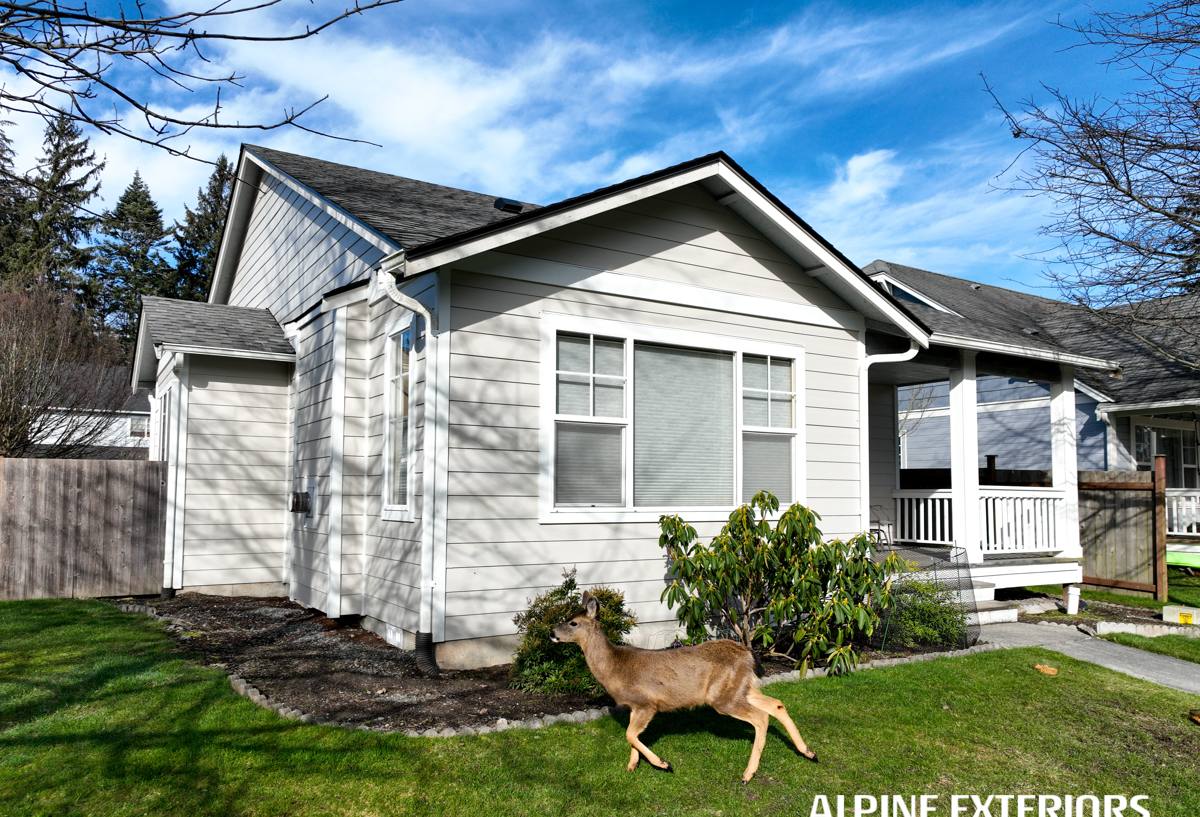
Why We Standardize on James Hardie Fiber Cement
We install James Hardie siding exclusively. We don't install vinyl, LP SmartSide, Cemplank, Allura, primed spruce, or cedar, and on a site like Sandy Point that decision isn't about brand loyalty — it's about what actually holds up against salt, wind-driven moisture, and prolonged dampness without becoming a maintenance project every couple of years.
| Factor | Why It Matters on Sandy Point |
|---|---|
| Non-combustible material | Fiber cement doesn't burn, swell, or delaminate from moisture the way wood-based products can |
| Factory-applied ColorPlus finish | Baked-on finish resists the chalking and fading that salt air accelerates on field-applied paint |
| Climate-engineered HZ5 product line | Built for harsh, wet, marine-influenced climates rather than a one-size-fits-all national spec |
| Dimensional stability | Fiber cement doesn't swell and shrink with moisture cycling the way wood and some composites do |
| Transferable warranty | Backed by a strong manufacturer warranty that follows the house, useful if you ever sell |
Wood-based siding and primed spruce trim can look and perform fine for a while, but they depend on paint film integrity to keep moisture out — and paint film is exactly what salt air and driving rain degrade fastest. Vinyl handles moisture fine but can warp under sustained sun-and-wind exposure and doesn't offer the same fire performance. We're not saying those products are junk everywhere; we're saying that on a coastal lot like this, we don't think they're the right long-term bet, and we'd rather stand behind one system we trust than sell whatever's cheapest that week.
Siding Installation: Where the Real Work Happens
The siding material only does half the job. The other half is installation detail, and on a wind-exposed coastal home those details carry more weight than usual.
- Proper rainscreen or drainage gap behind the siding so any water that gets past the surface can drain and the wall can dry
- Correctly lapped and sealed weather-resistive barrier, with extra attention at window and door openings where wind-driven rain concentrates
- Flashing at every horizontal transition — not caulk used as a substitute for flashing
- Fastener spacing and type per Hardie's HZ5 installation spec, since under-fastening or the wrong fastener is one of the most common causes of early siding failure
- Correct field-cut sealing on any exposed cut edges before installation, so raw material isn't left absorbing moisture
We follow Hardie's published installation instructions to the letter because doing so is what keeps the manufacturer warranty valid — and because on a site like this, cutting corners on flashing or fastening shows up as a callback within a couple of wet seasons, not a couple of decades.
Roofing Considerations for a Waterfront Lot
Siding doesn't work in isolation — a roof that's shedding moss, holding moisture, or leaking at flashing points will eventually compromise the wall assembly below it no matter how good the siding is. On Sandy Point we pay particular attention to:
- Roof-to-wall flashing details, since that's where roof and siding water management intersect
- Ventilation, which helps roof decking dry out between the rain events that are frequent here
- Valley and penetration flashing, the most common leak points on any coastal roof
If moss has been a recurring problem, we'll talk through options during an estimate rather than just patching around it — moss control is partly a maintenance habit and partly a design fix (shade, roof material, ventilation).
Windows: The Weak Point in Any Wall Assembly
Window openings are where most water intrusion problems actually originate, coastal home or not. On a house taking direct wind-driven rain, the flashing and integration between the window unit and the surrounding wall assembly matters as much as the window's own build quality. When we replace windows alongside siding, we treat the opening as a system — proper pan flashing, correctly lapped house wrap, and sealant used where it belongs rather than as a catch-all fix. Replacing windows without addressing how they tie into the wall around them is one of the more common ways coastal homes end up with hidden moisture damage.
Decks in a Marine Environment
Outdoor living space near the water takes a beating from the same salt air and rain exposure as the siding, plus direct UV and foot traffic. Fasteners, ledger flashing, and joist protection all matter more here than they would inland — galvanic corrosion on the wrong fastener-to-metal combination happens faster in salt air, and a poorly flashed ledger board is a common source of hidden rot behind an otherwise good-looking deck. We build and repair decks with materials and hardware rated for the exposure, not just what's standard elsewhere in the county.
Why a Local Crew Matters Here
A crew that mostly works inland jobs in Bellingham or Ferndale doesn't necessarily think about wind direction, salt exposure, or moss cycles the way a crew that works Blaine and the coastline does. Being based in Blaine means we're out on Sandy Point regularly, we see how houses out here age over multiple wet seasons, and we adjust details — flashing laps, fastener choice, drainage gap sizing — based on what actually happens to homes in this specific microclimate, not a generic Whatcom County spec.
Maintenance: What Sandy Point Homeowners Should Actually Watch For
| Check | Frequency | What You're Looking For |
|---|---|---|
| Caulk and sealant joints | Annually | Cracking, gaps, or pulling away from trim |
| Roof and shaded siding | Twice a year | Moss buildup, especially on north-facing surfaces |
| Gutters and downspouts | Fall and spring | Debris blocking flow, water overshooting onto siding |
| Trim and fastener heads | Annually | Rust staining, which signals fastener corrosion |
| Deck ledger and hardware | Annually | Corrosion, soft wood, or gaps at the house connection |
None of this is complicated, but it's the kind of routine check that gets skipped on a second home or a place that isn't lived in full-time — and Sandy Point has plenty of both. A rinse-off after a bad salt-spray stretch and a look at the gutters twice a year go a long way toward protecting whatever exterior work you've had done.
What to Expect From an Estimate
When we come out to a Sandy Point property, we're looking at more than square footage. We'll check exposure direction, existing moisture damage around windows and trim, moss patterns on the roof and shaded walls, and the condition of any existing flashing before we talk product and pricing. That's what lets us give you a straight answer about what your house actually needs versus what would just be nice to have.
If you're dealing with aging siding, a leaky window, moss you can't get ahead of, or a deck that's starting to feel soft underfoot, we'd rather take a look and tell you honestly what's going on than guess over the phone. Reach out for a free, no-pressure estimate using the form below.