 Blaine Siding
 Custer sits in the northwest corner of Whatcom County, close enough to Boundary Bay and the Strait of Georgia that salt-laced air is a fact of life, and close enough to the Cascade foothills and the region's marine weather patterns that rain is measured in months, not inches. Homes here take a different kind of beating than homes forty miles inland, and the exterior products that hold up in Spokane or even Seattle's rain shadow don't always hold up the same way out here. We've been doing exterior work in this corner of the state long enough to know what Custer homes actually face, and we build our recommendations around that reality rather than a generic sales pitch.
What Custer's Climate Does to a House
Three things define exterior wear in this part of Whatcom County: salt air, sustained driving rain, and a moss season that runs longer than most homeowners expect.
Salt Air and Moisture
Proximity to Boundary Bay and the Strait means airborne salt is a constant, low-level presence on siding, trim, fasteners, and roofing metal. Salt air doesn't destroy materials overnight, but it accelerates corrosion on unprotected metal fasteners and flashing, and it speeds up the breakdown of finishes that aren't rated for coastal exposure. Over years, that shows up as premature fading, chalking, or corrosion streaking on lower-grade products.
Driving Rain
Pacific storm systems push rain sideways here more often than people expect, especially on west- and southwest-facing walls with little tree cover. That means water isn't just falling on a house, it's being driven into every seam, joint, and butt edge in the siding. Products that rely on paint film alone for weather resistance, or that swell and contract with moisture, are working harder in Custer than they would in a drier climate.
A Long Moss Season
Whatcom County's tree cover and near-constant fall-through-spring dampness mean moss and algae have a long growing window on north-facing walls, rooflines, and anywhere shade keeps a surface from drying out. Roofing and siding that hold moisture against the substrate give moss more time to establish, which is one more reason material choice and installation detail matter as much here as anywhere in the Pacific Northwest.
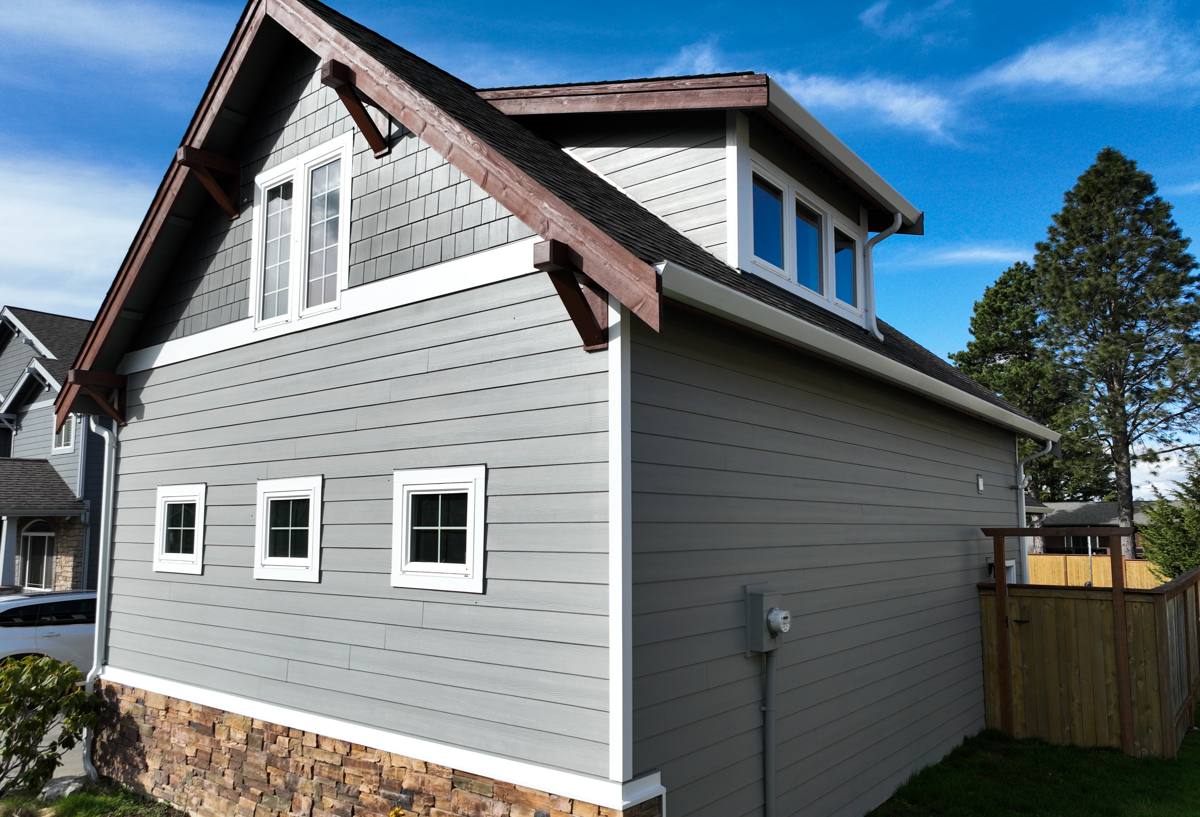
Why We Install Only James Hardie Fiber Cement Siding
We made a deliberate decision as a company to install one siding system: James Hardie fiber cement. We don't offer vinyl, LP SmartSide, Cemplank, Allura, primed spruce, or cedar as options, and that's worth explaining rather than just stating.
Vinyl siding is affordable and low-maintenance in a general sense, but it's a petroleum-based product that can warp or distort under sustained heat and UV exposure, and its seams and panel joints give wind-driven rain more opportunities to work moisture behind the cladding over time. In a climate where sideways rain is normal rather than occasional, that's a real trade-off, not a hypothetical one.
Engineered wood products like LP SmartSide use a wood-strand substrate with a resin-treated surface. It's a reasonable product where it's installed and maintained correctly, but wood-based substrates are inherently more sensitive to sustained moisture exposure than fiber cement, and any breach in the factory coating, whether from a cut edge, a fastener hole, or impact damage, gives moisture a path into the substrate. In a long, wet Whatcom County winter, that sensitivity matters.
Cedar and primed spruce are traditional, attractive materials, but they're wood, and wood siding in a marine, high-moisture climate demands a maintenance schedule most homeowners underestimate going in: regular refinishing, vigilant caulking, and prompt attention to any spot where the finish has failed. Skip a cycle or two and you're looking at rot repair, not just a paint job.
James Hardie fiber cement is a blend of cement, sand, and cellulose fiber. It doesn't absorb water the way wood-based products do, it doesn't warp with heat the way vinyl can, and it carries a factory-applied ColorPlus finish that's baked on and backed by its own warranty against fading and peeling, rather than relying on field-applied paint as the sole line of defense. It's also non-combustible, which is a meaningful consideration anywhere in Washington given regional wildfire smoke and ember exposure in dry summer stretches. None of this means fiber cement is magic or maintenance-free. It means the failure modes we see most often in this climate, moisture intrusion at seams, coating breakdown from salt exposure, and rot from sustained dampness, are the failure modes Hardie is specifically engineered to resist.
James Hardie Product Lines for This Climate
Hardie's HZ5 formulation is engineered for climates with freeze-thaw cycling and sustained moisture exposure, which fits western Washington's weather pattern well. Depending on the home, we typically work with:
- HardiePlank lap siding — the most common choice, available in smooth or cedar-textured finishes, installed as a traditional horizontal lap profile.
- HardiePanel vertical siding — often used for accent sections, gables, or a more modern look, and paired with battens for a board-and-batten style.
- HardieTrim — fascia, corner boards, and window trim in the same fiber cement material, so trim and field siding age and perform consistently rather than one component failing before the other.
- HardieShingle — a straight-edge or staggered shingle profile for homes where that look fits the architecture, without the moisture sensitivity of real wood shingles.
ColorPlus finishes come in a range of factory-baked colors designed to resist the fading and chalking that field-applied paint is more prone to, which matters in a coastal environment where sun, salt, and rain are all working on the finish at once.
Why Installation Quality Matters as Much as the Product
Fiber cement siding is only as good as its installation. Hardie publishes detailed fastening, clearance, and flashing specifications, and in a climate like Custer's, cutting corners on those details is where problems start.
Details We Don't Skip
- Proper ground clearance and roofline clearance so siding isn't sitting in standing moisture or splash-back.
- Correct fastener type, spacing, and depth, since under- or over-driven fasteners are a common source of early failure.
- Flashing and house-wrap integration at every window, door, and penetration, so water is directed out and away rather than trapped behind the cladding.
- Proper caulking at butt joints and trim intersections, using sealants rated for the movement and moisture exposure fiber cement actually sees.
- Correct panel gapping to allow for expansion without creating gaps wide enough to let driving rain in.
A crew that treats these as boxes to check moves fast and leaves problems for later. A crew that treats them as the actual job is the difference between siding that performs for decades and siding that needs early repair.
Roofing, Windows, and Decks in the Same Climate
Siding doesn't work in isolation, and we handle the rest of a home's exterior envelope for the same reason: water management has to be consistent across every component.
Roofing
Roofs in Custer deal with the same driving rain and moss pressure as siding, plus the added stress of wind off the water. Proper underlayment, flashing at valleys and penetrations, and ventilation to keep moisture from building up in the attic all matter as much as the shingle or roofing material itself.
Windows
Window flashing and integration with the siding plane is one of the most common leak points on any home. When we replace siding, we pay close attention to how windows tie into the new water-resistive barrier, since a well-installed window with poor flashing detail is still a leak waiting to happen.
Decks
Outdoor living structures in this climate face the same driving rain and moss exposure as the rest of the exterior, plus standing water on horizontal surfaces. Proper decking material choice, ledger board flashing, and drainage all extend the life of a deck significantly.
Comparing Common Siding Options for Coastal Whatcom County
| Material | Moisture Behavior in This Climate | Maintenance Burden | Finish Durability Near Salt Air |
|---|---|---|---|
| Vinyl | Seams and panels allow moisture intrusion under driving rain; can warp with heat | Low, but limited repair options once damaged | Can fade and become brittle over time |
| Cedar / primed spruce | Absorbs moisture readily; high rot risk if finish fails | High — regular refinishing and caulking required | Finish breaks down faster in salt/UV combination |
| LP SmartSide (engineered wood) | Better than raw wood, but substrate is still moisture-sensitive at cuts and breaches | Moderate — coating integrity must be maintained | Dependent on unbroken factory coating |
| James Hardie fiber cement | Does not absorb water or rot; engineered for climates like this one (HZ5) | Low — occasional cleaning, no refinishing cycle | Factory ColorPlus finish warrantied against fading/peeling |
What to Look for When Hiring a Local Exterior Contractor
Whatcom County has no shortage of contractors willing to quote a siding or roofing job, but coastal exterior work rewards local, specific experience over general contracting volume. When vetting anyone for exterior work in Custer or the surrounding area, a homeowner should expect:
- Manufacturer training or certification on the specific siding system being installed, not just general carpentry experience.
- A written scope that spells out flashing, fastening, and clearance details, not just "siding replacement."
- Proper licensing and insurance verified directly, not just claimed.
- A willingness to explain material trade-offs honestly, including why they do or don't install certain products.
- Local references or a track record specific to this region's weather, not just general reviews.
Planning an Exterior Project in Custer
Timing matters in this climate. Exterior work is generally easier to schedule and execute cleanly in the drier stretches of the year, but siding, roofing, and window projects can be planned and quoted year-round, with installation scheduled around weather windows. A good contractor will walk the property, assess sun and rain exposure on each elevation, check for existing moisture damage before it's covered up by new material, and give a realistic scope rather than a rushed estimate.
If you're weighing a siding, roofing, window, or deck project on a Custer home, we're happy to take a look and walk you through what we'd actually recommend for your specific exposure and budget. There's no pressure and no obligation, just a straight assessment from a crew that works in this weather regularly. Fill out the form below to schedule a free estimate.