 Blaine Siding
 Working Near the Peace Arch: A Different Kind of Weather Load
The homes around the Peace Arch border crossing sit about as close to the Salish Sea and the Canadian boundary as you can get in Whatcom County. That location is scenic, but it's also demanding on a house exterior. You're dealing with salt-laden air coming off Semiahmoo Bay and the Strait of Georgia, wind-driven rain that doesn't just fall straight down but gets pushed sideways into wall assemblies, and a shoulder season that stretches on for months where surfaces rarely get a chance to fully dry out. Add in the shade from mature evergreens common on older Blaine lots, and you've got ideal conditions for moss, algae, and slow moisture intrusion.
None of that is unusual for this part of Washington. But it means exterior materials that perform fine in a drier inland climate can struggle here, and it's a big part of why we've narrowed what we install down to one siding system.
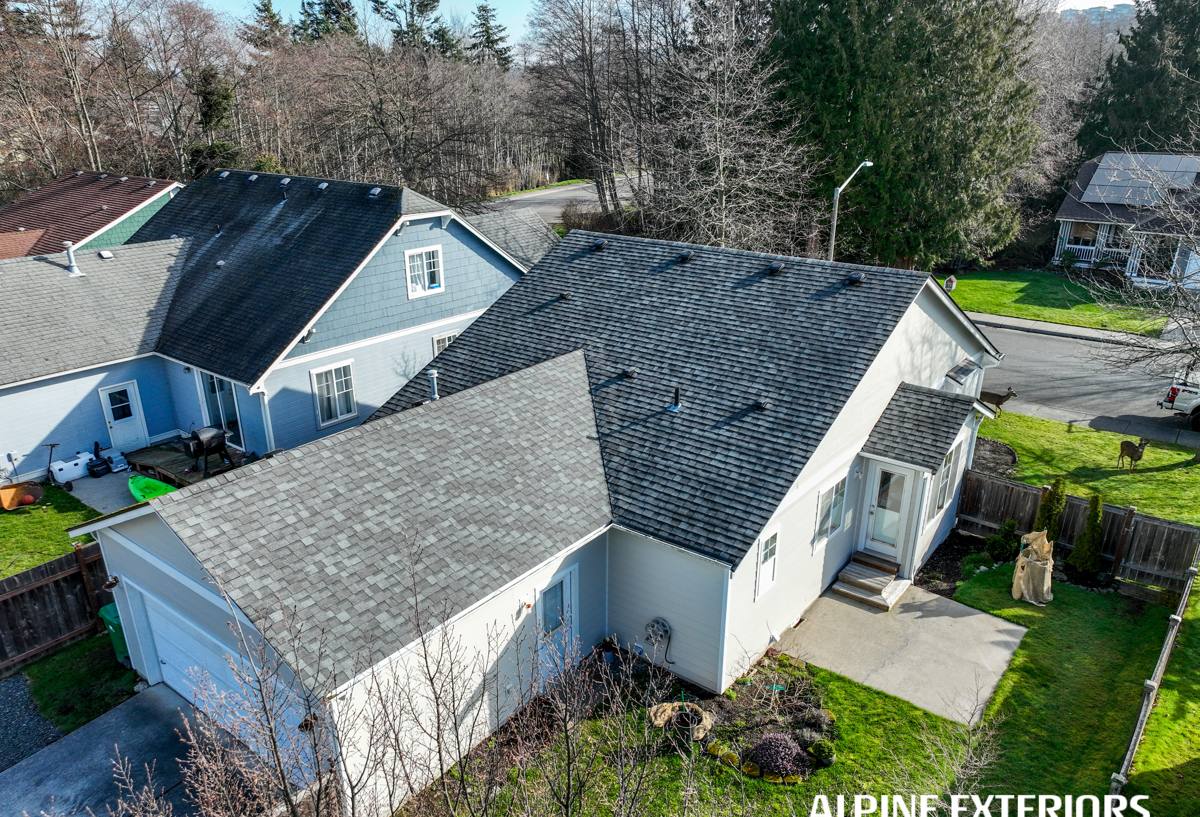
What Salt Air and Driving Rain Actually Do to Siding
Salt Air
Airborne salt is corrosive to exposed metal fasteners, flashing, and hardware, and it accelerates the breakdown of certain paint and coating systems over time. It doesn't ruin a house overnight, but it shortens the service life of anything not built or finished to handle it.
Driving Rain
Wind off the water pushes rain into laps, seams, and butt joints that would stay dry in a calmer climate. Siding products that rely on face-sealed joints or that swell and contract with moisture are more likely to develop gaps, cupping, or soft spots where water gets behind the material instead of shedding off it.
Moss and Sustained Dampness
Whatcom County's long wet season, combined with shaded lots near the Peace Arch area, means north-facing and tree-covered walls can stay damp for weeks at a stretch. Organic materials and porous surfaces give moss and algae something to hold onto, and constant moisture is the single biggest factor in premature siding failure, regardless of brand.
Why We Install Only James Hardie Fiber Cement Siding
We made a decision as a company to install one siding system: James Hardie fiber cement. We don't install vinyl, LP SmartSide, Cemplank, Allura, or primed wood siding like cedar or spruce. That's not a marketing angle — it's a standard we set because of what we've seen these products do over time in exactly this climate.
What the alternatives get right
To be fair to those products: vinyl is inexpensive and low-maintenance in the sense that it doesn't need painting. Engineered wood siding like LP SmartSide has a warmer, more traditional look and installs quickly. Cedar has real curb appeal and is a genuinely renewable material. None of these are scams or garbage products — they're reasonable choices in the right application.
Where they struggle here specifically
- Vinyl can warp, buckle, or become brittle with age and temperature swings, and it relies on lap joints that aren't as forgiving under sustained wind-driven rain.
- Engineered wood siding (LP SmartSide, etc.) is wood-based, so any breach in the factory coating or field-cut edge that isn't properly sealed becomes a path for moisture absorption and swelling.
- Cedar and primed spruce need real maintenance — re-staining or re-painting on a cycle, and vigilant caulking — to keep water out. Skip a cycle in a wet marine climate and you're behind fast.
- Cemplank and Allura are also fiber cement, and structurally comparable to Hardie in the raw material. Our reservation isn't about the cement itself — it's about factory finish consistency, product line engineering for local climate zones, and warranty backing, where we've found Hardie's system to be the stronger overall package.
Why Hardie fits this climate
James Hardie fiber cement is non-combustible, doesn't swell or rot from moisture the way wood-based products can, and comes with a factory-applied ColorPlus finish that's baked on under controlled conditions rather than field-painted. Hardie also engineers specific product lines (HZ5, for example) for climate zones like ours, meaning the formulation is built to handle freeze-thaw cycling and sustained damp exposure. The finish is backed by a real, transferable warranty, which matters when you're planning to own the house for the long haul or eventually sell it.
What Correct Installation Involves
Fiber cement siding is only as good as its installation, especially in a climate that punishes shortcuts. A few things we hold to on every job:
- Proper starter strips, flashing, and weather-resistant barrier behind the siding — not just the siding itself
- Correct fastener type and spacing to avoid splitting and to keep panels secure under wind load
- Manufacturer-specified clearances from grade, roofline, and decking so water has somewhere to go
- Caulking and sealing at penetrations (vents, hose bibs, light fixtures) done to spec, not as an afterthought
- Correct overlap and gapping at joints to allow for material movement without opening a path for water
A lot of siding problems we get called out to inspect aren't a failure of the product — they're a failure of installation detail. That's true of any siding system, which is part of why we'd rather install fewer products well than many products loosely.
Signs Your Current Siding Is Losing the Fight
If you're in the Peace Arch area and wondering whether it's time to start planning a siding project, a few signs are worth walking your exterior to check for:
- Persistent moss or algae streaking, especially on shaded or north-facing walls
- Soft spots, bubbling, or visible warping in wood-based or engineered wood siding
- Cracking or gaps at panel joints and corners
- Paint or finish that's chalking, peeling, or fading unevenly
- Rising energy bills that suggest the wall assembly isn't holding heat like it used to
- Visible rust streaking from fasteners, common with corroded metal hardware in salt air
Any one of these on its own isn't necessarily an emergency, but a couple together usually means moisture has already found its way behind the surface.
The Rest of the Exterior: Roofing, Windows, and Decks
Siding doesn't work in isolation — it's one part of a building envelope that has to work together to keep water out. We also handle roofing, windows, and decks, and in a climate like Blaine's, those systems interact more than people expect.
Roofing
Roof-wall intersections, valleys, and flashing details are where a lot of water intrusion actually starts, not the siding field itself. When we're on a property for siding work, we're also looking at how the roofline sheds water onto and around the walls.
Windows
Window flashing and integration with the siding plane is a common weak point, especially on older homes that have been re-sided once or twice without updating the window details underneath. Driving rain off the water finds these gaps first.
Decks
Decks attached to the house create another intersection point where moisture management matters — ledger board flashing, in particular, needs to be done correctly to keep water from tracking back into the wall.
Cost Factors to Expect
Every property near the Peace Arch is a little different, but the factors that move a project's cost are consistent. This isn't a quote — it's a way to think about what you're paying for.
| Factor | Why It Matters |
|---|---|
| Existing siding removal | Tear-off of old cedar, vinyl, or engineered wood adds labor and disposal cost versus a bare or already-stripped wall |
| Wall complexity | Dormers, multiple gables, and cut-up elevations near the water tend to be more architecturally detailed and take longer to trim out |
| Moisture damage found underneath | Rot or sheathing damage discovered once old siding comes off needs to be repaired before new siding goes on |
| Trim and accessory selection | Hardie trim boards, soffit, and fascia to match add cost over bare panel siding alone |
| House height and access | Multi-story homes or difficult site access (slopes, limited driveway room) affect equipment and labor time |
| Color and finish selection | Factory ColorPlus finishes vs. field-painted options affect material pricing and long-term maintenance |
Why a Local Crew Matters
A crew that works Whatcom County exteriors regularly knows what a Peace Arch-area wall is actually up against — the salt exposure, the tree cover, the wind direction off the water. That's different knowledge than a crew that mostly works dry inland siding jobs and treats every install the same way. Local also means we're not disappearing after the job — if a warranty question or a maintenance question comes up five years from now, we're still a Blaine-based company you can reach.
What to Expect From an Estimate Visit
When we come out to a Peace Arch-area home, we're not just measuring wall square footage. We're looking at:
- Current siding condition and where moisture may already be trapped
- Sun and shade exposure on each elevation, since that affects moss and drying time
- Flashing and trim details around windows, roof lines, and any attached decks
- Whether the project makes sense as siding-only or should include roofing, window, or deck work at the same time to close up other water paths
We'll walk you through what we find, what a correct installation looks like for your specific walls, and give you a straightforward, honest estimate — no pressure, no inflated scare tactics about your current siding.
A Quick Checklist Before You Call
- Walk your exterior and note any moss, staining, or soft spots you can see or feel
- Check window and door trim for gaps, cracking, or separation from the wall
- Look at fastener heads and metal trim for rust streaking
- Note which walls stay damp or shaded longest after a rain
- If you have a deck attached to the house, check the ledger board area for staining or soft wood
- Write down any rooms with drafts or noticeably higher heating costs in winter
If you're in the Peace Arch area of Blaine and want an honest look at where your exterior stands, we're happy to come out for a free, no-pressure estimate. There's a form below to get started.