 Blaine Siding
 Ferndale's Climate Is Hard on Roofs
Ferndale sits close enough to the water that homes here deal with a steady mix of salt-laden air, driving rain, and a moss season that can run for the better part of the year. That combination isn't unique to any one house in the area — it's just what roofs in this corner of Whatcom County are up against, season after season. A roof that might get a few extra trouble-free years in a drier, inland climate can start showing real wear here much sooner, especially if it wasn't installed and flashed with this exact climate in mind.
Salt air is corrosive to exposed metal — nails, flashing, vent boots, gutter hangers — long before most homeowners notice anything wrong with the shingles themselves. Driving rain, particularly when it comes in sideways during a winter blow, finds every gap in flashing and every lifted shingle tab and pushes water somewhere it doesn't belong. Moss, meanwhile, doesn't just sit on the surface looking bad. Its root structure works down into shingle granules and seams, holding moisture against the roof deck long after the rain itself has stopped.
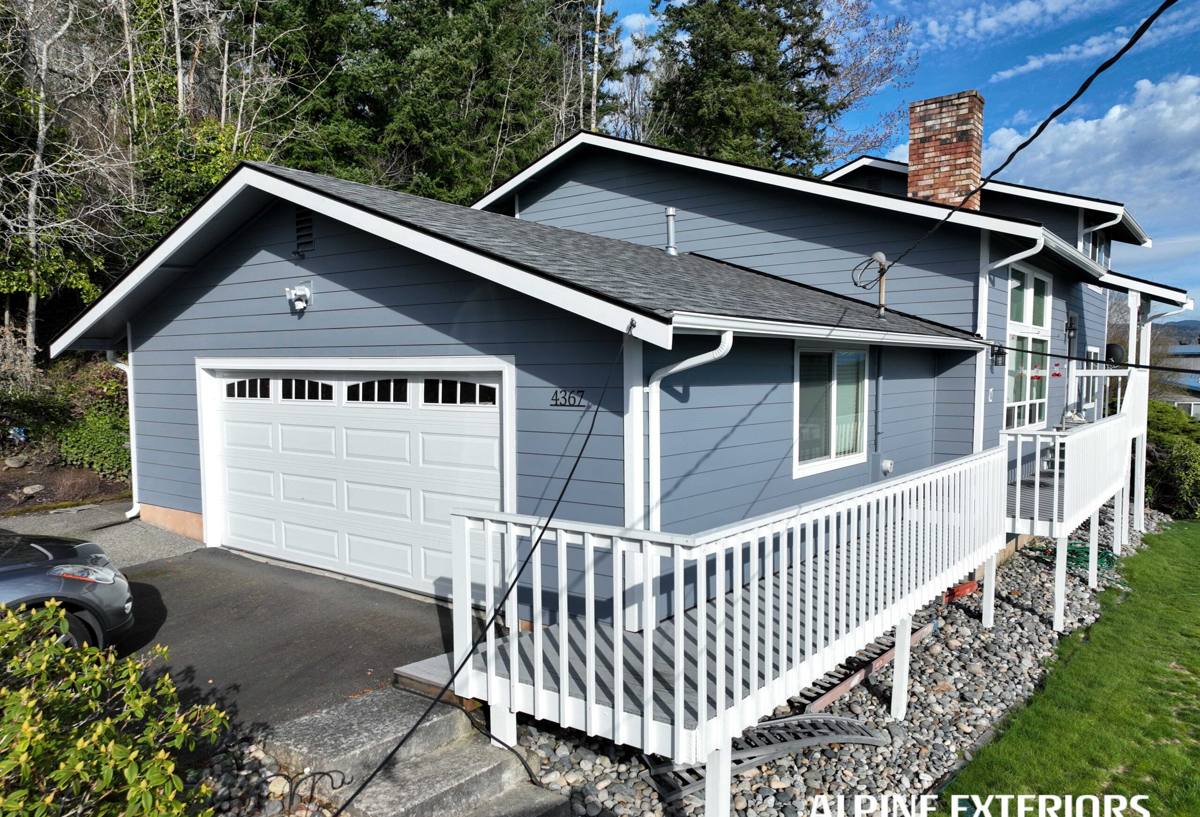
Signs a Ferndale Roof Needs Repair
Most roof problems around here don't start as a hole. They start small and get worse over one or two wet seasons. This is what we look for on an inspection, and what a homeowner can reasonably watch for between visits:
- Granules collecting in gutters or at downspout outlets — a sign shingles are wearing thin
- Moss or dark algae streaking, especially on north-facing slopes that stay shaded and damp longer
- Curling, cracked, or lifted shingle tabs, particularly on slopes exposed to wind off the water
- Rust staining or soft spots around flashing at chimneys, vents, and skylights
- Water stains on interior ceilings or in the attic, even faint or old-looking ones
- Sagging or spongy-feeling sections underfoot (something we check on the roof, not something to test yourself)
- Gutters pulling away from the fascia, which lets water run behind the roof edge instead of off it
Any one of these by itself might not mean much. Two or three together, especially after a hard winter, is usually worth a closer look before the next wet season sets in.
What a Correct Roof Repair Actually Involves
Finding the Real Source
Water rarely enters a roof at the spot where it shows up inside a house. It can travel along rafters or sheathing for several feet before it drips somewhere visible. A repair that only patches the ceiling stain's rooftop equivalent — without tracing the actual entry point — tends to fail again within a season or two. A proper repair starts with figuring out where water is actually getting in, which sometimes means checking flashing and penetrations well away from where the damage shows up indoors.
Flashing Comes First
Most repair calls we get that turn out to be a bigger problem than the homeowner expected trace back to flashing, not shingles. Flashing around chimneys, skylights, vent pipes, and roof-to-wall transitions is what actually keeps water out at the places where a roof plane changes direction. If flashing has rusted through, pulled loose, or was installed with the laps running the wrong way, no amount of new shingles nearby will fix the underlying leak. Any repair we do addresses flashing condition first, then shingles.
Matching Materials the Right Way
A repair that leaves a patch of obviously different shingles isn't just a cosmetic miss — mismatched materials can also mean mismatched thickness, granule wear, or flexibility, which creates new weak points at the seams. Where we can source a close match to existing shingles, we do. Where a close match isn't available because the roof is older, we'll say so up front and talk through the honest options rather than installing something that looks patched.
Common Roofing Materials on Ferndale Homes
What a repair involves depends a lot on what's already on the roof. Here's how the materials we commonly see in this area compare when it comes to repair work specifically:
| Material | Typical Repair Considerations | Climate Notes for This Area |
|---|---|---|
| Asphalt composition shingle | Most repairable option; individual shingles and flashing can usually be replaced without disturbing the whole field | Performs well if ventilation and flashing are solid; moss can shorten lifespan without maintenance |
| Cedar shake or shingle | Repairs require matching weathered wood tone and thickness; splitting and moisture damage are common repair triggers | Attractive but needs more attention here — retains moisture longer and is a natural moss host |
| Standing seam or metal panel | Repairs are usually about fastener backout, sealant failure at penetrations, or panel damage rather than the metal itself | Handles driving rain and salt air well when properly coated and fastened |
| Torch-down or membrane (low-slope) | Seam failures and blistering are the usual repair points; patching requires heat-welding or compatible adhesive, not just sealant | Common on additions or garages; ponding water from clogged drains is the main local risk |
How Our Repair Process Works
- We inspect the roof in person, including the attic side where it's accessible, rather than quoting from photos or a drive-by look
- We identify the actual source of the problem, not just where the damage is showing
- We give a written scope and price before any work starts, including what we can match versus what may need a broader repair
- We do the repair, which usually includes checking surrounding flashing and fasteners while we're already up there, not just the one spot that was reported
- We check that the fix holds under real conditions — proper flashing laps, sealed penetrations, and shingles set correctly for wind and rain exposure, not just patched over
We'll also tell you plainly if what you're describing sounds more like a full section replacement than a spot repair. Not every roof problem needs a full new roof, and not every leak can be permanently solved with a patch — we'd rather tell you which one you're actually dealing with than guess in a direction that's easier to sell.
Moss and Algae: A Year-Round Concern Here
Why Cleaning Alone Isn't Always Enough
Washing moss off a roof addresses the surface, but if moss has been established for a while, it's often already worked into shingle seams and granule loss has already started underneath. Part of an honest repair visit is telling you whether a section is a cleaning-and-treatment situation or whether moss has already caused enough granule loss and moisture retention that the shingles underneath need to be replaced, not just cleared. Given how much of the year this area supports moss growth, a roof with poor airflow or heavy shade is going to need this checked more often than a roof in full sun.
Zinc or copper strips near the ridge, kept-clear gutters, and trimmed overhanging branches all reduce how fast moss comes back after a cleaning, and we'll talk through those with you as part of any repair rather than treating moss as a one-time fix.
What Roof Repair Costs Depend On
We don't like giving a number without seeing the roof, because repair costs vary a lot based on what's actually wrong. What we can tell you honestly is what tends to move the price up or down:
| Factor | Why It Matters |
|---|---|
| Roof pitch and access | Steeper roofs and limited ground access around the house take longer and require more safety setup |
| How far the damage has spread | A leak caught early at one flashing point costs far less than one that's been soaking sheathing for a season or two |
| Material match availability | Older or discontinued shingle styles can mean a larger repair area to keep the roof looking uniform |
| Underlying deck condition | If plywood or sheathing underneath has softened from sustained moisture, that has to be addressed, not just covered over |
| Number of penetrations involved | Roofs with several vents, a chimney, and a skylight simply have more places flashing can fail at once |
As a general guide, small, caught-early repairs (a section of flashing, a handful of shingles) tend to run in the low hundreds to low thousands of dollars, while repairs involving deck damage or a larger area climb from there. A firm number only comes after we've actually looked at your roof.
Why a Crew That Already Works in Ferndale Matters
A roofer who works this part of Whatcom County regularly already knows what salt air does to fasteners over time, how long moss takes to become a structural concern rather than a cosmetic one, and which flashing details hold up against driving rain off the water and which don't. That's not a substitute for a careful, in-person inspection of your specific roof — every house is different — but it does mean fewer surprises and less guesswork once we're up there. We're based nearby in Blaine, which means a repair estimate doesn't require someone driving in from out of the area unfamiliar with this stretch of coastline, and it means we're reachable if a repair needs a follow-up look after the next storm.
If you're seeing granule buildup in the gutters, a damp spot on a ceiling, or moss that's gotten ahead of you, we're happy to take a look and give you a straight answer — repair, monitor, or something bigger — with a free, no-pressure estimate.