 Blaine Siding
 Exterior Work Built for Everson's Climate
Everson sits inland from Blaine along the Nooksack River in Whatcom County, and while it's tucked away from the immediate coastline, the same weather system that soaks the whole county doesn't skip this stretch of farmland and river valley. Homes here deal with a long wet season, heavy fall and winter rain, humid air off the river bottom, and enough shade from mature trees and cloud cover to keep moss and algae growing on siding, roofs, and decks for much of the year. Add in the salt-tinged marine air that rides inland off the Salish Sea on a west wind, and you've got a combination that's hard on building materials that weren't chosen with this region in mind.
We're based out of Blaine and work throughout Whatcom County, including Everson, Nooksack, and the surrounding rural and residential areas. We install siding, roofing, windows, and decks, and on the siding side we've made a deliberate decision: we only install James Hardie fiber cement. That's not a marketing angle — it's a standard we hold to because of what we've seen happen to other siding materials in exactly this kind of climate.
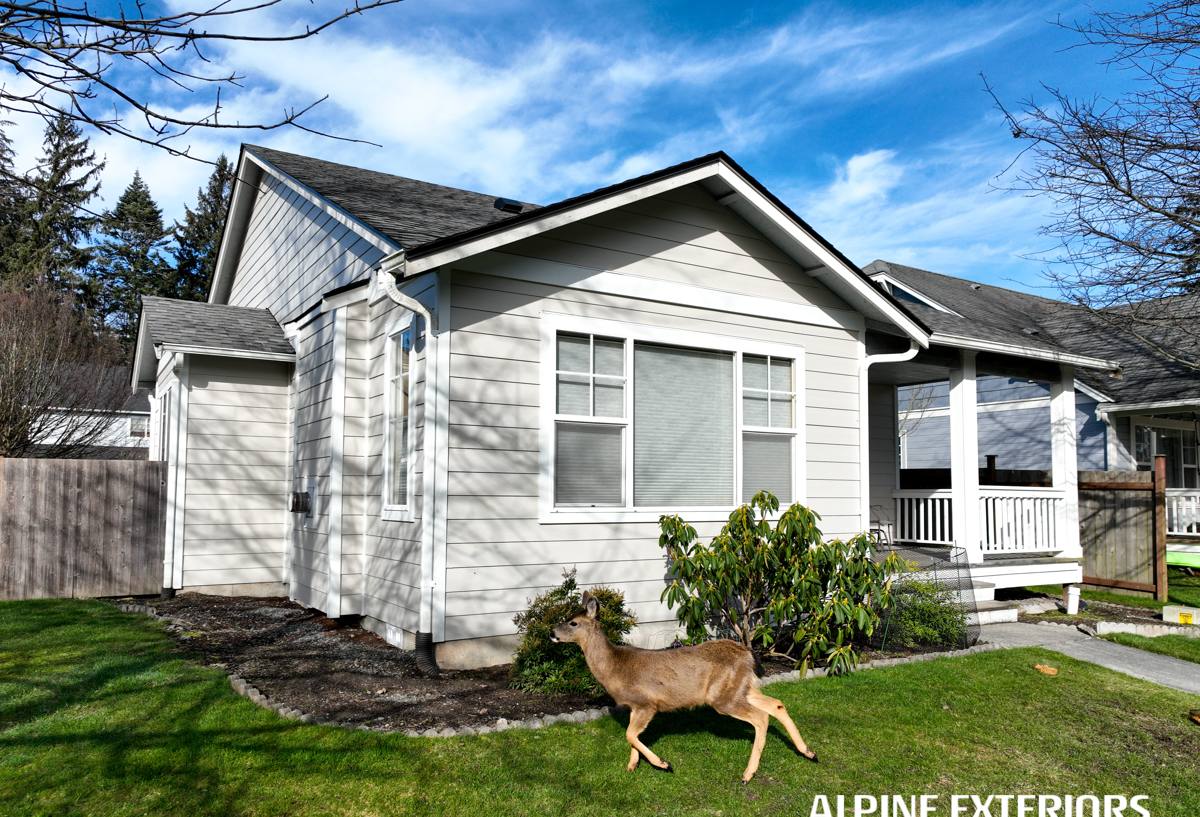
What Local Homes Are Up Against
Everson's mix of older farmhouses, mid-century homes, and newer construction all face the same basic exposure, just in different ways depending on age, orientation, and how much tree cover surrounds the lot.
Moisture That Doesn't Let Up
Whatcom County gets a long, steady wet season, and Everson's river-valley setting means humidity and morning fog linger even after the rain itself has passed. Wood-based siding products swell, cup, and eventually rot when they can't dry out between rain events. Any material with a wood component — engineered wood, primed spruce, cedar — is fighting a losing battle against that kind of sustained moisture exposure unless it's maintained on a strict schedule.
Moss and Algae Growth
Shaded north- and east-facing walls, roof valleys, and anywhere water sits or drains slowly are prime spots for moss, algae, and mildew to take hold. This isn't just cosmetic — moss holds moisture against the surface it's growing on, which accelerates rot in wood siding and trim, and it can work into seams and laps where water then has an easy path inward.
Salt-Influenced Air
Everson isn't waterfront, but Whatcom County as a whole sits close enough to the Salish Sea that airborne salt is part of the equation, especially on west-facing exposures. Salt exposure accelerates corrosion on fasteners, flashing, and any exposed metal, and it can degrade certain paint and coating systems faster than a purely inland climate would.
Temperature Swings
Summers bring real heat and sun exposure that dries and stresses exterior materials, while winters bring freeze-thaw cycles. Materials that absorb moisture and then freeze are prone to cracking, splitting, and finish failure over time.
Why We Only Install James Hardie Fiber Cement
We used to install a wider range of siding products, like most contractors in this region do. Over years of installs, repairs, and re-do calls in Whatcom County's climate, a pattern became clear: fiber cement from James Hardie held up in ways that other materials consistently did not, and we stopped installing anything else.
What We Moved Away From
- Vinyl siding — inexpensive and low-maintenance, but it can warp or buckle in temperature swings, fades over time, and offers no real fire resistance. In wind-driven rain it also relies heavily on a well-executed water-resistive barrier behind it, since the panels themselves aren't a true moisture seal.
- LP SmartSide and other engineered wood products — engineered wood performs reasonably when installed and maintained exactly to spec, but any breach in the factory coating (a cut edge, a fastener hole, a scrape) opens a path for moisture to wick into the wood substrate. In a climate with this much sustained damp, that's a maintenance burden we don't think most homeowners want to sign up for.
- Cemplank and Allura — these are also fiber cement products and share some of Hardie's core strengths, but we've standardized on one manufacturer so we can guarantee consistent installation training, warranty support, and color-match availability across every job we do.
- Primed spruce and cedar — beautiful materials with real character, but solid wood siding demands ongoing refinishing, caulking, and inspection to keep moisture out. In a river-valley climate with this much shade and rainfall, that upkeep schedule is demanding, and skipping a cycle can mean rot before it's visually obvious.
What Hardie Gets Right
James Hardie fiber cement is non-combustible, which matters in a region that sees wildfire smoke and occasional dry-season fire risk even this far north. It's engineered specifically for climate zones like ours through Hardie's HZ product lines, meaning the formulation accounts for moisture cycling rather than treating it as an afterthought. The ColorPlus factory finish is baked on and warranted separately from the substrate, so you're not relying on a field-applied coat of paint to be your primary defense against the weather. And because it's cement-based rather than wood-based, it doesn't feed moss and mildew the way organic materials can, and it doesn't rot.
None of this means fiber cement is maintenance-free — no exterior product is. But the maintenance it requires (periodic cleaning, caulk inspection, occasional repainting on non-ColorPlus trim) is far less demanding than what wood-based or vinyl systems ask of a homeowner in this specific climate.
How a Siding Project Works, Start to Finish
- On-site assessment — we look at your current siding, the condition of the sheathing and water-resistive barrier underneath where accessible, trouble spots like window and door flashing, and any moss or moisture damage already present.
- Product and color selection — we walk through Hardie's plank, shingle, and panel options along with the ColorPlus palette, and help you land on something that fits the home and the neighborhood.
- Tear-off and prep — old siding comes off, damaged sheathing gets replaced, and we install or repair the water-resistive barrier and flashing details before a single new plank goes up. This step is where most long-term failures either get prevented or get built in — it's not a step to shortcut.
- Installation to manufacturer spec — proper fastener placement, clearances, and lap spacing all matter for both performance and warranty validity. Hardie's warranty can be affected by installation error, so we follow their published specs closely.
- Trim, caulking, and cleanup — final detailing at corners, windows, and transitions, followed by a full site cleanup.
- Walkthrough — we go over the finished work with you before calling the job done.
Roofing, Windows, and Decks Alongside Siding
Siding is one piece of a home's exterior envelope, and in Everson's climate it rarely makes sense to think about it in isolation. A roof with worn or moss-covered shingles will send more water down the wall plane than a sound roof will. Old windows with failed seals or flashing are a common source of the water intrusion that gets blamed on siding. And a deck built without the right ledger flashing and moisture-resistant fasteners can rot from the inside before the surface ever looks bad.
Because we handle all four — siding, roofing, windows, and decks — we can look at a home's exterior as one connected system rather than four separate trades that don't talk to each other. That matters most at transition points: where a roof meets a wall, where a window meets siding, where a deck ledger attaches to the house. Those junctions are where the majority of real-world water damage actually starts.
Comparing Siding Options for a River-Valley Climate
| Material | Moisture Resistance | Maintenance Demand | Fire Resistance | Typical Lifespan Range |
|---|---|---|---|---|
| James Hardie Fiber Cement | High — cement-based, engineered for wet climates | Low to moderate | Non-combustible | Long-term with correct install |
| Vinyl | Moderate — relies on barrier behind panels | Low, but degrades and fades over time | Poor — can melt or deform under heat | Shorter, variable |
| Engineered Wood (e.g., LP SmartSide) | Moderate — vulnerable at cut edges/fasteners | Moderate to high — coating must stay intact | Combustible | Shorter without diligent upkeep |
| Solid Wood (cedar, primed spruce) | Low without constant upkeep | High — regular refinishing required | Combustible | Variable, upkeep-dependent |
This table reflects general material characteristics, not guaranteed outcomes — installation quality, maintenance follow-through, and site-specific exposure all affect how any of these products actually perform on a given home.
Signs Your Everson Home May Need Exterior Attention
- Visible moss or algae streaking on siding, especially on shaded or north-facing walls
- Soft or spongy spots when you press on wood-based siding or trim
- Peeling, bubbling, or chalky paint that keeps recurring in the same spots
- Gaps or cracking at caulked joints around windows, doors, or corner trim
- Warped, bowed, or buckled siding panels
- Water stains or discoloration on interior walls near exterior corners
- Roof shingles showing granule loss, moss growth, or curling edges
- Deck boards that feel spongy, or fasteners that are rusting and staining the wood
Why a Local Crew Matters
A contractor who works this specific stretch of Whatcom County day in and day out knows things a general regional crew won't: which wall exposures in a river valley tend to hold moisture longest, how much shade and moss pressure to plan around, and how the marine-influenced air moving in from the west interacts with the more humid, tree-shaded conditions further inland around Everson. That knowledge shapes real decisions — where extra flashing attention is worth it, which exposures benefit most from a lighter ColorPlus finish versus a darker one, and how to sequence a project around the wettest months of the year.
It also means accountability. If a warranty question comes up or you want a follow-up inspection five years down the road, you're calling a crew that's still working in your area, not chasing down a company that moved on to the next region.
Getting Started
If your Everson home is showing early signs of wear — moss buildup, aging siding, a roof that's due, windows that don't seal like they used to, or a deck that needs attention — it's worth having someone look at it before small issues turn into structural repairs. We offer free, no-pressure estimates, and we're happy to walk through what we see and what your options are, with no obligation attached. Use the form below to get in touch and set up a time.