 Blaine Siding
 New-Construction Windows in Ferndale: What This Climate Actually Demands
Ferndale sits close enough to the water that homes here deal with salt-laden air, wind-driven rain off the Strait, and a moss season that can run eight months or more out of the year. None of that is dramatic on its own, but it adds up fast at the window openings of a new build. A window unit is only as good as the flashing and integration work around it, and in this climate, small gaps in that work don't stay small. Water finds the path of least resistance, and in Whatcom County that path gets tested a lot more often than it does in drier parts of the state.
New construction is the one point in a home's life where the window opening is completely open — no siding, no trim, no old caulk to work around. Get the sequencing right at this stage and the windows should be trouble-free for decades. Get it wrong, and the mistakes get sealed behind siding where nobody sees them until there's a stain on a wall or rot in a sill years later.
New Construction vs. Replacement Windows: Why the Job Is Different
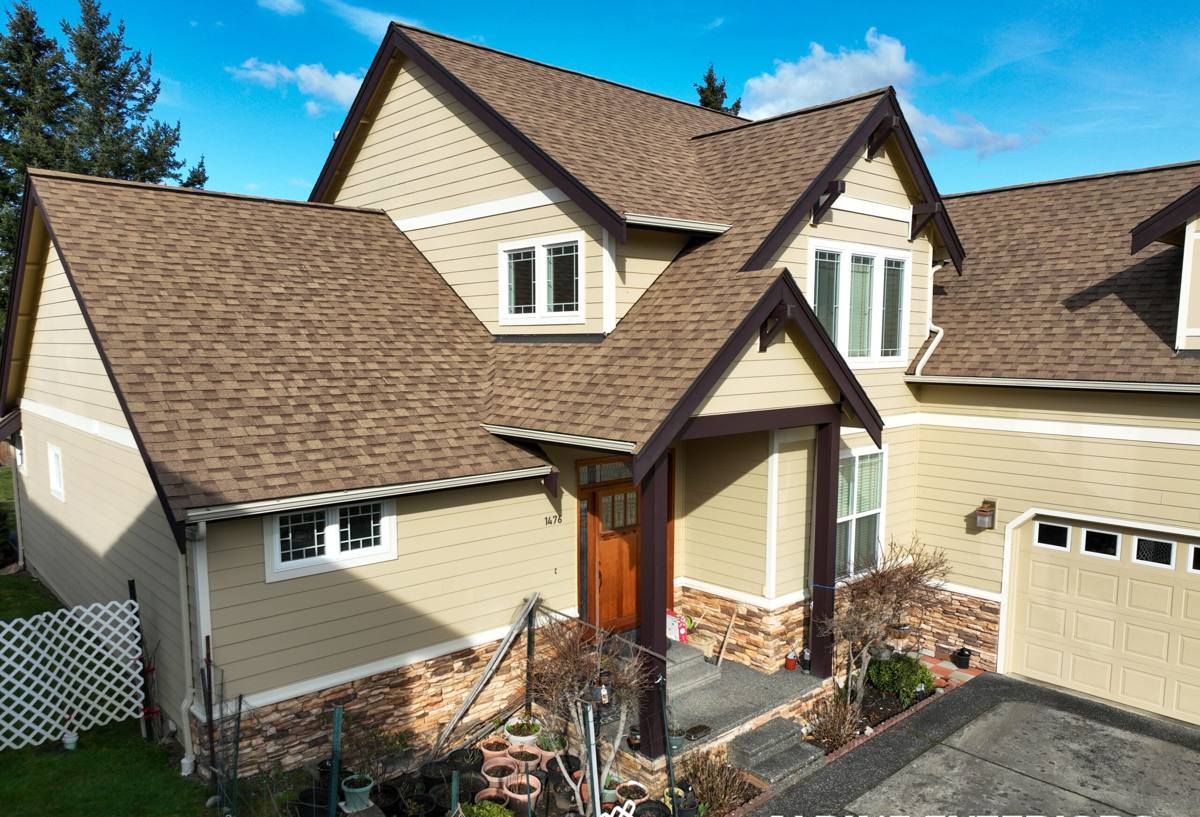
A lot of homeowners assume "installing a window" is one job. It isn't. New-construction windows have a nailing fin around the perimeter that gets fastened directly to the sheathing and integrated with the house wrap and flashing before siding goes on. Replacement or "pocket" windows go into an existing, already-clad wall and rely on the old frame and trim for weather protection.
New construction gives a crew the chance to build the water management system correctly from the studs out — sill pan, flashing tape, shingle-lapped house wrap, and a fastening pattern that meets the window manufacturer's warranty requirements. There's no old damage to work around, but there's also no room for shortcuts, because whatever goes in behind the siding stays there for the life of the house.
What a Correct New-Construction Install Involves
Rough Opening and Sill Pan
Before a window ever goes in, the rough opening needs to be checked for square, level, and correct dimensions against the window's actual size — not just the plan spec. A sloped sill pan (either a manufactured pan or a properly flashed and sloped built-up sill) is the first line of defense. Its job is to catch any water that gets past the window and direct it back outside, not let it pool against the sheathing.
Flashing and Water Management
Flashing goes on in a specific order — sill first, then the sides, then the head — so each layer overlaps the one below it like shingles on a roof. That shingle-lap principle is what keeps water moving downward and outward instead of behind the housewrap. Head flashing in particular needs a drip cap or flashing that directs water out and away from the top of the frame, not straight down the wall.
Integration with House Wrap
The house wrap has to be cut and taped so it laps over the flashing correctly at the top of the window and under it at the bottom. This is one of the most common places we find errors on other people's work — house wrap taped in the wrong order traps water against the sheathing instead of shedding it.
Sealant and Fastening
Sealant belongs at specific points — generally the sides and top of the nailing fin — not as a full bead around the entire perimeter. Sealing the bottom of the window solid is a common mistake; it blocks the weep path and turns the sill pan into a bathtub instead of a drain. Fasteners go in the pattern and spacing the manufacturer specifies, hitting solid framing at every location, including the corners where builders sometimes skip a nail to save time.
Window Materials That Hold Up Near Salt Air
Material choice matters more here than in inland parts of the state. Salt air accelerates corrosion on hardware and finishes, and the constant damp keeps wood products wet longer between dry-outs. Here's how the common options generally compare for a coastal Whatcom County build:
| Material | Salt Air / Moisture Resistance | Maintenance | Typical Cost Tier |
|---|---|---|---|
| Vinyl | Good — won't corrode or rot, UV-stable frames age slowly | Low — occasional cleaning | Lowest |
| Fiberglass | Very good — dimensionally stable, resists corrosion | Low | Mid to upper |
| Wood-clad | Depends heavily on cladding integrity and finish upkeep | Higher — finish and seal maintenance | Upper |
| Aluminum | Fair — can pit or corrode near salt air without a quality finish | Moderate | Mid |
We're not going to tell you a given brand or material is "bad" — every option here can perform well when it's specified and installed correctly. The honest trade-off is what you're willing to maintain. Wood-clad windows can look great, but the cladding has to stay sealed at every joint or moisture gets underneath it, and that's a harder problem to catch early in a salt-air environment. Vinyl and fiberglass ask less of the homeowner over time, which is why we lean toward them for most new-construction jobs in this area unless the design calls for something else.
Our Process for Ferndale New-Construction Projects
Coordinating with Your Builder or GC
On a new build, we're usually one piece of a larger schedule. We review the window schedule and rough opening dimensions against the actual units ordered before anything ships, so we're not discovering a mismatch on install day. Lead times on windows can run several weeks, so we try to get involved in that conversation early rather than after framing is already done.
Install Timing in the Framing Sequence
Windows go in after the house is framed and dried in with house wrap, but before siding starts. That sequencing lets us do the flashing integration properly instead of working around finished trim. In Ferndale's wetter months, we also pay attention to weather windows during install — taping and sealant both need dry surfaces and the right temperature range to bond correctly.
Final Check Before Siding Closes It Up
Before siding covers the openings, we walk every window — checking flashing laps, fastener count, sealant placement, and that each unit operates and locks properly. This is the last point where a mistake is cheap to fix. Once siding is on, fixing a flashing error means pulling siding back off.
Common Mistakes We See in New-Construction Window Work
These come up often enough on other builders' work — or on repair calls years later — that they're worth flagging if you're evaluating a crew or a set of plans:
- No sill pan flashing, or a flat sill pan with no slope to drain water back out
- House wrap taped over the top of the head flange instead of under it, reversing the shingle-lap
- Sealant run in a solid bead around the entire window perimeter, blocking the weep path at the sill
- Rough openings shimmed out with excess sealant or foam instead of proper shims at the fastening points
- Missing or skipped fasteners at the corners of the nailing fin
- No backer rod behind sealant joints, which shortens the sealant's working life and leads to early cracking
- Window schedule not checked against actual rough openings before install, leading to gaps packed with foam instead of sized correctly
Cost Factors for Ferndale New-Construction Windows
Per-Opening Cost Drivers
Cost per window depends on size, material, glass package, and shape. A standard vinyl double-hung is going to run less than a large fiberglass slider or a specialty shape like an arch-top or a bay unit. Low-E coatings and argon gas fills add a modest amount but are worth it for energy performance in this climate. Tempered glass is required near doors, low sills, and other code-defined hazard locations, which adds a bit more to those specific units.
Whole-House Considerations
On a full new build, total window cost is really a function of how many openings, how large they are, and how much of the house's design leans on glass. Grid patterns, custom colors, and upper-floor or gable-end access can also move the number. Rather than quote a single price that won't hold up across different plans, we'd rather walk your actual window schedule with you and give you real numbers for your project.
Why a Local Blaine Crew That Already Works Ferndale Matters
We're based in Blaine and work Whatcom County new-construction sites regularly, which means we already know how the local building department wants flashing details documented, and we're not learning the region's moisture behavior on your dime. Crews that don't work this area day to day sometimes bring details that are fine for a drier climate but undersized for the rain volume and salt exposure Ferndale actually sees.
Being local also matters after the crew leaves. If a warranty question or a callback comes up, we're a short drive away, not a company that finished the job and moved on to a different region. On a new-construction project, that ongoing relationship with your builder and with you is part of what you're paying for, not an afterthought.
If you're planning a new build in Ferndale or elsewhere in Whatcom County, we're glad to walk your window schedule and plans with you and give you a straightforward, no-pressure estimate — just fill out the form below.