 Blaine Siding
 Ferndale's Climate Is Harder on Siding Than It Looks
Ferndale sits close enough to Bellingham Bay and the Strait of Georgia that salt-laden marine air is a constant, low-grade presence on exterior surfaces — even on properties that feel inland once you're standing in the yard. Add Whatcom County's long, wet winters, wind-driven rain off the water, and the shaded, damp conditions that let moss and algae take hold on north-facing walls and roof-adjacent siding, and you've got a climate that's genuinely tough on exterior materials. It's not dramatic weather, in the sense of hurricanes or wildfire smoke — it's persistent, quiet moisture exposure, month after month, for most of the year.
That matters more for siding than most homeowners realize. Siding isn't just a cosmetic layer. It's the first line of defense against water intrusion, and in a climate like Ferndale's, a siding system that's even slightly wrong — the wrong material, a poor installation detail, a missed flashing point — doesn't fail dramatically. It fails slowly, behind the wall, where you can't see it until there's already damage to the sheathing or framing.
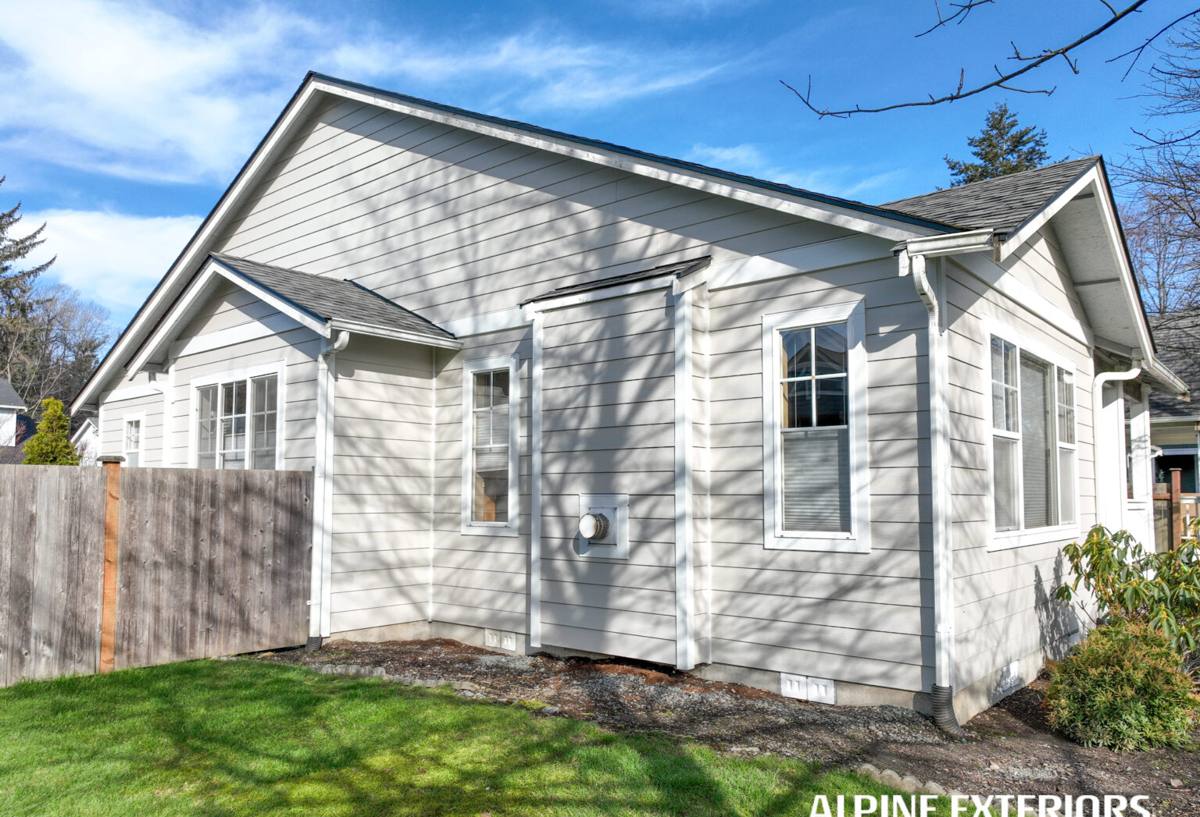
What Ferndale Homes Actually Need From Their Siding
Given the local conditions, a siding system in Ferndale needs to do a few specific things well:
- Resist moisture absorption, since the siding stays damp for extended stretches during fall and winter
- Hold paint and factory finish without heavy chalking or fading from salt air and UV exposure
- Resist moss and algae growth on shaded or north-facing elevations, or at least not feed it the way some organic-based materials do
- Stay dimensionally stable through repeated wet-dry cycles so seams, caulking, and paint lines don't fail early
- Handle driving rain at the details that matter most — inside corners, window and door flashing, and siding-to-trim transitions
None of this is exotic. It's the same list any coastal Pacific Northwest town would need. But it's worth stating plainly, because a lot of siding failures we see in this area trace back to a product or installation approach that wasn't built with this specific moisture load in mind.
Why We Only Install James Hardie Fiber Cement Here
We've made a deliberate decision as a company to install James Hardie fiber cement siding exclusively — not vinyl, not LP SmartSide, not primed wood products. That's not a marketing position; it's a practical one, based on what holds up in Whatcom County conditions and what we're willing to warranty our labor against.
Fiber cement is non-combustible and dimensionally stable in a way wood-based and vinyl products aren't. It doesn't absorb water the way engineered wood siding can at cut edges and seams, which matters enormously in a climate where those edges stay wet for days at a time. James Hardie's ColorPlus factory finish is baked on and warranted separately from the substrate, which means the paint layer is engineered specifically to hold color and resist the fading and chalking that comes from repeated salt-air and UV exposure. And Hardie's HZ5 product line is formulated for exactly this kind of freeze-thaw, high-moisture climate — it's not a one-size-fits-all national product.
We're not going to tell you vinyl or engineered wood siding is junk — plenty of it is manufactured well and installed correctly on plenty of homes. But we've chosen not to install it, because in this specific climate, we don't think it gives homeowners the same margin for error over 20-30 years that fiber cement does. When we stand behind our installation work, we want to be standing behind a product we trust to perform here, specifically.
How Hardie Handles Ferndale's Moss and Algae Pressure
Moss and algae don't grow on fiber cement the way they can on wood-based products, because there's no organic material in the substrate for them to feed on. That doesn't mean a shaded, damp wall will never show any growth — airborne spores can settle on any surface — but it does mean the siding itself isn't contributing to the problem, and painted fiber cement is far easier to clean without damaging the surface underneath.
What a Correct Installation Actually Involves
The siding product is only part of the equation. In our experience, most siding failures we're called out to inspect in this region trace back to installation shortcuts, not the material itself. A correct install in a climate like Ferndale's comes down to a handful of details done right, every time, not just on the parts of the house people notice.
Weather-Resistive Barrier and Flashing
Everything starts with a properly lapped weather-resistive barrier and correctly integrated flashing at every window, door, and roof-to-wall transition. Siding is not the primary water barrier — it's a rain screen. The barrier and flashing behind it are what actually keep water out of the wall assembly when wind-driven rain gets past the surface, which it will, given enough time and enough storms.
Fastening, Gaps, and Clearances
Fiber cement has to be fastened according to manufacturer spec — correct nail placement, correct spacing, correct penetration into framing. It also needs proper clearance from grade, roofing, and decks so it isn't sitting in standing water or splash-back during Whatcom County's wettest months. These are the kinds of details that don't show up as a problem for a year or two, then quietly become a moisture problem that's expensive to fix.
Caulking and Trim Transitions
Inside corners, trim boards, and siding-to-trim transitions are where most water intrusion actually starts. These joints need to be caulked with a product rated for the exposure and installed with enough of a gap to allow for expansion and contraction — sealed tight with no room to move, caulk just tears.
Our Installation Process in Ferndale
We follow the same disciplined process on every Ferndale project, whether it's a full re-side or a smaller section replacement:
- Assessment: We inspect the existing siding, sheathing, and any visible signs of moisture damage before quoting anything, so there are no surprises once tear-off starts.
- Removal and sheathing check: Old siding comes off and we check the sheathing underneath for rot or soft spots — this is the point where hidden water damage from a prior installation often shows up.
- Weather barrier and flashing: We install a new weather-resistive barrier and properly integrate flashing at every penetration before a single piece of siding goes up.
- Hardie installation to spec: Fastening, spacing, and clearances follow James Hardie's published installation requirements — this is also what keeps the manufacturer's product warranty valid.
- Trim, caulking, and paint touch-up: Final trim work and sealant at every transition point, plus any factory-finish touch-up needed at cut edges.
- Final walkthrough: We walk the exterior with the homeowner before calling the job done.
Climate Factor vs. Installation Response
| Ferndale Climate Factor | What It Does to Siding | How We Address It |
|---|---|---|
| Salt-laden marine air | Accelerates fading, chalking, and corrosion of fasteners over time | ColorPlus factory finish plus corrosion-resistant fastening per Hardie spec |
| Wind-driven rain | Forces water past face-sealed joints and into trim transitions | Properly lapped weather barrier, flashing, and correctly gapped caulk joints |
| Extended damp/shade periods | Feeds moss and algae growth, especially on north-facing walls | Non-organic fiber cement substrate that doesn't feed growth |
| Repeated freeze-thaw and wet-dry cycling | Causes swelling, warping, or seam failure in less stable materials | HZ5-rated fiber cement engineered for dimensional stability |
Why It Matters to Hire a Crew That Already Works Ferndale
A siding crew that mostly works drier inland climates, or that installs whatever product a homeowner asks for without pushback, isn't necessarily set up to get the details right for a marine, high-moisture town like Ferndale. Local experience shows up in small ways: knowing which elevations on a typical Ferndale lot take the worst weather exposure, knowing how much clearance to leave near grade given the rainfall this area sees, and knowing not to caulk a joint that needs to breathe. None of that is exotic knowledge, but it's the kind of thing that only comes from doing the work here, repeatedly, and paying attention to how installations hold up a few years later.
It also matters that the crew installing your siding is the crew standing behind it. We don't subcontract out the installation work on Hardie siding, which means the people who show up to fix a problem are the same people who understand exactly how the job was built.
What to Check Before Hiring Anyone for Siding Work
- Are they a James Hardie-focused or certified installer, or do they install "whatever the customer wants" without steering you toward what actually performs in this climate?
- Will they show you the flashing and weather-barrier details, not just the finished siding?
- Do they check sheathing condition during tear-off before quoting a final price, or is that left as a surprise change order?
- Is their installation warranty separate from — and clearly explained alongside — the manufacturer's product warranty?
- Can they explain why they'd install a particular product on your specific elevation, given sun and shade exposure?
What to Expect for Cost and Timeline
Siding installation cost in Ferndale depends mainly on the size and complexity of the home, how much of the existing siding and trim needs to be removed, whether any sheathing repair is needed once tear-off begins, and the specific James Hardie product line and finish chosen. Homes with more corners, dormers, and trim detail take longer and cost more per square foot than a simple rectangular footprint. We won't quote a number without seeing the house, but we're upfront during the estimate about what's driving the price so there are no surprises later.
If you're weighing a full re-side against repairing a section, or just want a straight answer about whether your current siding is past its useful life, we're happy to take a look. Reach out for a free, no-pressure estimate — we'll walk the exterior with you, point out anything we see, and give you a clear picture of what the job would actually involve.