 Blaine Siding
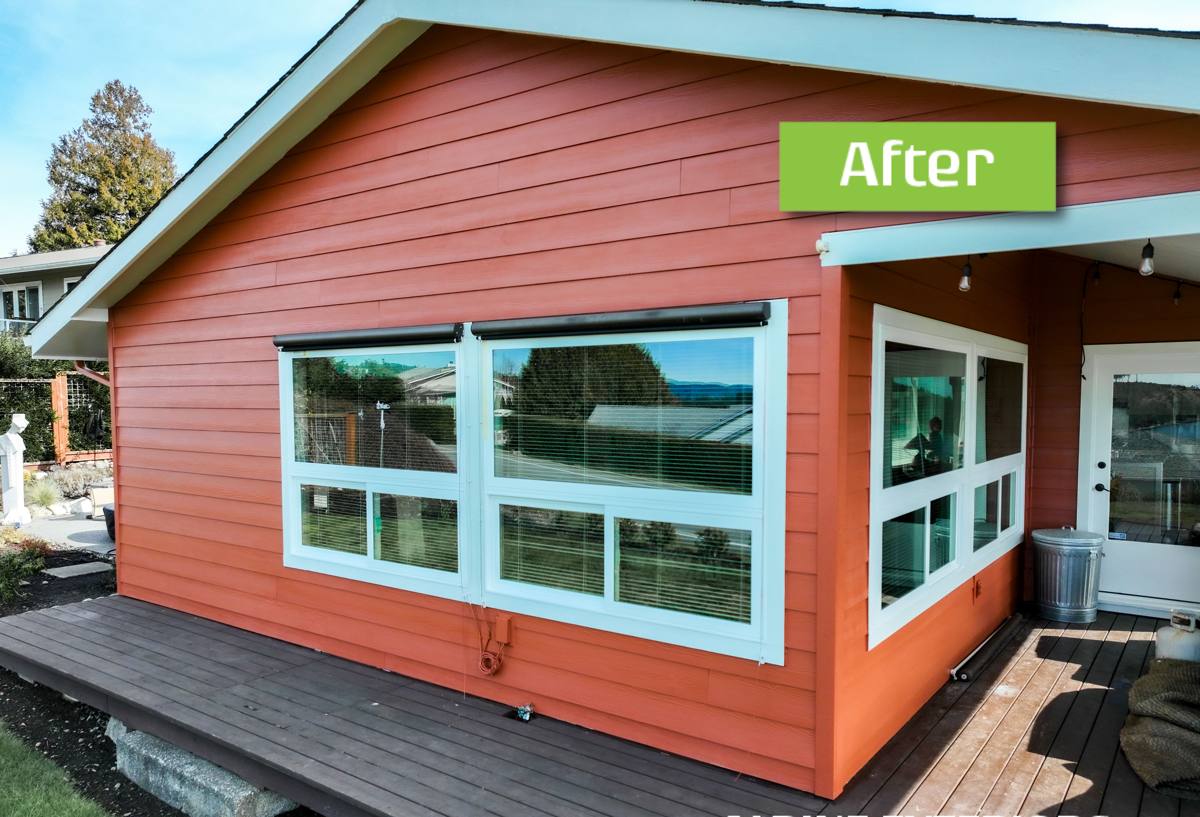
 Fiber Cement Siding in Birch Bay: A Waterfront Job From the Start
Birch Bay sits on the water in northern Whatcom County, just south of Blaine, and that location changes what a siding job actually needs to hold up to. This page is specifically about fiber cement siding on Birch Bay homes: what the local climate does to it, which James Hardie products make sense here, how the installation needs to be handled, and what a project actually looks like from estimate to final walkthrough.
We install James Hardie fiber cement exclusively, on every siding job we take on in Birch Bay and the rest of the Whatcom County coastline. That's a professional standard, not a sales pitch, and it comes directly from what we've seen hold up — and what hasn't — on siding work in this specific stretch of shoreline.
Why Birch Bay Is a Harder Climate on Siding Than It Looks
Salt Air, Every Day
Homes close to the water in Birch Bay get salt-laden marine air as a daily, direct condition, not an occasional one. Salt speeds up corrosion on fasteners, flashing, and lower-grade trim hardware, and it wears down weaker finishes faster than a drier or more inland climate would. Siding material and hardware both need to be chosen with that in mind, not just picked for how they look going up.
Driving Rain, Pushed Sideways
Open water exposure means more wind, and wind-driven rain doesn't fall straight down onto a wall — it gets pushed sideways into siding joints, trim seams, and window flashing. That sideways load is what actually determines whether a siding job holds up for decades or starts letting water in behind the cladding after a few wet winters, regardless of what the material is rated for on a spec sheet.
A Moss Season That Barely Breaks
Mild temperatures, shade, and near-constant moisture add up to a moss and mildew season that can run close to year-round on north-facing or tree-shaded walls around Birch Bay. Any siding material that's even slightly porous, or that traps moisture against the substrate instead of shedding it, becomes a growth surface over time. On a lot of properties here, the water-facing side of the house dries out faster than the shaded, landward side, which means moss pressure and moisture exposure can vary a lot across the same home.
Why We Install Only James Hardie Fiber Cement
We narrowed our siding offering down to one system after seeing, repeatedly, what actually holds up in sustained marine exposure versus what looks fine on a spec sheet and struggles a few winters into a Birch Bay job.
- Non-combustible core: fiber cement doesn't feed a fire the way wood-based siding can, which matters for homeowner safety and can matter for insurance as well.
- Factory-applied ColorPlus finish: baked on under controlled conditions rather than brushed on in the field, so it holds color and adhesion longer under sustained salt air and UV exposure.
- Climate-engineered HZ formulation: Hardie's HZ5 product line is built for regions with heavy moisture exposure and freeze-thaw cycling, which fits Birch Bay's conditions closely.
- Dimensional stability: fiber cement doesn't swell, cup, or warp the way engineered wood siding can after repeated wetting cycles through a wet coastal season.
- A strong transferable warranty: backed by one of the more robust warranty structures in the industry, provided installation follows Hardie's published specs.
We don't install LP SmartSide, vinyl siding, Cemplank, Allura, primed spruce, or cedar. Each of those has a place in the broader market and homeowners elsewhere who are satisfied with them. Our position is specific to this climate: on a shoreline exposure like Birch Bay, we'd rather stand fully behind one system we know performs here than offer a cheaper alternative that quietly shifts maintenance risk onto the homeowner a few years out.
Choosing the Right Hardie Product for a Birch Bay Home
HardiePlank Lap Siding
Lap siding is the most common choice for Birch Bay homes and the one we install most often. It comes in several textures and exposure widths, and it reads as a traditional siding profile that fits most house styles in the area. For water-facing walls, we pay particular attention to lap overlap and caulking at butt joints, since that's where wind-driven rain finds its way in first.
HardiePanel Vertical Siding
Panel siding, often installed as board-and-batten, works well as an accent on gables, entryways, or a full modern-style elevation. Because it runs as larger sheets with fewer horizontal joints than lap siding, it can actually shed wind-driven rain a bit more simply on some wall configurations — but it depends on correct battens and flashing behind every seam.
HardieTrim
Trim boards finish out corners, window and door casings, fascia, and any transition point where two materials meet. In a coastal climate, trim is often where problems show up first, since end grain and joints are the most vulnerable spots on the whole system. We treat trim detailing as part of the core siding job, not an afterthought.
| Hardie Product | Best Fit on a Birch Bay Home | What Needs Extra Attention |
|---|---|---|
| HardiePlank lap siding | Full-elevation siding on most house styles | Butt joint caulking and lap overlap on water-facing walls |
| HardiePanel (board-and-batten) | Gables, entries, accent walls, modern elevations | Batten spacing and flashing behind every vertical seam |
| HardieTrim | Corners, window/door casings, fascia | End-grain sealing and joint detailing at every cut |
What Correct Installation Looks Like on a Birch Bay Job
Tear-Off and Substrate Check
Once old siding comes off, we check the sheathing underneath for rot or soft spots before anything new goes up. Covering damaged sheathing with new siding just hides a problem that keeps getting worse behind the wall — we'd rather find it now and address it before it's buried again.
Weather Barrier and Flashing
Most coastal siding failures trace back to water getting behind the cladding, not through it. That makes the house wrap, window flashing, and every wall penetration the most important step in the whole job, even though it's the least visible once siding goes up. This gets full attention on every Birch Bay project, especially on water-facing walls.
Fastening, Clearance, and Joints
Hardie's warranty depends on installation matching their published spec — correct fastener type and spacing, proper clearance above grade, roof lines, and decks, and factory-mitered or properly sealed joints. Skipping or shortcutting any of these still lets the siding look fine for a while, but it's usually the reason a job starts showing moisture problems a few years earlier than it should.
Finish and Caulking
Field-cut edges get sealed, joints get caulked with a product rated for the exposure, and any transition to trim or a different material gets a proper detail rather than a bead of caulk covering a gap. This is easy to rush and hard to inspect after the fact, so we treat it as a required step, not a finishing touch.
What Affects the Cost of a Fiber Cement Job in Birch Bay
Every estimate is specific to the house, but the same factors consistently move the number one way or another:
| Factor | How It Affects the Estimate |
|---|---|
| Square footage and number of stories | More surface area and taller walls mean more material and labor time |
| Trim and detail complexity | Homes with more windows, gables, and architectural detail take longer to flash and finish correctly |
| Sheathing condition | Rot or soft spots found at tear-off add repair scope before new siding can go up |
| Water exposure and orientation | Walls facing open water often need extra flashing and joint attention that shaded, landward walls don't |
| Product line and color | HardiePlank, HardiePanel, and specific ColorPlus finishes carry different material costs |
Signs a Birch Bay Home's Siding Needs a Closer Look
- Moss or dark staining that returns quickly after cleaning, especially on shaded or north-facing walls
- Soft or spongy siding, particularly low on the wall or around window and door trim
- Peeling paint or visible warping, most common on older wood-based or engineered wood siding
- Cracked, buckled, or missing panels after a windstorm off the water
- Rust staining running down from fasteners or trim hardware
- Gaps opening up at butt joints or around trim that weren't there when the siding was new
- Siding older than 20-25 years with no documented replacement history
None of these automatically mean a full replacement, but each is worth a professional look before the next wet season adds to whatever's already started.
Why Hiring a Crew That Already Works Birch Bay Matters
A crew that works this stretch of coastline regularly already knows how salt air, wind exposure, and near-constant moisture behave differently here than they do even a few miles inland. That familiarity shows up in specific decisions on a Birch Bay job — how much lap overlap to build in on a water-facing wall, where extra flashing attention actually earns its keep, which install-day details are worth the extra time so a homeowner isn't dealing with a callback two winters later. It also means that if a warranty question comes up years down the line, it's a call to a crew still working in the same area, not one that's moved on somewhere else.
If your Birch Bay home needs new siding, or you'd like an honest read on what your current siding actually needs, we're glad to come take a look. Reach out using the form below for a free, no-pressure estimate.