 Blaine Siding
 Why Birch Bay Decks Wear Out Faster Than You'd Expect
A deck in Birch Bay lives a harder life than the same structure would twenty or thirty miles inland. The combination that does the damage is specific: salt-laden air coming off the water, long stretches of driving rain through the fall and winter, and a moss season that can run from October well into spring. None of these three is dramatic on its own. Together, over several seasons, they quietly take apart the fasteners, framing, and decking that hold a deck up.
Salt air accelerates corrosion on anything metal — nails, screws, joist hangers, bolts — even when that hardware is rated for exterior use. Once a fastener starts to rust, it loses grip on the wood around it, and the connection it was supposed to hold gets weaker every month, not just when it finally fails. Driving rain, meanwhile, doesn't just wet the surface of a deck; wind-driven rain gets pushed sideways and upward, into gaps under ledger boards, around post bases, and beneath decking that isn't spaced or flashed correctly. And moss doesn't just look bad — it holds moisture against wood and decking surfaces for weeks at a time, which is exactly the environment rot fungus needs to get established.
None of this means a Birch Bay deck is doomed. It means the repair work has to account for all three factors at once, not just patch the board that's visibly failing.
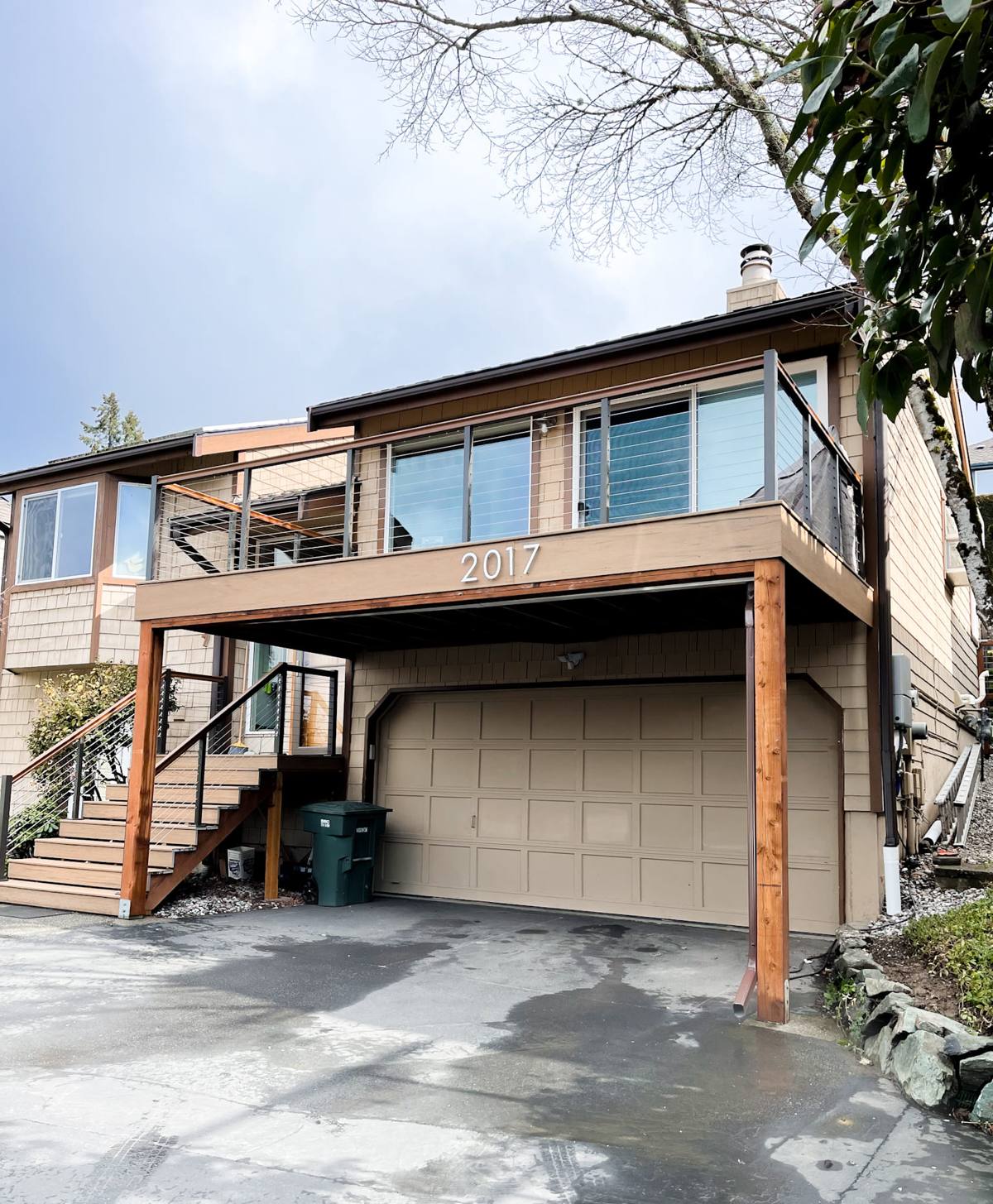
Signs a Deck Needs Repair — Not Just a New Board
Homeowners usually call us about one obvious problem — a spongy board, a wobbly rail — but a proper inspection almost always turns up related issues nearby, because the conditions that damaged one area are present everywhere on the deck. Before you decide a repair is "just cosmetic," walk the deck and check for these:
- Decking boards that feel soft, spongy, or flex more than boards next to them
- Any board where you can push a screwdriver into the wood without much resistance
- Rust streaks bleeding out from screw heads or around joist hangers
- A ledger board (where the deck attaches to the house) that looks discolored, swollen, or has gaps behind the flashing
- Railings or posts that move more than they should when pushed firmly
- Persistent moss or algae growth in the same spots after every cleaning
- Stair stringers or the areas around footings that look darker or feel damp long after the last rain
- Gaps opening up between decking boards, or boards cupping (edges higher than the center)
Any one of these can be a simple fix. Several of them together, especially around the ledger board or support posts, usually mean the framing underneath needs attention, not just the visible decking.
What a Correct Deck Repair Actually Involves
Structural framing first
The decking boards are the part you see, but the joists, beams, posts, and ledger connection are what keep the deck safe. A repair that replaces surface boards over compromised framing is a repair that will need to be redone, sooner rather than later. We check framing for soft spots, undersized or corroded connectors, and any post or footing that's shifted or settled — settling is more common on lots with poor drainage, which shows up in low-lying and waterfront areas around Birch Bay.
The ledger board and flashing
This is where most serious deck failures start, because it's the one connection point where the deck meets the house and water has the most opportunities to get trapped. Correct ledger flashing sheds water away from the house rather than letting it pool behind the board. If the original flashing was missing, undersized, or improperly lapped, we address that as part of the repair — patching decking while leaving bad ledger flashing in place just delays the real problem.
Fasteners and hardware
In a salt-air environment, fastener choice matters more than it does inland. We use hardware rated for coastal and treated-lumber exposure — stainless steel or heavy hot-dip galvanized, matched correctly to whatever decking and framing material is involved, since mixing incompatible metals accelerates corrosion at the connection point.
Guardrails and code compliance
Any rail or stair repair is a chance to confirm the structure actually meets current guardrail height, baluster spacing, and stair rise/run requirements. Older Whatcom County decks are sometimes grandfathered under codes that have since tightened, and once a rail is opened up for repair, it's worth bringing it up to current standards rather than reinstalling the same configuration.
Repair or Replace? What Actually Drives That Decision
Not every damaged deck needs to come down. The honest answer depends on how much of the structure is affected and how old the deck already is. Here's how we think through it:
| Factor | Leans Toward Repair | Leans Toward Replacement |
|---|---|---|
| Extent of rot/damage | Isolated boards, one post, or a rail section | Rot found at multiple framing members or the ledger board |
| Age of the deck | Under 15–20 years, built to a reasonable spec | Older deck already near the end of typical service life |
| Foundation/footings | Footings solid, posts plumb | Footings undersized, shifted, or below current code |
| Ledger connection | Flashing intact, minor gaps | Missing or failed flashing with water damage behind it |
| Budget goal | Extend usable life a number of years | Want a longer-term, lower-maintenance surface (e.g., composite) |
We'll tell you plainly which category your deck falls into. A repair that only addresses the symptom while the ledger or footings stay compromised isn't a favor to you — it's a deck that fails again in a year or two.
Our Birch Bay Deck Repair Process
- On-site inspection — we walk the full deck, check the framing from underneath where accessible, probe suspect boards, and inspect the ledger and post connections.
- Written scope — you get a clear explanation of what's failing, what's still sound, and what the repair covers, in plain language.
- Demo of the affected area only — we remove what needs to come out without disturbing sound structure around it.
- Framing and flashing repair — any compromised joists, posts, or ledger flashing get corrected before new decking goes down.
- Refastening with coastal-rated hardware — matched to the decking material and framing.
- Rail and stair check — confirmed secure and brought up to current code where the repair touches them.
- Final walkthrough — we point out anything worth keeping an eye on and talk through basic maintenance for your specific setup.
Materials: Matching the Repair to the Exposure
What we use to repair a deck depends on what's already there and what the specific spot is exposed to.
Pressure-treated lumber
Still the standard for framing repairs — joists, beams, posts — because it's rated for ground and weather contact and it's straightforward to match to existing framing dimensions. The trade-off is that it needs periodic sealing to perform well long-term, especially with Whatcom County's rain volume.
Composite and PVC decking for surface repairs
When the decking surface itself is failing repeatedly, composite or PVC boards are worth considering for the replaced sections — they don't absorb moisture the way wood does, which matters directly in a moss-prone, high-rainfall area, and they don't need refinishing. The trade-offs are a higher upfront cost per board and the fact that composite requires correct spacing and fastening (hidden fastener systems, proper gapping) to perform as intended — installed wrong, it can trap moisture just like anything else.
Real cedar
Still chosen by homeowners who want the look and are willing to keep up with sealing and cleaning on a regular schedule. It's a reasonable choice for a repair when it matches an existing all-cedar deck, but it's the highest-maintenance option in this climate.
We don't push one material over another as a default. We'll walk you through what fits the repair, your maintenance appetite, and your budget — including the honest maintenance commitment each option carries.
Keeping a Repaired Deck Ahead of the Climate
A good repair buys you years, but only if a few basic habits go with it:
- Sweep debris and standing organic matter off the deck regularly — it's what feeds moss growth
- Keep gutters and downspouts clear so runoff isn't dumping extra water onto or near the deck
- Reseal wood decking on the schedule appropriate for the product — don't wait until it's visibly graying
- Check under the deck once or twice a year for standing water or poor drainage around footings
- Address a soft board or loose rail as soon as you notice it, before it spreads to neighboring framing
Why a Crew That Already Works Birch Bay Matters
Deck repair isn't a one-size-fits-all trade. A crew that works regularly in Birch Bay and the surrounding Blaine area already knows what salt exposure does to fasteners over a five-year span, has seen how driving rain finds its way behind ledger boards on this coastline, and understands the moss cycle here well enough to repair a deck in a way that actually holds up to it — not just a generic repair pulled from a national playbook. We're also close enough to respond promptly if something needs a second look after the repair, and we're familiar with Whatcom County permitting requirements for structural deck work, which keeps the project from stalling on paperwork.
If you've got a deck in Birch Bay that's showing any of the signs above, we're happy to take a look and give you a straightforward assessment — no pressure, no upsell, just an honest read on what it needs. Use the form below to request a free estimate.