 Blaine Siding
 Why Roofs in Semiahmoo Wear Differently
Semiahmoo sits right on the water, and that changes what a roof has to deal with compared to a home a few miles inland in Blaine or elsewhere in Whatcom County. Salt-laden air off Semiahmoo Bay is corrosive to exposed metal — fasteners, flashing, drip edge, and vent hoods all take more abuse here than they would on a house set back from the shoreline. Add wind-driven rain, which doesn't just fall straight down but gets pushed sideways and upward under shingle edges and around penetrations, and you have a roof system that's being tested in ways a standard install doesn't always account for.
Then there's moss. Whatcom County's mild, wet winters and springs give moss a long growing season, and Semiahmoo's tree cover and shaded, north-facing slopes make it worse. Moss isn't just cosmetic — it holds moisture against the roofing material, lifts shingle edges, and creates channels for water to work its way under the surface. On a coastal property, you're layering moss growth on top of salt corrosion and wind-driven rain, and that combination shortens the life of a roof that wasn't built or installed with these conditions in mind.
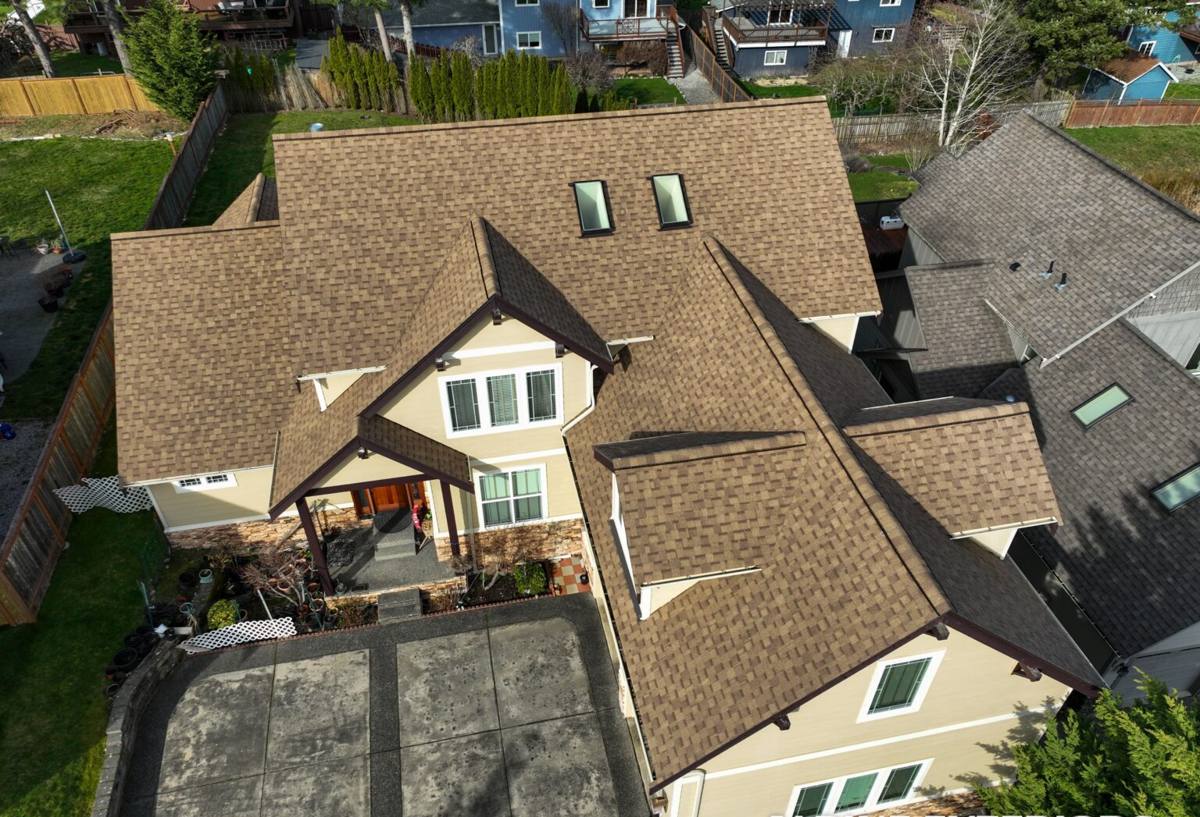
What a Correct Roof Replacement Actually Involves
A roof replacement is more than stripping old material and nailing down new shingles. Done right, on a home exposed to Semiahmoo's conditions, it means paying attention to details that get skipped on a lot of standard jobs.
Tear-off and deck inspection
Every layer of old roofing comes off so we can actually see the deck. Plywood or plank sheathing that's been sitting under a leaking or moss-choked roof often has soft spots, rot, or delamination that won't show up until the old material is gone. Any damaged decking gets replaced before anything new goes down — covering over a compromised deck just hides the problem for a few years.
Underlayment built for wind-driven rain
On a waterfront-exposed property, we don't rely on standard felt alone. Self-adhered, ice-and-water-style membrane at eaves, valleys, roof-to-wall transitions, and around every penetration gives you a sealed layer that resists the kind of sideways-driven moisture Semiahmoo gets during a winter storm off the bay.
Corrosion-resistant fasteners and flashing
Standard electroplated fasteners can start showing rust streaks within a few years in a salt-air environment. We use stainless steel or hot-dip galvanized fasteners and flashing metal on coastal jobs, because replacing a roof only to have the nails and flashing corrode early defeats the point of a new roof.
Drip edge and flashing details
Flashing at chimneys, skylights, dormers, and valleys is where most roof leaks actually start — not in the open field of shingles. We pay close attention to these transitions because they're the first place wind-driven rain finds a way in.
Choosing a Roofing Material for Salt Air and Moss
There's no single "best" roofing material for every home — it depends on your budget, your roof's pitch and shading, and how much maintenance you're willing to keep up with. Here's how the common options compare for a Semiahmoo-type exposure:
| Material | Salt Air Performance | Moss Resistance | Typical Maintenance |
|---|---|---|---|
| Architectural asphalt shingle | Good, with corrosion-resistant fasteners/flashing | Moderate — needs periodic cleaning on shaded slopes | Low to moderate |
| Standing seam metal | Very good, with marine-grade or coated panels | Very good — moss struggles to grip smooth metal | Low |
| Cedar shake | Fair — needs regular treatment near salt air | Poor without upkeep — wood holds moisture | High |
| Synthetic/composite shingle | Good — doesn't corrode | Moderate | Low |
We're honest with clients about trade-offs rather than pushing one product for everyone. Cedar shake can look great on the right home, but it's a real maintenance commitment in a wet, mossy climate, and we'll say so up front. Metal costs more initially but sheds moss and handles salt exposure better than almost anything else, which matters more the closer a home sits to the water.
Our Roof Replacement Process
Here's what to expect when you work with us on a Semiahmoo roof replacement, start to finish:
- On-site inspection and honest assessment of whether you need a full replacement or targeted repairs
- Written estimate covering material options, scope, and timeline
- Permit pulled through the appropriate local building department before work starts
- Full tear-off of old roofing material and disposal
- Deck inspection, with any rotted or delaminated sheathing replaced
- Installation of storm-grade underlayment and corrosion-resistant flashing
- New roofing material installed to manufacturer specification
- Ventilation check and correction if intake or exhaust venting is inadequate
- Job-site cleanup, including magnetic sweep for stray fasteners
- Final walkthrough so you can see the finished work before we call it done
We don't skip the boring steps because they're the ones that determine whether a roof actually holds up to another decade of Semiahmoo weather.
Ventilation and Moss Control
A new roof with poor attic ventilation will still trap moisture, which shows up as premature aging from the underside and can accelerate moss growth on the surface as the roof deck stays cooler and damper than it should. Balanced intake and exhaust venting — soffit vents pulling air in, ridge vents letting it out — keeps the attic and roof deck closer to outdoor temperature and humidity, which matters in a climate where moisture is nearly constant for months at a time.
For moss specifically, we'll talk with you about zinc or copper strips near the ridge, which release trace amounts of metal ions that discourage moss regrowth as rainwater washes over them. It's not a substitute for occasional cleaning on heavily shaded slopes, but it reduces how often that cleaning needs to happen. If overhanging branches are keeping a section of roof shaded and damp most of the year, we'll flag that too — sometimes the best moss prevention has nothing to do with the roofing material itself.
Signs Your Semiahmoo Roof May Need Replacing
Not every roof problem means a full replacement — sometimes a repair is the right call. But a few signs point toward the roof being past the point where patching makes sense:
- Granules collecting in gutters or downspouts, especially after wind events
- Shingles that are curling, cracking, or missing entirely
- Moss that keeps coming back within a season or two of being cleaned off
- Soft or spongy spots when walking the roof
- Daylight visible through the roof deck from inside the attic
- Rust staining on flashing, vent boots, or exposed fasteners
- Interior ceiling or wall stains that show up after a wind-driven rainstorm
- An asphalt shingle roof that's 20+ years old, regardless of surface appearance
If you're seeing more than one or two of these, it's worth having someone look before the next storm off the bay finds the weak spot for you.
What Affects the Cost of a Roof Replacement
Every roof is priced based on its own specifics, but these are the factors that move the number most:
| Factor | Why It Matters |
|---|---|
| Roof size and pitch | More surface area and steeper slopes both increase labor and material |
| Number of existing layers | Tearing off multiple old layers takes more time and disposal cost than one |
| Deck condition | Rot or soft sheathing found during tear-off adds repair cost before install |
| Material choice | Asphalt, metal, cedar, and composite all carry different material and labor costs |
| Roof complexity | Valleys, dormers, skylights, and chimneys all add flashing detail and time |
| Site access | Waterfront lots, steep driveways, or limited staging space can affect logistics |
We give a written estimate after seeing the roof in person, not a phone-quote guess. That's the only way to price in things like deck repair or access challenges honestly.
Why Hire a Crew That Already Works in Semiahmoo
A roofing crew that mostly works inland doesn't always think about salt-air fastener corrosion or wind-driven rain at flashing details until it's already a callback. Working Semiahmoo regularly means we already build those details into the plan instead of treating them as an upgrade. We're familiar with the local permitting process through the county and the city of Blaine, we know how moss patterns tend to run on wooded, waterfront lots in this area, and we understand how wind off the bay behaves differently than wind on a sheltered inland property.
That local familiarity also means fewer surprises during the job — we're not guessing at how a coastal roof in this specific area holds up over time, we're applying what we've already seen work here. And because we're local, warranty follow-up and any questions after the job don't mean waiting on a crew that has to drive in from out of the area.
Get a Straightforward Estimate
If your roof is showing wear from salt air, wind-driven rain, or persistent moss, we're happy to take a look and give you an honest read on whether you need a full replacement or something less. Fill out the form below for a free, no-pressure estimate on your Semiahmoo home.