 Blaine Siding
 Roofing in Everson: What Whatcom County Weather Actually Does to a Shingle Roof
Everson sits inland from the coast but still gets the full weather pattern that defines this part of Whatcom County: a long wet season that runs from fall through spring, driving rain that comes in sideways during storm systems, and damp, moisture-laden marine air that moves through the whole region off the Salish Sea. None of that is dramatic on its own. The problem is duration. A roof here doesn't fail from one bad storm — it fails from years of shingles staying wet longer than they were designed to, freeze-thaw cycling in the shoulder seasons, and moss quietly working its way under tab edges while nobody's looking.
That combination is why a shingle roof that would last 25+ years in a dry climate can start showing real problems well before that out here if it wasn't installed with this climate in mind — or if it's gone too long without basic upkeep.
Why Moss Is the Long-Term Threat, Not the Storms
Wind and rain get the attention, but moss is what actually shortens roof life in this part of Whatcom County. Shaded, north-facing slopes and roofs near mature conifers stay damp longer after every rain, which is exactly what moss needs to establish. Once it takes hold, moss holds moisture directly against the shingle mat, works into the gap under tab edges, and gradually lifts them — which is what lets wind-driven rain get underneath instead of running off. It's a slow process, which is exactly why it's easy to ignore until a soft spot or a stain shows up on a ceiling.
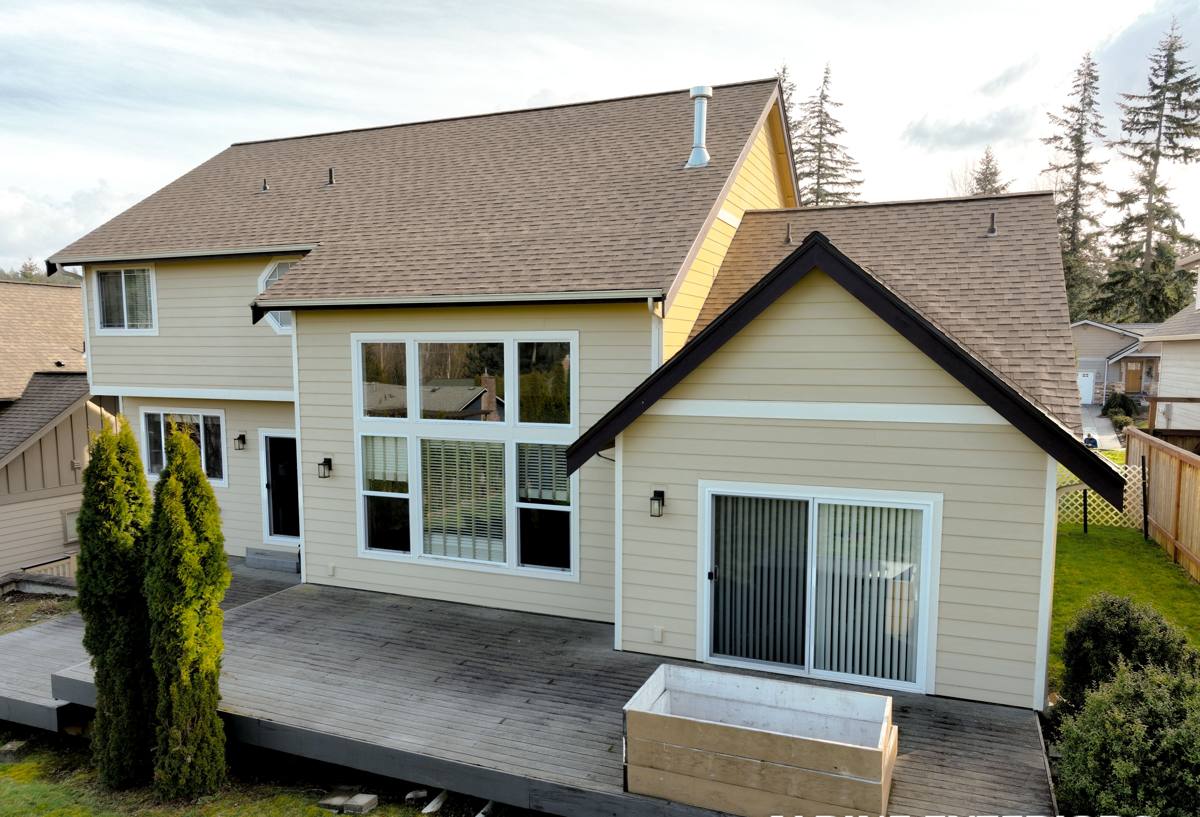
What a Correct Asphalt Shingle Roof Installation Actually Includes
Asphalt shingles look like a simple product, but a roof is a system — the shingle is just the visible top layer. Skipping or shortcutting any of the layers underneath is how a roof ends up leaking years before it should, even with good shingles on top.
Deck Inspection and Repair
Before anything new goes down, the deck underneath needs to be sound. Soft, delaminated, or water-stained sheathing gets replaced, not covered up. This is the step that's easiest to skip and the most expensive to skip wrong — nailing new shingles over a compromised deck doesn't hold, and it hides a problem instead of fixing it.
Underlayment and Ice-and-Water Protection
A synthetic underlayment goes down as the roof's real waterproof barrier, with self-adhering ice-and-water membrane at the vulnerable points — eaves, valleys, and around any roof penetration. In a climate with this much sustained rain, that membrane is what keeps water out if wind ever drives rain up under a shingle edge.
Ventilation
Balanced intake at the eaves and exhaust at the ridge keeps the attic close to outdoor temperature and lets moisture escape instead of condensing against the underside of the deck. Poor ventilation is a quiet cause of premature shingle failure and rot that has nothing to do with the roofing material itself.
Flashing and Edge Detail
Step flashing at walls, counter-flashing at chimneys, and properly lapped valley metal matter more in a wet climate than almost anything else on the roof. Flashing failures — not worn-out shingle fields — are behind most of the leaks we're called out to diagnose.
Choosing the Right Shingle for This Climate
Not every asphalt shingle performs the same way once moss, moisture, and wind are part of the picture year after year. Here's how the common options compare for a home in this area.
| Shingle Type | Typical Lifespan | Wind Rating | Algae/Moss Resistance | Best Fit |
|---|---|---|---|---|
| 3-tab | 15–20 years | Lower | Standard granules only | Budget-driven projects, simple roof shapes |
| Architectural/laminate | 25–30 years | Higher | Available with algae-resistant granules | Most homes in this climate — better wind and moisture performance |
| Impact-resistant/premium laminate | 30+ years | Highest | Algae-resistant granules standard | Exposed roofs, homes wanting maximum service life |
For most Everson homes, an architectural shingle with algae-resistant (usually copper-infused) granules is the right balance — the added upfront cost over 3-tab is modest, and the moss and streak resistance directly addresses the biggest local wear factor. Copper granules don't make a roof moss-proof, but they measurably slow regrowth compared to standard granules, which stretches the time between treatments.
Signs Your Everson Roof Is Telling You Something
Most roof problems give warning signs well before there's an active leak. Worth checking for, especially after storm season:
- Moss visible on the roof surface, especially on shaded or north-facing slopes
- Granules collecting in gutters or at downspout outlets
- Shingle edges that look curled, cupped, or lifted
- Dark streaking that doesn't wash off with rain (algae staining)
- Soft spots underfoot or visible sagging along the roofline
- Daylight visible through the attic sheathing
- Water stains on interior ceilings or in the attic near penetrations
- Missing or cracked shingles after a windstorm
Any one of these is worth a look. Several at once usually means it's time for a real inspection rather than a patch.
Our Process, Start to Finish
Inspection and Honest Assessment
We start on the roof, not with a sales pitch — checking the deck, the flashing, the ventilation, and the shingle condition to figure out whether the home needs a full replacement, a repair, or just maintenance. We'll tell you if a repair is genuinely the right call instead of pushing a full roof.
Written Estimate
You get a clear, itemized estimate that spells out material, scope, and price before any work is scheduled — no vague allowances or surprise add-ons discovered mid-job.
Tear-Off and Deck Check
Old material comes off down to the deck so it can be inspected directly, not assumed to be fine underneath. Any damaged sheathing is flagged and replaced before new material goes down.
Installation
Underlayment, ice-and-water membrane, flashing, and shingles go in per manufacturer specification — not a shortcut version of it. This is what keeps the manufacturer's warranty valid and keeps the roof performing the way it's supposed to for the length of its rated life.
Cleanup and Walkthrough
Job site is cleared of debris and swept for nails, and we walk the finished roof with you so you know exactly what was done and what to expect going forward.
What Affects the Cost of a Shingle Roof Replacement
There's no single price for a roof — it depends on a handful of specific factors that vary from house to house. Here's what actually moves the number.
| Factor | Why It Matters |
|---|---|
| Roof size and pitch | More square footage and steeper pitches mean more material and more labor time |
| Number of existing layers | Tear-off of multiple old layers costs more than a single-layer removal |
| Deck condition | Rotted or delaminated sheathing found during tear-off adds repair cost |
| Shingle tier chosen | 3-tab, standard architectural, and premium laminate carry different material costs |
| Roof complexity | Valleys, dormers, skylights, and multiple chimneys all add labor and flashing work |
| Access and site conditions | Steep lots, tight setbacks, or limited staging area can affect labor time |
An accurate number only comes from seeing the actual roof — anything quoted without an inspection is a guess, and guesses are how homeowners end up with mid-project surprises.
Maintenance Between Roof Replacements
A well-installed shingle roof still needs periodic attention in this climate, especially where moss is a factor. Gutters and valleys should be cleared of needles and debris at least once a year so water has somewhere to go instead of backing up under shingle edges. Roofs with a history of moss benefit from a gentle moss treatment on a regular cycle, applied in a way that doesn't strip granules or damage the shingle surface. Overhanging branches that keep a roof shaded and damp are worth trimming back where practical, since sunlight and airflow are two of the simplest things working against moss growth.
Why Hire a Crew That Already Works in Everson
A roofer who works this part of Whatcom County regularly already knows which slopes hold moisture longest, which shingle products actually hold up to a marine-influenced climate versus which ones just look good on a spec sheet, and how local permitting and inspection expectations work. That's different from a crew passing through the area for one job. It shows up in the details — how flashing is handled at a valley that stays wet most of the year, or which ventilation setup actually keeps an attic dry through a Pacific Northwest winter — the details that don't show up on a shingle sample but decide how long the roof actually lasts.
If your roof is showing moss, granule loss, curling edges, or you just haven't had it looked at in a few years, we're glad to come take a straightforward look. There's no cost and no pressure for a free estimate — just an honest read on where your roof actually stands and what, if anything, it needs.