 Blaine Siding
 Why Composite Decking Makes Sense for Dakota Creek Homes
Homes in the Dakota Creek area sit close enough to the water that salt-laden air is a fact of daily life, not an occasional nuisance. Add the Pacific Northwest's driving, wind-blown rain and a moss season that can stretch from fall through spring, and you've got a climate that is genuinely hard on outdoor wood surfaces. A deck here isn't just exposed to sun — it's exposed to months of standing moisture, salt corrosion on metal parts, and shaded, cool conditions that never really let anything dry out completely.
Composite decking, installed correctly, holds up to that combination better than solid wood does. It doesn't need annual staining or sealing, it resists cupping and splintering from repeated wet-dry cycles, and it gives us more consistent, predictable results board to board. That said, "composite" isn't a magic word — the material still has to be matched to this climate and installed by people who understand what salt air and constant moisture do to a structure over years, not just what a deck looks like on install day.
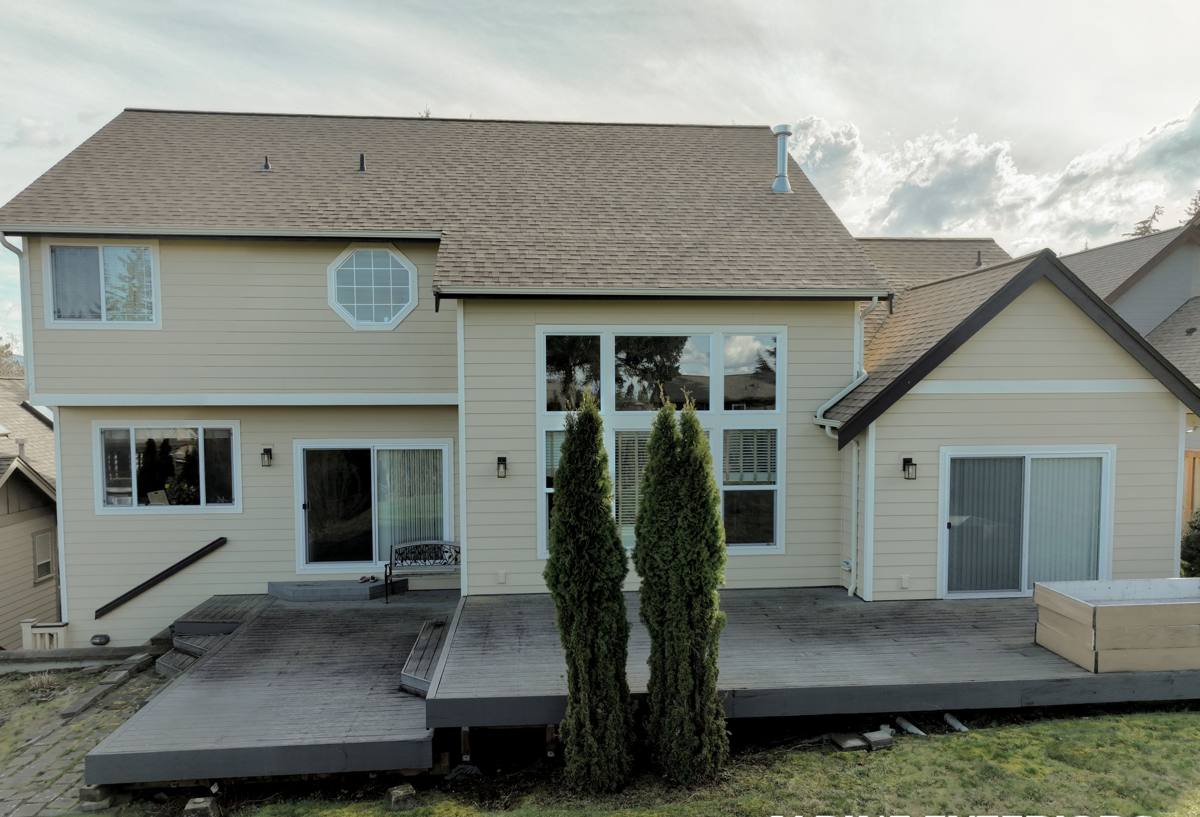
What Salt Air, Rain, and Moss Actually Do to a Deck
Three things wear on decks in this part of Whatcom County, and they don't act alone — they compound each other.
Salt air accelerates corrosion on any exposed metal — fasteners, brackets, hardware — and that corrosion doesn't stay put. Rust streaks bleed into decking boards and railings, and a fastener that's weakening structurally often shows no visible sign until it fails. Driving rain doesn't just fall straight down here; wind pushes it sideways into ledger connections, end grain, and any gap where water can get behind a board instead of running off it. That's how rot starts from the inside of a structure while the surface still looks fine. Moss and algae need organic material and sustained moisture to establish, and a shaded, cool deck near Dakota Creek can stay damp for days after a storm passes. Once moss gets a foothold on a walking surface, it's not just unsightly — it's a slip hazard.
None of these three problems is solved by decking material alone. They're solved by design and installation decisions — flashing, fastener selection, airflow, and drainage — that happen mostly out of sight.
Composite vs. Wood vs. Uncapped Composite: An Honest Comparison
There's no single "best" decking material for every budget and every home. Here's how the common options actually compare for a coastal, high-moisture site like this one.
| Factor | Pressure-Treated Wood | Uncapped Composite | Capped Composite |
|---|---|---|---|
| Moisture absorption | High — swells, cups, and checks with wet/dry cycles | Low, but the exposed core can still absorb some moisture and stain | Very low — the cap sheds water and resists staining |
| Maintenance | Annual cleaning, sealing/staining to prevent rot | Periodic cleaning; more prone to surface fading and mold in shaded spots | Occasional washing; no staining or sealing needed |
| Fastener/hardware needs | Standard exterior fasteners, still vulnerable to salt corrosion | Coated or stainless fasteners recommended | Coated or stainless fasteners recommended |
| Typical upfront cost | Lowest | Mid-range | Highest |
| Realistic lifespan in this climate | Shorter without consistent upkeep | Moderate | Longest, with proper installation |
For most Dakota Creek homeowners we talk to, the deciding factor isn't which material looks nicest in a sample rack — it's how much upkeep they're willing to commit to over the next 15-20 years, and how much of that upkeep the material can shed on its own given how wet this area stays.
What a Correct Composite Deck Installation Involves
Composite boards get most of the attention, but the installation details underneath them determine whether that investment lasts. A correct install here includes:
Ledger flashing done right
The ledger board — where the deck attaches to the house — is the single most common source of hidden water damage on any deck, composite or wood. Proper flashing, tied into the house's existing weather barrier, keeps wind-driven rain from working its way behind the connection and into the framing or the house wall itself.
Joist spacing and joist protection
Composite boards typically require tighter joist spacing than solid wood to avoid flexing or deflection over time — manufacturer specs vary by product, and we follow them rather than treating composite as a drop-in wood replacement. We also run joist tape over the top of the framing, which stops moisture from wicking down into the wood substructure through screw penetrations.
Fastener selection
In a salt-air environment, standard fasteners corrode faster than the deck around them ages. We use stainless or coated fasteners rated for coastal exposure, and where the board profile allows it, hidden fastener systems that also reduce the number of penetration points in the board surface.
Gapping for expansion
Composite boards expand and contract with temperature and moisture more than people expect. Correct gapping between boards prevents buckling in wet weather and unsightly gaps when things dry out.
Substructure, Fasteners, and Flashing — the Parts You Don't See
The visible decking is maybe a third of what actually determines how a deck performs near the water. The substructure matters just as much, especially on lower decks or ones close to grade where airflow is limited. We look at whether the framing lumber is properly rated for ground or near-ground exposure, whether there's enough clearance and ventilation underneath for the structure to dry out between rain events, and whether drainage around the footings directs water away from the deck rather than letting it pool. On sites near Dakota Creek where the water table can sit higher, that drainage planning matters more than it does on a dry inland lot.
We also inspect and upgrade ledger and rim joist flashing on replacement projects, even when the homeowner only asked about new boards — reusing an old, failing flashing detail under brand-new composite decking just moves the same water problem one layer deeper.
Our Process for Dakota Creek Deck Projects
Every project starts with a site walk, not a sales pitch. We look at sun exposure, tree cover, proximity to water, existing drainage patterns, and the condition of anything we'd be building on or attaching to. From there:
- We confirm permitting requirements with the City of Blaine or Whatcom County, depending on the property, before any work begins.
- We review board options and fastener systems suited to the site's actual exposure — a heavily shaded, close-to-water lot gets different recommendations than an open, sunnier one.
- We handle demolition of any existing structure, checking the framing and ledger connection for hidden rot before building on top of it.
- We install substructure, flashing, and joist protection first — the parts that determine longevity — then the decking itself.
- We walk the finished deck with the homeowner and go over basic care specific to this climate, not a generic manufacturer pamphlet.
Living With Composite Decking Through a Long Moss Season
Composite decking cuts down on maintenance dramatically compared to wood, but "low-maintenance" isn't "no-maintenance" — especially with the moss and algae pressure this area sees for much of the year. A little regular attention goes a long way:
- Sweep debris and organic buildup off the deck regularly, especially in shaded corners where leaves and needles collect
- Wash with a soft-bristle brush and a cleaner approved for composite surfaces — avoid high-pressure washing directly into board grooves, which can force water and grime deeper rather than out
- Keep nearby vegetation trimmed back to let in more light and airflow, which slows moss and algae growth more than any cleaning product
- Check that gutters and downspouts near the deck are clear so runoff isn't draining directly onto or under it
- Do a fastener and board check each fall before the wet season sets in, and address anything loose before winter storms
- Rinse off salt residue after storms with heavy onshore wind, particularly on railings and hardware
Why Hiring a Crew That Already Works Dakota Creek Matters
A deck built to a generic spec sheet can still fail here if it isn't adapted to what this specific area does to a structure. Crews who regularly work Dakota Creek and the surrounding Blaine waterfront know which lots hold moisture longest, which board textures actually stay safe underfoot through a wet winter, and which fastener and flashing shortcuts show up as callbacks two or three years down the road — after the crew that cut corners is long gone. That local pattern recognition is hard to replace with a manual, and it's the difference between a deck that needs real work again in five years and one that's still solid at fifteen.
It also means warranty and service calls aren't a hassle. A company based in and around Blaine can actually show up if something needs a look, rather than routing you through a call center for a crew that built the deck and left the region.
If you're weighing composite decking for a home in the Dakota Creek area, we're glad to walk the site, look at your exposure and drainage, and give you a straightforward, no-pressure estimate — just fill out the form below.