 Blaine Siding
 Window Replacement Built for Nooksack's Weather, Not Just Its Openings
Replacing windows sounds like a simple swap — old unit out, new unit in. In practice, a window replacement job in Nooksack has to account for what Whatcom County weather actually does to a house over the course of a year: long stretches of driving rain, marine moisture that rolls in off the Salish Sea and settles into every shaded corner of a property, and a moss season that can run from fall through spring. Windows here aren't just letting in light and keeping out cold — they're one of the main seals standing between your framing and a climate that stays damp for months at a time.
A window that's rated fine for a dry inland climate can still fail early here if it's installed without the right flashing detail or air-sealing approach. That's the piece homeowners often don't see when they're comparing quotes: the window unit itself is only part of the job. The other part is how it's tied into the wall assembly so water has nowhere to go but back outside.
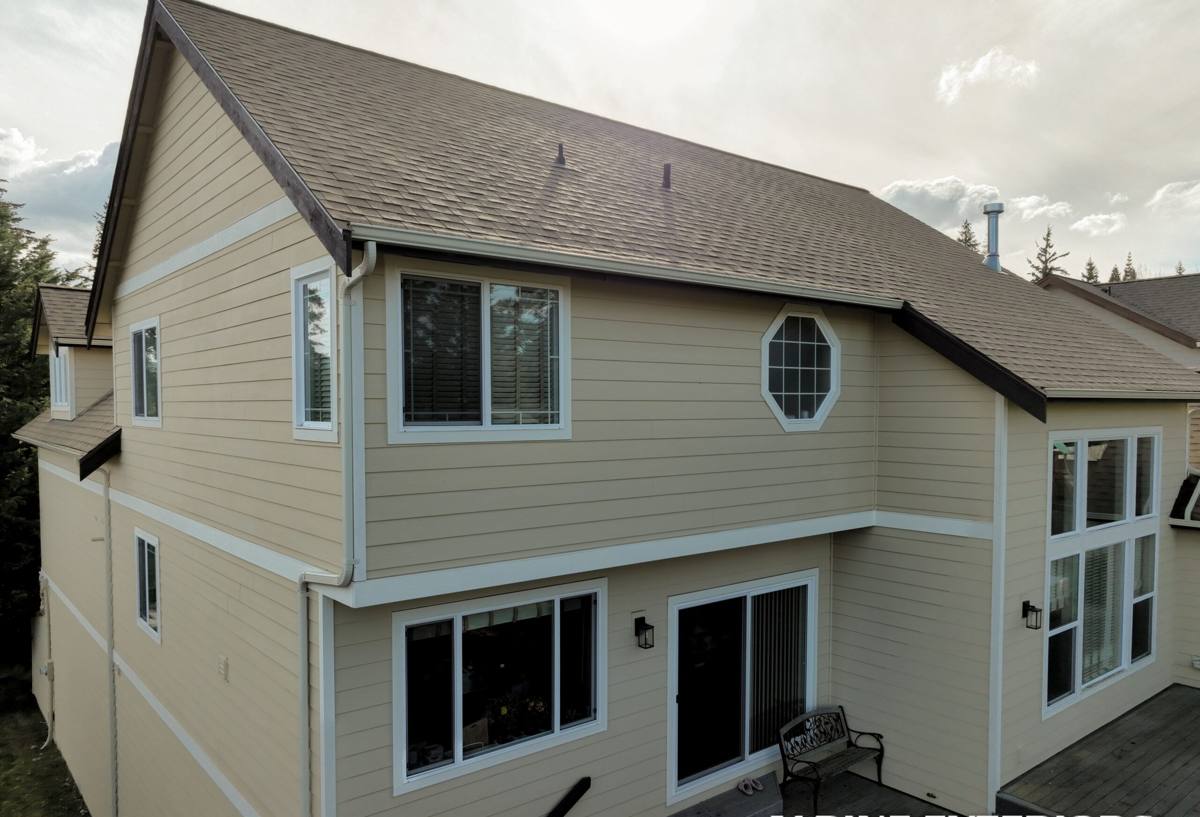
How Local Weather Wears Down Old Windows
Driving Rain and Wind-Driven Moisture
Whatcom County storms don't always fall straight down. Wind-driven rain pushes moisture sideways against window frames and can work its way behind trim and siding if the flashing or sealant has degraded. Over years, this shows up as soft wood at the sill, stained drywall below a window, or a frame that's slightly swollen and harder to open than it used to be.
A Long, Damp Moss Season
Moss doesn't just grow on roofs. On north-facing walls and shaded elevations, it can creep onto window trim and sills, holding moisture against the wood or vinyl far longer than a sunnier wall would ever see. That constant dampness accelerates rot in wood-framed windows and can degrade caulking and weatherstripping faster than the manufacturer's warranty assumes.
Marine Air and Temperature Swings
Even away from the immediate coastline, the marine influence off the Salish Sea keeps humidity elevated for much of the year in this part of Whatcom County. Combined with the region's daily and seasonal temperature swings, that moisture load puts real stress on seals, weatherstripping, and any hardware that isn't corrosion-resistant. Older aluminum-framed windows in particular tend to show pitting and stiff hardware well before homeowners expect it.
Signs a Nooksack Home Needs Window Replacement
Not every window problem means a full replacement — some issues are solved with re-caulking or hardware repair. But a few signs consistently point to windows that are past the point of a reasonable fix:
- Visible condensation or fogging between the panes, which means the seal has failed and can't be repaired
- Soft, discolored, or spongy wood at the sill or lower frame corners
- Windows that are difficult to open, close, or lock, especially after damp weather
- Noticeable drafts near the frame even when the window is fully latched
- Visible daylight or gaps around the frame from outside
- Moss or persistent green staining building up on the trim or sill
- A jump in heating costs without any other clear explanation
- Frames that are chalky, cracked, or separating from the siding around them
If you're seeing two or more of these, it's worth having someone look at the whole window — not just the glass — before deciding what to do.
What a Correct Window Replacement Job Actually Involves
Removal and Honest Inspection
Once the old window is out, that's the moment to actually look at the rough opening — the framing, the sheathing, and whatever flashing (or lack of it) was there before. This is where a lot of hidden rot from years of moisture intrusion gets found. A crew that rushes this step is setting the new window up to fail the same way the old one did.
Flashing and Water Management
This is the step that matters most in a climate like this one. Proper flashing directs any water that gets behind the siding back out and away from the framing, using a shingle-style layering — house wrap, then sill pan, then side and head flashing — so water always drains downward and outward, never toward the wall cavity. Skipping or shortcutting this step is the single biggest reason window replacements fail early in wet climates.
Insulation and Air Sealing
The gap between the new window frame and the rough opening needs to be sealed with a low-expansion foam or backer rod and sealant — not stuffed with fiberglass insulation alone, which does little to stop air movement. Done right, this step is a big part of why a replacement improves comfort and energy bills, not just appearance.
Installation and Finish Work
The window has to be set plumb, level, and square, shimmed correctly, and fastened per the manufacturer's instructions to keep the warranty valid. Exterior trim and caulking are finished last, matched to the surrounding siding so the house doesn't end up with an obvious patch where the old window used to be.
Choosing Windows That Make Sense for This Climate
There's no single "best" window for every home — the right choice depends on your budget, your home's age and style, and how much upkeep you want to take on. Here's how the common frame options actually compare for a wet, moss-prone climate like this one:
| Frame Material | Moisture Behavior | Maintenance | Typical Fit |
|---|---|---|---|
| Vinyl | Won't rot; handles damp conditions well | Low — occasional cleaning | Most homes; best value for the climate |
| Fiberglass | Very stable in moisture and temperature swings | Low | Homes wanting a stronger frame or larger openings |
| Wood | Attractive but vulnerable to rot without diligent upkeep | High — regular painting/sealing | Historic or period-style homes where the look matters most |
| Wood-clad | Wood interior, weather-resistant exterior cladding | Moderate | Homes wanting wood look inside with better outdoor durability |
| Aluminum | Prone to corrosion and condensation in wet, salty air | Moderate to high | Rarely our recommendation for this region |
We steer most Nooksack homeowners toward vinyl or fiberglass for the exterior-facing frame, simply because they hold up to this region's moisture load with the least amount of homeowner maintenance. If you want a wood interior look, a wood-clad unit gets you that appearance without leaving bare wood exposed to the weather outside.
Our Process, Start to Finish
- On-site assessment — we look at your existing windows, note any signs of rot or water intrusion, and measure each opening.
- Straightforward quote — you get a clear breakdown of window options and installed cost, with no pressure to decide on the spot.
- Scheduling around the weather — we plan installation days to minimize how long any opening sits uncovered.
- Removal and inspection — old windows come out and we check the framing before anything new goes in.
- Flashing, insulation, and installation — done in the order and manner outlined above, every time, not just when it's convenient.
- Finish work and walkthrough — trim, caulking, and a final check with you before we consider the job done.
- Cleanup — old windows and debris hauled away; we don't leave a mess behind.
What Affects the Cost
Every home is different, but the same handful of factors drive most of the cost variation we see on window replacement jobs in this area:
| Factor | Why It Matters |
|---|---|
| Number and size of windows | More openings and larger units mean more material and labor |
| Frame material | Vinyl is typically the most budget-friendly; fiberglass and wood cost more |
| Condition of the rough opening | Hidden rot found during removal adds repair work before the new window can go in |
| Glass package | Double-pane vs. triple-pane, and any low-E or gas-fill upgrades, change the price per unit |
| Access and second-story work | Harder-to-reach windows take more time and equipment |
| Trim and siding match | Custom trim work to match existing exterior finishes adds labor |
We'd rather walk your property and give you real numbers than throw out a broad range that doesn't mean much once we see the actual openings.
Why It Matters to Hire a Crew That Already Works in Nooksack
A window replacement crew that regularly works this part of Whatcom County has already seen what happens when flashing details get skipped in a climate this wet — because we've been called back to fix that exact problem in homes that weren't ours. That experience shapes how carefully we handle the water-management side of the job, not just the parts that are visible once the trim goes back on. It also means we're not guessing at what this area's rain, moss, and marine air will do to a given product over time — we've watched it happen, and we build accordingly.
Local also means accountability. If something needs a follow-up look after a hard winter storm, we're not far away and we're not hard to reach.
If your windows in Nooksack are showing their age — or you're just tired of the drafts and the condensation — we're happy to take a look and give you an honest read on what you actually need. Use the form below to request a free, no-pressure estimate.