 Blaine Siding
 Storm Damage That Doesn't Look Like Storm Damage
When people picture storm damage to a roof, they usually picture something dramatic: a tree limb through the decking, a whole section of shingles peeled back, a tarp on the news. That kind of damage is easy to spot and easy to act on. What we see more often on Nooksack-area homes is quieter and easier to ignore — a handful of shingles lifted at the tab by a hard gust, a ridge cap cracked from wind flex, flashing worked loose around a chimney or vent pipe, granules washed into the gutters after a heavy blow. None of it looks urgent from the ground. All of it is an open door for water.
Whatcom County storms rarely come as a single dramatic event. More often it's a string of fronts moving through over a few days, each one adding wind-driven rain at an angle that pushes water sideways under laps and flashing that a straight-down rain would never reach. A roof that's been fine for years can develop a leak after one bad week of weather, and the leak often shows up somewhere far from where the actual damage is, tracking down a rafter before it ever stains a ceiling.
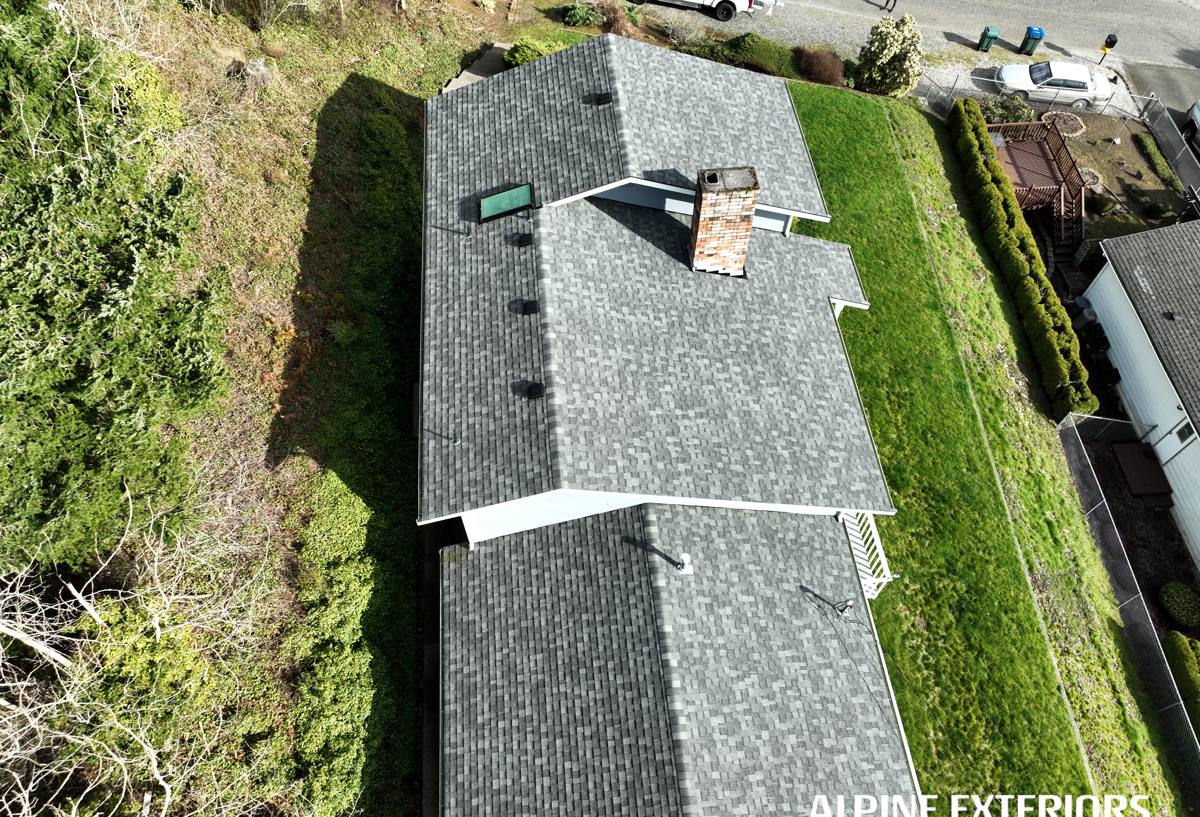
Why This Corner of Whatcom County Wears Roofs Down Faster
Blaine and the surrounding Nooksack-area communities sit right where three things stack on top of each other: salt-laden air off the coast, long stretches of wind-driven rain, and a moss season that runs longer here than it does further inland. Any one of those is manageable on its own. Together, they shorten the useful life of roofing materials and fasteners faster than a standard warranty timeline assumes.
- Salt air accelerates corrosion on exposed metal — nail heads, flashing, drip edge, and gutter hardware — which is often the first thing to fail even while the shingles themselves still look fine.
- Driving rain tests laps, seals, and flashing details in a way that vertical rain doesn't. A roof that would hold up fine somewhere with calmer weather can still leak here if those details weren't installed with wind-driven moisture in mind.
- Moss and moisture build up on north-facing slopes and shaded valleys for much of the year, holding damp against the shingle surface and working into any gap a storm has already opened.
None of this means Nooksack-area homes need exotic materials or constant work. It means storm repairs here have to account for what comes after the storm — not just patch the visible damage and move on.
What Actually Counts as Storm Damage
Homeowners often ask us to draw a clear line between storm damage and ordinary wear, especially when insurance is involved. In practice it's rarely a bright line — a storm usually finishes off something that was already weakening. Here's how we sort it out during an inspection:
Clear storm damage
Shingles physically torn, creased, or missing after a specific wind event; flashing bent or pulled loose; a limb or debris strike; granule loss concentrated on the windward slope right after a storm rather than spread evenly across the whole roof.
Wear that a storm exposed
Shingles that were already brittle from age and simply gave out under wind load; fasteners that had already backed out from years of thermal movement; flashing sealant that had already dried and cracked before the storm hit.
Both categories need repair. The distinction mostly matters for insurance purposes and for setting honest expectations — a storm can be the trigger without being the whole story, and we'll tell you plainly which is which rather than blaming every issue on the weather.
What a Correct Storm Damage Repair Involves
A repair that looks fine from the driveway but was rushed underneath is the most common reason homeowners end up calling someone twice for the same roof. Doing it right means working through the same steps every time, no matter how small the visible damage looks.
1. A full inspection, not just the reported spot
We check the whole roof, not only the area the homeowner points out. Wind damage on one slope often has a quieter twin on another slope that hasn't leaked yet. We look at flashing, vents, valleys, and the ridge along with the field of the roof.
2. Decking check before anything gets covered
If water has been getting in for any length of time, the decking underneath needs to be checked for soft spots or rot before new material goes down. Covering damaged decking with new shingles just hides the problem for another season.
3. Underlayment and flashing, not just shingles
Shingles are the visible layer, but the underlayment and flashing are what actually keep wind-driven rain out. A repair that replaces shingles but reuses old, cracked flashing or damaged underlayment is a repair that will need to be redone.
4. Matching the existing roof where it makes sense
For a partial repair, we match shingle profile, color, and exposure as closely as the original manufacturer's current lineup allows. Where an exact match isn't possible — which happens with older or discontinued shingle lines — we'll tell you upfront and talk through the options rather than let you discover a mismatched patch later.
Our Process, Start to Finish
Homeowners dealing with storm damage are usually stressed enough without also having to guess what happens next. Here's how a typical job runs:
- Call and initial questions — we ask what you're seeing (stains, missing shingles, a specific storm date) so we can prioritize the visit if there's active water intrusion.
- On-site inspection — we walk the roof and attic access where possible, document what we find, and explain it in plain terms.
- Written scope and estimate — what needs to be repaired, what materials are involved, and a straightforward cost range, before any work starts.
- Temporary protection if needed — if there's an active leak and a full repair can't happen immediately, we'll talk about interim protection to stop further interior damage.
- Repair work — decking, underlayment, flashing, and shingles addressed in that order, not just shingles on top of an unresolved problem underneath.
- Final walkthrough — we show you what was done and what to watch for going forward.
Repair or Replace? What Actually Tips the Decision
Not every storm-damaged roof needs full replacement, and not every roof that "just needs a patch" is actually a good repair candidate. The honest answer depends on a few factors working together, not any single one.
| Factor | Leans Toward Repair | Leans Toward Replacement |
|---|---|---|
| Age of roof | Under roughly 12-15 years, still within useful shingle life | Near or past the shingle's expected service life |
| Extent of damage | Isolated to one slope or a small area | Spread across multiple slopes or recurring in different spots |
| Decking condition | Solid, dry, no rot found | Soft spots or rot found during inspection |
| Shingle availability | Close match still manufactured | Discontinued line, visible mismatch unavoidable |
| Storm history | First significant damage in years | Repeated storm damage over recent seasons |
When a roof lands in the middle of that table, we'll walk you through the trade-offs rather than push toward the bigger job. A well-executed repair on a roof with useful life left is often the right call, and we'll say so even when replacement would be the larger invoice.
Working With Your Insurance Claim
Storm damage repairs often involve an insurance adjuster, and the process goes smoother when the documentation is thorough from the start. We photograph and describe damage in the terms adjusters actually use, provide a written scope that lines up with standard claim categories, and can meet an adjuster on-site if that's useful. We don't handle the claim itself — that's between you and your carrier — but we won't leave you guessing about what the damage actually involves or inflate a scope to chase a bigger payout. A straightforward, well-documented estimate tends to move faster through the claims process than a vague one.
Why a Crew That Already Works This Area Matters
Storm damage repair isn't just about roofing technique in the abstract — it's about knowing what this specific stretch of Whatcom County does to a roof over time. A crew that regularly works Nooksack-area and Blaine homes has already seen how salt air corrodes a particular flashing detail, which slopes tend to hold moss the longest, and where wind-driven rain typically finds its way in on local roof styles. That's not something you get from a general contractor passing through on a single job. It shows up in small decisions — which side of the roof gets extra attention, how flashing gets sealed against wind direction, what underlayment makes sense for a long moss season — that add up to a repair that actually holds.
What To Do Right After a Storm
If you suspect storm damage, a few simple steps in the first day or two make a real difference in how the repair goes and how smoothly any insurance claim moves:
- Check ceilings and attic spaces (if safely accessible) for new stains, drips, or damp insulation.
- Look at the ground around your home for shingle pieces, granules, or metal flashing debris.
- Take photos of any visible roof damage from the ground — don't climb up yourself.
- Note the date and general conditions of the storm for your records and any insurance claim.
- Cover any active interior leak with a bucket or tarp to limit damage while repairs are arranged.
- Call for an inspection promptly rather than waiting to see if it gets worse — small openings widen fast under repeated rain.
If you're in Blaine or the Nooksack area and dealing with roof damage after a storm, we're glad to take a look. Reach out for a free, no-pressure estimate using the form below — we'll inspect the roof, tell you honestly what we find, and lay out your options in plain terms.