 Blaine Siding
 Why Decks in the Sumas Area Wear Differently Than Decks Inland
If you've lived around Blaine for any length of time, you already know your house doesn't age the way a house forty miles inland does. The same is true for anything you build outside, and decks take it worse than almost anything else on the property. A deck sits low, holds moisture underneath it, and gets rained on, snowed on, and salted by sea air all at once. In the Sumas area, with Whatcom County's marine exposure feeding in salt-laden air and long stretches of driving rain, a deck that's built to a generic national spec starts showing problems years before it should.
Salt Air and Metal Fatigue
Salt air doesn't just affect railings and visible hardware — it gets into joist hangers, structural screws, and any fastener that isn't rated for the exposure. Standard zinc-coated fasteners can start showing surface corrosion within a few seasons this close to the water. Once a fastener corrodes, it loses holding strength long before it looks like a problem, which is part of why deck fastener choice matters more here than it does in drier, inland parts of the state.
Driving Rain and Standing Water
Blaine doesn't get gentle, straight-down rain most of the year — it gets wind-driven rain that pushes water sideways into ledger connections, under railing posts, and into any gap in the decking that isn't sealed or spaced correctly. A deck built without real attention to water management will trap moisture in exactly the spots you can't see: behind ledger boards, around post bases, and in framing that never fully dries out between storms.
Moss Season and Surface Wear
Whatcom County's moss season runs long, and a shaded deck near tree cover or a north-facing wall can stay damp for weeks at a time. Moss on a deck surface isn't just cosmetic — it holds moisture against the wood or composite surface, and on wood decking specifically, it accelerates surface decay and makes boards slick and dangerous underfoot.
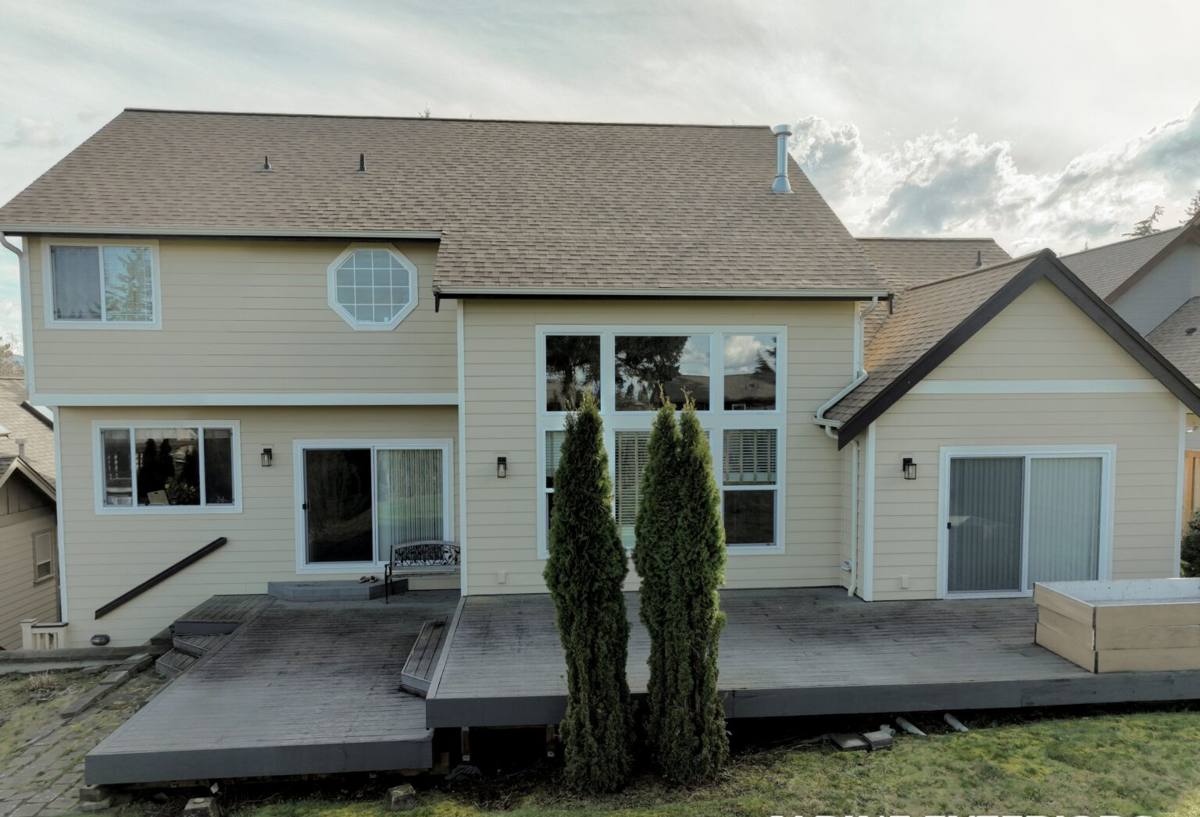
What a Correctly Built Deck Actually Requires Here
A lot of deck problems we get called out to fix in this area aren't design failures — they're water management failures. The build was structurally fine but never accounted for how much water this climate throws at a structure over a full year.
Ledger Board Flashing
The ledger board — where the deck attaches to the house — is the single most common failure point on decks in wet coastal climates. Done correctly, it includes proper flashing that sheds water away from the house band joist, not just a bead of caulk and some lag screws. Done incorrectly, it's one of the few deck mistakes that can lead to actual structural rot inside your wall framing, not just deck framing.
Footings Set for Wet, Shifting Ground
Ground conditions near Blaine can hold more moisture through the winter than homeowners expect, especially on lots with heavier clay content or poor natural drainage. Footings need to be set to the correct frost depth and on solid, well-compacted ground — not just poured to the minimum and called done. A footing that shifts even slightly over a few wet winters will telegraph into a bouncy, uneven deck surface.
Fastener and Hardware Selection
For this climate, we treat fastener and hardware selection as part of the structural decision, not an afterthought. Stainless steel or heavily coated, coastal-rated fasteners cost more up front than standard hardware, but replacing a corroded structural screw buried under decking is a much bigger job than paying the difference at build time.
Decking Material and Board Spacing
Board spacing has to account for wood movement and drainage, not just appearance. Too tight, and water sits on the surface and behind boards; too loose, and you get debris buildup that holds moisture against the framing below.
Comparing Decking Materials for a Salt Air, High-Moisture Climate
| Material | How It Handles This Climate | Maintenance Load | Honest Trade-Off |
|---|---|---|---|
| Pressure-treated wood | Good structural performance if properly sealed and re-coated on schedule | Highest — needs regular cleaning, moss treatment, and re-sealing | Lowest upfront cost, but ongoing upkeep is real and easy to fall behind on |
| Cedar | Naturally moisture- and insect-resistant, but surface still needs protection from moss and UV | Moderate to high — needs periodic cleaning and finish maintenance | Better look and feel than treated lumber, at a higher material cost |
| Composite decking | Resists moisture absorption and moss staining much better than wood surfaces | Low — periodic washing, no sealing or staining | Higher upfront cost; framing underneath still needs to be built and protected correctly |
| PVC/synthetic decking | Fully resists rot and moisture absorption in the decking itself | Lowest — occasional cleaning only | Highest material cost; framing and fasteners still determine long-term structural life |
Whatever surface material a homeowner chooses, it's worth understanding that the decking itself is only part of the equation. Composite and synthetic boards handle moss and moisture far better than wood, but if the framing, flashing, and fasteners underneath aren't built for this climate, the surface material won't save the structure.
Our Process for Deck Projects in the Sumas Area
Site Assessment
We start by looking at sun exposure, drainage patterns on the lot, and how close the deck will sit to grade or tree cover, since that tells us how much moss and moisture pressure the deck will actually face year-round.
Design and Material Discussion
We walk through material options honestly, including what each one will actually cost you in upkeep over ten or twenty years, not just what it costs to install. We'd rather you choose the option that fits your maintenance tolerance than upsell a product that doesn't match how you actually want to spend your weekends.
Permitting
Most deck builds in this area require a permit, particularly for structures above a certain height or attached directly to the house. We handle that process as part of the job so the structure is inspected and documented correctly.
Build, Flashing, and Inspection
Ledger flashing, footing depth, joist hanger installation, and fastener selection all get done to the same standard regardless of which decking material sits on top. We treat the framing and water management as the part of the job that determines how long the whole structure lasts.
What Deck Ownership Actually Looks Like in This Climate
No deck in a marine climate is maintenance-free, even composite and synthetic ones. Setting realistic expectations upfront saves homeowners frustration later.
- Sweep debris off the deck surface regularly, especially in fall — trapped leaves hold moisture against the boards
- Check for moss growth in shaded corners and along the house-facing edge each winter
- Inspect railing posts and stair connections annually for movement or loosening hardware
- Keep gutters and downspouts clear so roof runoff isn't dumping extra water onto or near the deck
- Reseal or re-stain wood decking on the schedule the product actually requires, not just when it looks faded
- Have ledger flashing and under-deck framing checked periodically, since that's the area least visible and most consequential if it fails
Why It Matters That Your Crew Already Works This Area
A crew that only occasionally works near the water tends to build to a generic spec because that's what they know. A crew that works the Sumas area and greater Blaine regularly builds differently by default — coastal-rated fasteners aren't an upsell, they're just what goes on the truck. Flashing details that matter here get done right the first time because we've seen what happens when they don't. And because we're local, a callback for a maintenance question or a warranty concern doesn't mean scheduling around a drive from somewhere else in the region.
Common Deck Problems We're Called to Fix in This Area
Most of the repair calls we get for decks near Blaine trace back to a handful of recurring issues: ledger boards flashed poorly or not at all, standard hardware corroding faster than expected in the salt air, decking installed without enough attention to drainage and spacing, and moss allowed to sit on wood surfaces long enough to start real surface decay. None of these are exotic problems — they're the predictable result of building a deck without accounting for this specific climate.
If you're planning a new deck or replacing one that's showing its age, we're glad to come take a look and talk through what makes sense for your home, your budget, and how much upkeep you actually want to take on. There's a free, no-pressure estimate form below — reach out and we'll walk the site with you.