 Blaine Siding
 Roof Repair Built for Lynden's Climate
Homes in and around Lynden deal with a specific combination of weather that's harder on roofs than most homeowners realize. Whatcom County sits under a marine layer that keeps things damp for much of the year, and that dampness doesn't just mean rain on the day it falls — it means roofs stay wet longer between dry spells, moss and moss spores have more time to take hold, and any small gap in flashing or shingles has more opportunities to let water in. Add in the salt-tinged air that moves inland off the Strait of Georgia and Puget Sound, and you've got a climate that quietly accelerates wear on fasteners, flashing, and exposed metal even when the roofing material itself still looks fine from the ground.
None of this means Lynden roofs are doomed to constant problems. It means roof repair here has to account for moisture cycling and organic growth in a way that repair work in a drier climate doesn't. A patch that would hold up fine in eastern Washington can fail here in a season if it doesn't address how water actually moves across a wet, moss-prone roof.
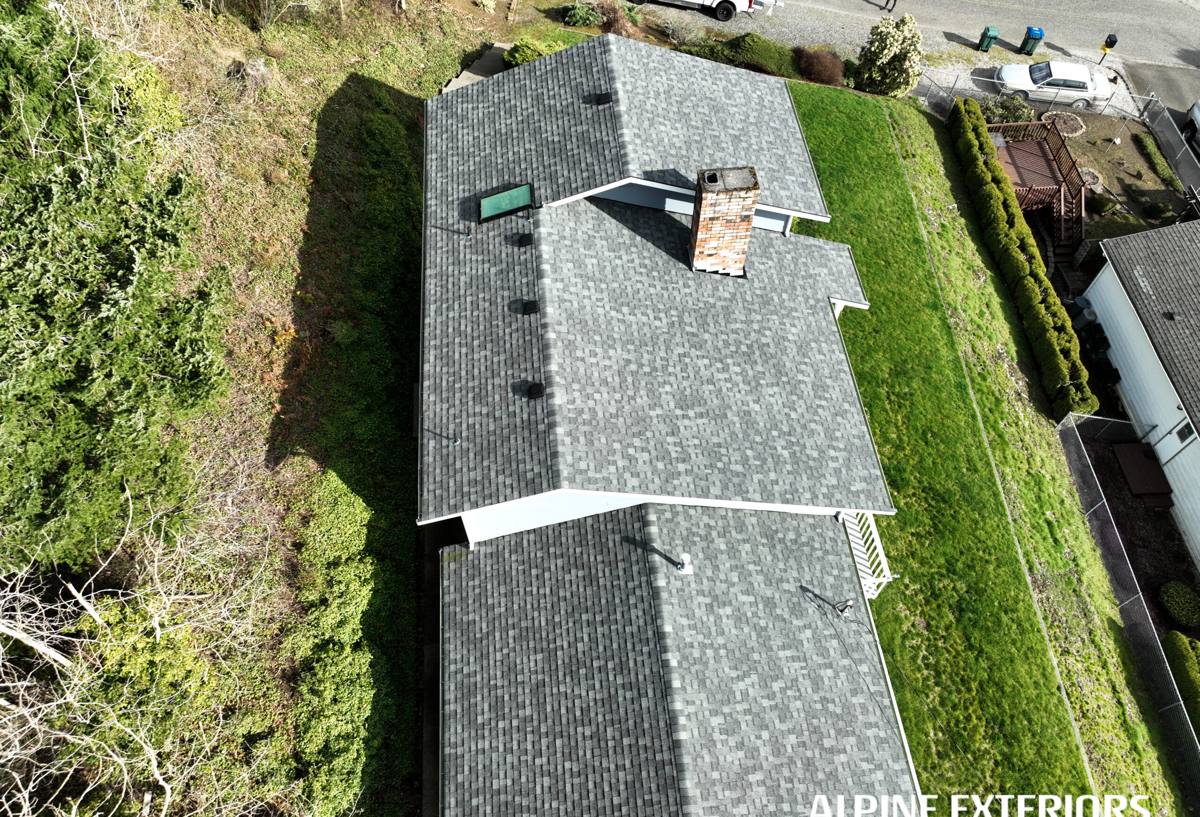
Signs a Lynden Roof Needs Repair, Not Just a Look
Because so much roof damage in this region starts small and hidden — a lifted shingle tab, a hairline gap in flashing, moss holding moisture against the deck — it's worth knowing what to watch for before a small issue becomes a ceiling stain.
- Dark streaking or green-black growth concentrated on north-facing slopes or shaded areas
- Granules collecting in gutters or at downspout outlets
- Shingles that look cupped, curled at the edges, or visibly out of alignment
- Soft or spongy spots when the roof is walked, or sagging visible from the ground
- Water stains on interior ceilings, especially near chimneys, skylights, or where roof planes meet
- Daylight visible through the attic roof deck, or damp insulation
- Rusted, lifted, or missing flashing around vents, chimneys, and valleys
- Gutters pulling away from the fascia or overflowing during normal rain
Any one of these on its own might be minor. Several at once, or one that's been ignored for more than a season, usually means water has already found a way past the surface layer.
What an Honest Roof Repair Actually Involves
Diagnosis Before Patching
A repair that only addresses the spot where water is showing up inside the house often misses where it's actually getting in — water can travel along rafters or sheathing before it drips somewhere visible. A correct repair starts by tracing the leak to its real entry point, which usually means checking flashing, valleys, and penetrations (vents, chimneys, skylights) before assuming the shingles themselves are at fault.
Clearing Moss and Debris the Right Way
Moss removal on an occupied roof has to be done carefully. Scraping moss off aggressively can lift or crack shingles that are otherwise still serviceable, and pressure washing can drive water under the shingle layer instead of removing it. We remove moss with methods that don't strip granules or force water beneath the roofing material, then treat the area to slow regrowth rather than just clearing what's visible that day.
Matching Materials, Not Just Covering the Hole
Replacement shingles, flashing, and underlayment should match the existing roof's material and, where possible, its wear pattern — a repair with mismatched or incompatible components can create a new weak point even if it stops the immediate leak. On older roofs, exact shingle matches aren't always available; we'll tell you honestly when that's the case rather than pretend a patch will be invisible.
Sealing and Flashing Detail Work
Most roof leaks in this climate trace back to flashing and sealant, not the field shingles. Valleys, chimney flashing, vent boots, and skylight curbs are where water is most likely to find a path, and they're the details most often rushed in a quick patch job. We rebuild these connections properly rather than relying on caulk or roofing cement as a long-term fix.
Common Repair Issues We See Around Lynden
Moss and Moisture Damage
Extended damp periods let moss establish on shaded or low-slope sections, and moss roots and moisture retention slowly degrade shingle granules and the mat beneath them. Left unaddressed, this turns a surface issue into deck-level rot.
Flashing and Fastener Failures
Repeated wet-dry cycling and salt-influenced air can accelerate corrosion on lower-grade metal flashing and fasteners faster than in drier inland climates. Once flashing rusts through or fasteners back out, wind-driven rain finds the gap.
Wind and Driving Rain Intrusion
Storms off the water bring rain at an angle, not straight down, which pushes water under shingle edges and around penetrations that would stay dry in a calmer rain. This is a common cause of leaks that only show up during specific storms rather than every time it rains.
Gutter and Edge Damage
Overflowing or sagging gutters send water back up under the roof edge (or down the fascia and into the wall assembly) instead of away from the house. Roof edge repair is often paired with gutter correction for this reason.
Repair or Replace? What Actually Determines the Answer
Not every roof problem calls for a full replacement, and not every leak is fixable with a patch. The honest answer depends on a handful of factors, not just the roof's age.
| Factor | Favors Repair | Favors Replacement |
|---|---|---|
| Roof age relative to material lifespan | Well within expected service life | Near or past expected lifespan |
| Extent of damage | Isolated to one section or detail | Spread across multiple slopes |
| Decking condition | Solid, no soft spots | Soft, delaminated, or rotted |
| Number of past repairs | First or second repair | Long history of patch after patch |
| Moss/moisture history | Caught early, limited spread | Chronic, recurring across seasons |
We'll always tell you which side of this table your roof falls on, including when a repair is genuinely the right call and replacement would be an unnecessary expense.
Our Roof Repair Process
- Inspection. We check the roof from both the exterior and, when accessible, the attic side to see whether moisture has already reached the deck or insulation.
- Diagnosis and explanation. We show you what we found and explain the likely cause in plain terms, not just a recommendation to sign off on.
- Written estimate. A clear scope of work and price range before anything is touched — no surprise add-ons once we're on the roof.
- Repair. Moss and debris cleared, damaged material removed back to sound decking, and new material tied in and flashed correctly.
- Verification. We check the repair holds under normal conditions and confirm there's no secondary damage we need to flag, like insulation that needs to dry or be replaced.
Materials and Standards We Hold To
We use roofing materials and flashing metals selected for how they hold up under repeated wet-dry cycling and coastal air exposure, not just for upfront cost. Some lower-cost flashing and fastener options save money at installation but corrode faster in this climate, which means they fail and need re-repair sooner — a false economy for the homeowner. Our standard is to use materials with a track record in wet, marine-influenced climates like Whatcom County's, even when that costs a little more up front, because the alternative is doing the same repair again in a few years.
Why Hire a Crew That Already Works in Lynden
Roof repair done by a crew unfamiliar with the local climate tends to treat every roof the same way, regardless of region. A crew that regularly works Whatcom County roofs already knows which details fail first in this climate — flashing, valleys, and shaded moss-prone slopes — and inspects those areas specifically rather than doing a generic walk-around. That local pattern recognition often catches a developing problem before it becomes a leak, and it means the repair itself is built with this area's rain and moss cycle in mind rather than a one-size-fits-all approach.
A Practical Roof Maintenance Checklist for Lynden Homeowners
- Have gutters cleared at least twice a year, more often under overhanging trees
- Check shaded, north-facing roof sections for moss buildup each spring
- Look at attic insulation and rafters after major storms for new damp spots
- Have flashing around chimneys, vents, and skylights inspected every couple of years
- Address small leaks promptly — deck rot from a slow leak costs far more to fix than the original repair would have
If you're seeing any of the warning signs above, or it's just been a while since your roof was actually looked at rather than glanced at from the driveway, we're happy to come out, take an honest look, and put together a free, no-pressure estimate using the form below.