 Blaine Siding
 Windows Built for Semiahmoo's Waterfront Exposure
Semiahmoo sits right up against the water, and that location is exactly what makes window selection and installation here different from a typical inland Blaine job. Homes on or near the spit and the surrounding shoreline take a steady diet of salt-laden air, wind-driven rain that hits window walls at an angle instead of straight down, and a long stretch of the year where moss and moisture just sit on exterior surfaces without much sun to dry them out. Windows are one of the biggest gaps in a home's weather envelope, and in this kind of exposure, an average installation shows its weaknesses fast — usually as fogged glass, soft trim, or water tracking down interior walls within a few winters.
We're not describing a worst-case scenario to scare anyone. It's just what Whatcom County's marine climate does to any building component with seams, fasteners, and a seal that has to hold for decades. The good news is that custom windows, sized and installed correctly for this environment, handle it well. The key word is "correctly" — the product matters, but the installation detail matters just as much, sometimes more.
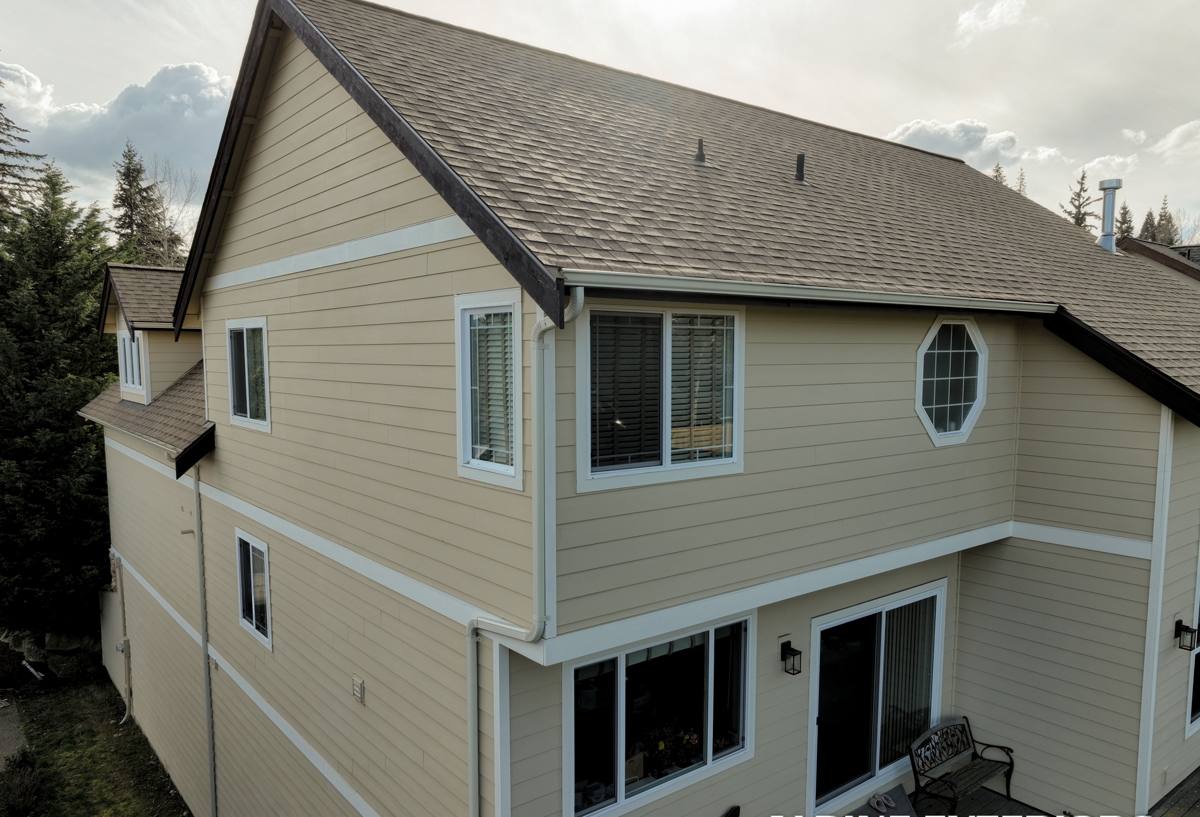
What Salt Air and Driving Rain Actually Do to Windows
Salt Air
Airborne salt from Semiahmoo Bay and the Strait settles on every exterior surface, including window frames, hardware, and fasteners. Over time it accelerates corrosion on lower-grade metal components — hinges, cranks, screws, and cheap cladding fasteners are usually the first to show it. It also breaks down finishes faster than an inland installation would experience, which is why we pay attention to hardware grade and finish warranty on anything going into a Semiahmoo home, not just the glass package.
Driving Rain
Wind off the water doesn't let rain fall straight down — it pushes it sideways into window walls, especially on west- and south-facing exposures. That means water is testing the seal around a window far more aggressively than it would on a sheltered inland wall. Flashing details, sill pans, and sealant joints have to be done right the first time, because driving rain will find any gap that a light, straight-down rain would never reach.
Extended Moss Season
Blaine's long, mild, wet season means moss and algae get a real foothold on north-facing and shaded exterior surfaces, including window sills, trim, and the siding immediately around a window opening. Beyond the cosmetic issue, sustained moisture retention around a window opening keeps wood trim and sheathing damp longer, which is where rot gets started if the original install didn't manage water properly.
What a Correct Custom Window Job Includes Here
"Custom" doesn't just mean an odd-shaped opening or a special sightline — for Semiahmoo it also means the installation approach is matched to the exposure. A correct job includes:
- Accurate field measurement of every opening — older Blaine-area homes rarely have perfectly square or consistent openings, and custom sizing avoids the gaps and shims that generic stock sizes require
- A sloped sill pan or equivalent drainage detail so any water that gets past the exterior seal drains back out instead of pooling on the sill
- Correctly lapped flashing tape and building paper/house wrap integration, so water sheds over each layer the way it's supposed to, from the top down
- Marine-grade or corrosion-resistant hardware and fasteners appropriate for coastal exposure
- Continuous, properly tooled exterior sealant joints — not just a bead of caulk run around the trim after the fact
- Frame and glazing options matched to the specific wall orientation (a water-facing wall often warrants a different spec than a sheltered side of the same house)
Skipping any one of these doesn't usually cause an immediate problem. It shows up two, five, or ten years later as a soft sill, a foggy insulated glass unit, or interior staining below a window — and by then it's a repair job instead of a five-minute install detail.
Frame Material and Glass: What We Recommend and Why
There's no single "best" window for every Semiahmoo home — orientation, budget, and the home's existing construction all factor in. Here's how the common options stack up for this specific climate:
| Frame Material | Coastal Performance | Maintenance | Notes for Semiahmoo |
|---|---|---|---|
| Vinyl (quality-grade) | Good — won't corrode or rot | Low | Solid value option; check weld quality and hardware grade on water-facing exposures |
| Fiberglass | Very good — dimensionally stable, resists warping in wet/dry cycling | Low | Often our recommendation for direct water exposure; higher upfront cost |
| Aluminum-clad wood | Good exterior protection, but interior wood still needs sealing attention | Moderate | Strong look, but we're careful about clad seams in high-salt exposure |
| Bare wood | Weakest in this specific environment | High | We generally steer clients away from unclad wood on direct-exposure walls here — it's a real maintenance commitment against salt and moisture, not a defect in the product itself |
For glass, we typically recommend dual-pane, low-E glazing as a baseline for anything in this area, with argon fill and upgraded spacer systems for water-facing rooms where condensation and heat loss are more noticeable. None of this is about chasing the fanciest spec sheet — it's about matching the glass and frame to how hard that particular wall of the house actually gets hit by weather.
Our Process for a Semiahmoo Window Project
1. On-Site Assessment
We walk the home, look at the current windows and surrounding trim/siding condition, and note which walls take the brunt of wind-driven rain. This tells us where to spend a little more on drainage detail and hardware grade versus where a standard-good install is plenty.
2. Measurement and Product Selection
Openings are measured precisely, and we go over frame material, glass package, and hardware options against your budget and the exposure notes from the assessment. No pressure toward the most expensive option — we'll tell you honestly where the upgrade matters and where it doesn't.
3. Removal and Opening Prep
Old windows come out, and we inspect the sheathing and framing underneath before anything new goes in. This is often the point where hidden moisture damage from a prior install gets caught — better to find and fix it now than seal it back up behind a new window.
4. Installation with Proper Water Management
Sill pan, flashing, window, and sealant go in as a system, in the correct order, with each layer lapping the one below it. This is the step that determines whether the window performs for decades or becomes a callback in a few years.
5. Final Check and Walkthrough
We check operation, seal integrity, and trim finish, and walk the job with you before we call it done.
Cost Factors for Custom Windows in This Area
Every project is different, but the main variables that move the price on a Semiahmoo window job are:
| Factor | Why It Matters |
|---|---|
| Frame material | Fiberglass and clad-wood run higher than vinyl; coastal exposure often justifies the upgrade on water-facing walls |
| Opening size and shape | True custom shapes (arched, oversized, non-standard) cost more than standard rectangular openings |
| Existing damage | If we find rot or moisture damage during removal, repair work is additional but far cheaper than deferring it |
| Glass package | Upgraded low-E coatings, argon fill, and impact-rated glass add cost but reduce energy loss and condensation issues |
| Number of exposed vs. sheltered openings | We can often save cost on sheltered walls by matching spec to actual exposure instead of over-speccing the whole house |
We give straightforward written estimates broken down by these factors, so you can see exactly what you're paying for and where there's room to adjust.
Why Hiring a Crew That Already Works Semiahmoo Matters
A window installer who mostly works inland jobs may do fine work in general, but they haven't necessarily had to think through sill pan drainage on a wall that takes rain sideways, or hardware corrosion on a house fifty yards from the water. We work throughout Blaine and this stretch of Whatcom County regularly, including homes right along the water, so the coastal-specific details in this page aren't theoretical for us — they're the standard part of how we spec and install a job out here. That familiarity also means we're not guessing at what your particular street or block tends to deal with in terms of wind exposure and moss buildup; we've likely already worked on a home nearby.
Signs Your Current Windows Are Losing the Battle
- Fogging or moisture between panes of double-glazed glass (a failed seal on the insulated glass unit)
- Soft or spongy wood at the sill or lower corners of the frame
- Visible moss or dark staining building up on the sill or surrounding trim, especially on shaded sides
- Drafts or noticeably cold air near the window even when it's fully closed and locked
- Difficulty opening, closing, or locking — often a sign the frame has shifted from moisture or settling
- Peeling paint or bubbling on interior trim near the window, which usually points to water intrusion behind the wall surface
Catching these early keeps a window replacement a planned project instead of an emergency repair after water finds its way into the wall assembly.
If you're seeing any of these signs, or you're planning ahead for a window upgrade on a Semiahmoo home, we're happy to take a look and give you a straightforward, no-pressure estimate. There's a form below — reach out and we'll get a time on the calendar.