 Blaine Siding
 Why Nooksack Siding Takes a Beating
Homes in and around Nooksack sit in one of the wetter, damper corners of Whatcom County. You're close enough to Bellingham Bay and the Strait of Georgia to pick up salt-laden air on windy days, but you're also inland enough to catch the full brunt of driving rain that rolls in off the water and gets funneled up the Nooksack River valley. Add in the low winter sun angle and the tree cover common on rural and semi-rural lots out here, and you get long stretches where a home's north and west-facing walls simply don't dry out for days at a time. That combination — salt exposure, wind-driven rain, and shade — is exactly the recipe for moss, mildew, and slow water intrusion that most siding products aren't built to handle over the long run.
We install James Hardie fiber cement siding exclusively, and a big part of why is that it's one of the few siding systems engineered specifically for climates like this one. This page walks through what that actually means for a Nooksack-area home — not the marketing version, the practical one.
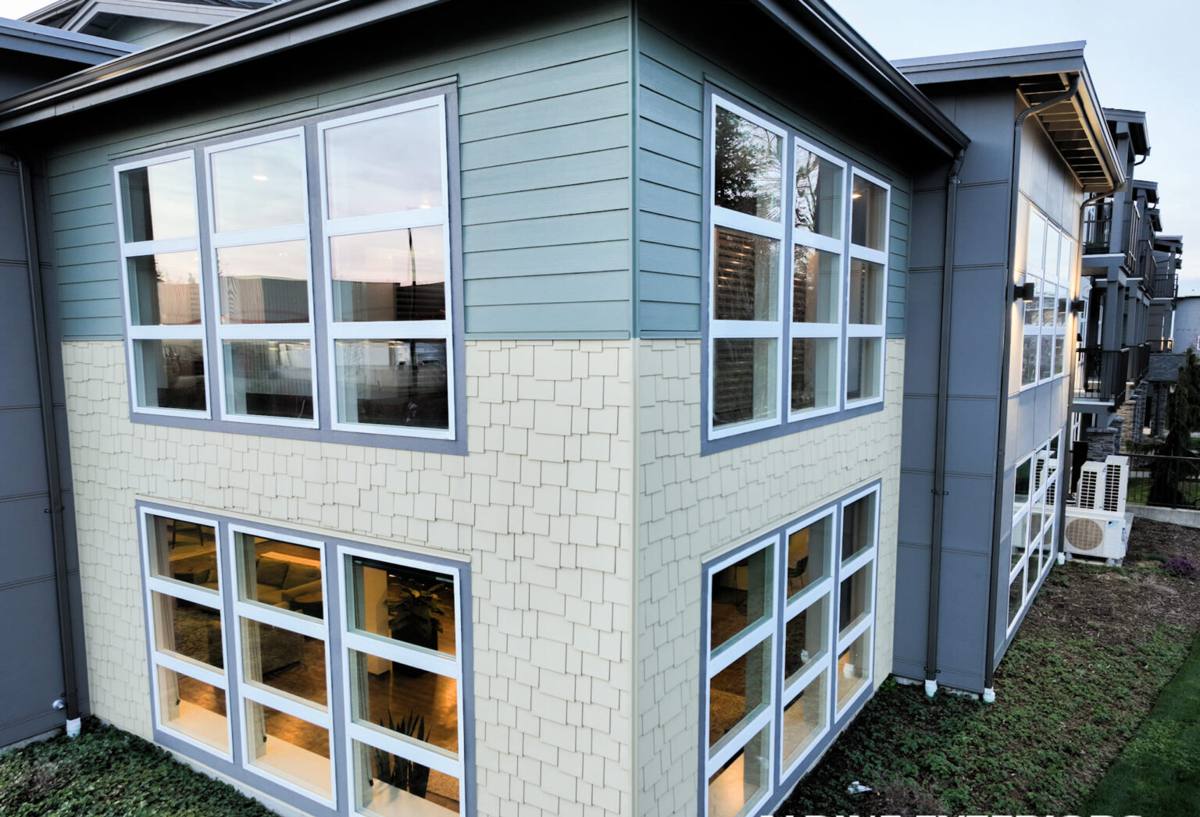
What "Salt Air, Driving Rain, and Moss Season" Actually Does to a Wall
Salt Air
Salt-laden moisture accelerates corrosion on fasteners, flashing, and any exposed metal trim. It also settles into porous or textured surfaces and holds moisture longer than it otherwise would, which feeds mildew growth and speeds up paint failure on lower-grade siding materials.
Driving Rain
Wind-driven rain doesn't just run down a wall — it gets pushed sideways and upward into laps, seams, and butt joints. Siding that isn't installed with the right clearances, flashing, and caulking details will eventually let water behind the cladding, where it can sit against sheathing and framing unseen for years.
Moss Season
Whatcom County's moss season effectively runs most of the fall through spring. Moss and algae need three things to establish on a wall: moisture, shade, and a surface they can grip. Rough-textured or absorbent siding gives moss a foothold; siding that stays damp because it's too close to grade, gutters, or landscaping gives it the moisture. Once moss takes hold, it holds water against the surface constantly, which is worse for the material underneath than open exposure to rain ever was.
What James Hardie Is Built to Handle
James Hardie fiber cement is a cement, sand, and cellulose fiber composite — it's non-combustible, dimensionally stable, and doesn't absorb water the way wood-based or wood-composite sidings do. For a wet, coastal-influenced area like Nooksack, a few specific engineering points matter most:
- HZ5 climate engineering: Hardie manufactures regional product lines matched to moisture exposure and freeze-thaw conditions. The HZ5 formulation used in the Pacific Northwest is engineered for cold, wet climates specifically — it's not the same board sold in Arizona.
- ColorPlus factory finish: The finish is baked on in a controlled factory environment rather than field-applied, which gives it far better adhesion and UV/moisture resistance than a job-site paint job, and it comes with its own finish warranty.
- Dimensional stability: Fiber cement doesn't swell, cup, or rot when it takes on moisture the way wood and wood-composite products can. That matters a lot when a wall stays damp for days at a stretch, which is normal here for much of the year.
- Surface texture options: Smoother-texture Hardie profiles give moss and algae less to grip than deeply textured wood-look sidings, which helps on shaded elevations.
None of that means Hardie siding is maintenance-free or immune to moss — nothing mounted on the exterior of a house in this climate is. It means the material itself isn't the weak point. The weak point, on almost every siding failure we look at, is the installation.
What a Correct Installation Involves in This Climate
Fiber cement siding is only as good as the water management system behind it. In a high-moisture area like Nooksack, we pay particular attention to a handful of details that get skipped more often than homeowners realize:
Weather-Resistive Barrier and Rainscreen
A properly lapped weather-resistive barrier behind the siding is the last line of defense if water does get past the cladding. On many walls, especially shaded or west-facing ones, we install a rainscreen gap behind the siding so that any moisture that does work its way in can drain and the wall can actually dry between rain events instead of staying saturated.
Flashing and Clearances
Every window, door, deck ledger, and roof-to-wall transition is a place water wants to get in. Correct step flashing, kick-out flashing at roof lines, and head flashing over openings are non-negotiable. We also hold the manufacturer's required clearances from roof lines, decks, and grade — siding installed too tight to a walkway or too close to soil stays wet far longer and is one of the most common moss and rot triggers we see on older installs.
Fastening and Caulking
Fasteners have to be corrosion-resistant and set to Hardie's spec — over-driven or under-driven nails both create problems, and in salt air, the wrong fastener metal will show rust bleed through the finish within a few years. Joints and butt seams get sealed with a caulk rated for the exposure, not whatever tube happens to be on the truck.
Trim and Penetrations
Every hose bib, light fixture, vent, and piece of trim that penetrates the siding is a potential leak point. These get flashed and sealed individually, not just caulked over after the fact.
Our Process on Nooksack-Area Homes
- Walk and assess: We look at the existing siding, sheathing condition where accessible, moisture patterns, moss/algae growth, and problem areas like north walls, deck ledgers, and low-clearance sections before quoting anything.
- Scope the water management, not just the siding: Our proposal covers the weather-resistive barrier, rainscreen where warranted, flashing details, and trim — not just board-and-batten or lap siding square footage.
- Tear-off and inspect: Once old siding comes off, we check sheathing for hidden rot or moisture damage before anything new goes up, and flag it before proceeding.
- Install to Hardie's fastening, clearance, and flashing spec: Not the fastest way to close in a wall — the correct way for this climate.
- Final detail and walkthrough: Caulking, trim, and touch-up get checked, and we walk the finished job with the homeowner.
Signs Existing Siding Is Losing the Fight
- Persistent moss or dark streaking that comes back within weeks of cleaning
- Soft or spongy spots, especially near the bottom courses or below windows
- Paint that's bubbling, peeling, or chalking heavily on north or west walls
- Visible gaps, warping, or separation at butt joints and corners
- Rust staining running down from fasteners or trim
- Musty smell or visible staining on interior walls that back up to exterior siding
Any of these on a Nooksack-area home is worth a look before another wet season passes — moisture problems behind siding rarely stay small.
Cost Factors on a Nooksack James Hardie Job
| Factor | Why It Moves the Price |
|---|---|
| Tear-off and sheathing condition | Hidden rot found during tear-off adds repair scope before new siding goes up |
| Wall complexity | Dormers, multiple gables, and cut-in trim take more labor per square foot than flat walls |
| Rainscreen application | Shaded or high-exposure elevations often warrant a drainage gap, which adds a step |
| Siding profile and finish | Lap, shingle-style, and panel products carry different material and labor costs |
| Trim and accessory scope | Full trim, fascia, and soffit replacement versus siding-only changes total cost significantly |
| Access and site conditions | Steep grades, limited staging area, or multi-story walls affect labor and equipment needs |
We give firm, itemized numbers after walking the actual house — broad ranges without seeing the walls aren't useful to you or to us.
Maintenance That Actually Matters Here
- Rinse siding annually, more often on shaded or north-facing walls, to keep moss and algae from establishing
- Keep gutters clear so overflow doesn't run down the wall face
- Trim back vegetation and landscaping so siding gets airflow and sun exposure where possible
- Re-caulk trim joints and penetrations if you notice cracking or gaps, rather than waiting for a leak
- Have an annual or biannual visual check after big wind and rain events, since that's when flashing and trim problems tend to show up first
Why It Matters That We Already Work This Area
Whatcom County's building conditions aren't uniform — a wall detail that's fine in a drier, more sheltered part of the county can fail fast on a shaded, wind-exposed wall closer to Blaine and the water. A crew that installs Hardie siding regularly in this specific stretch of the county already knows which elevations need a rainscreen, which clearances actually hold up through moss season, and which flashing details matter most given the local rain patterns. That local pattern recognition is worth more than a generic install — it's the difference between siding that looks good for a season and siding that's still performing correctly in fifteen years.
If you'd like a straight assessment of your home's siding and what correct James Hardie installation would look like for your walls, we're glad to walk the property and give you a free, no-pressure estimate — the form below gets that started.