 Blaine Siding
 Why Sandy Point Decks Take More Punishment Than Most
Sandy Point sits close enough to the water that the air itself is part of the maintenance equation. Salt-laden air off the water speeds up corrosion on anything metal — fasteners, brackets, railing hardware — faster than it would a few miles inland. Add in driving rain that comes at decks sideways during winter storms, not just straight down, and you've got moisture finding its way into board gaps, ledger connections, and post bases that a calmer climate would never test. Then there's the moss season, which in this part of Whatcom County isn't really a season so much as most of the year: shade, humidity, and standing surface moisture give algae and moss everything they need to take hold on any deck surface that doesn't shed water well.
None of this makes decks impossible to build well here — it just means the standard has to be higher than what works in a drier, calmer part of the state. A deck built without accounting for salt exposure, wind-driven rain, and moss growth will show problems within a few years: corroded fasteners, soft spots at the ledger, slick green boards by November. A deck built with this climate in mind can go the distance.
What Composite Decking Is Actually Built To Handle
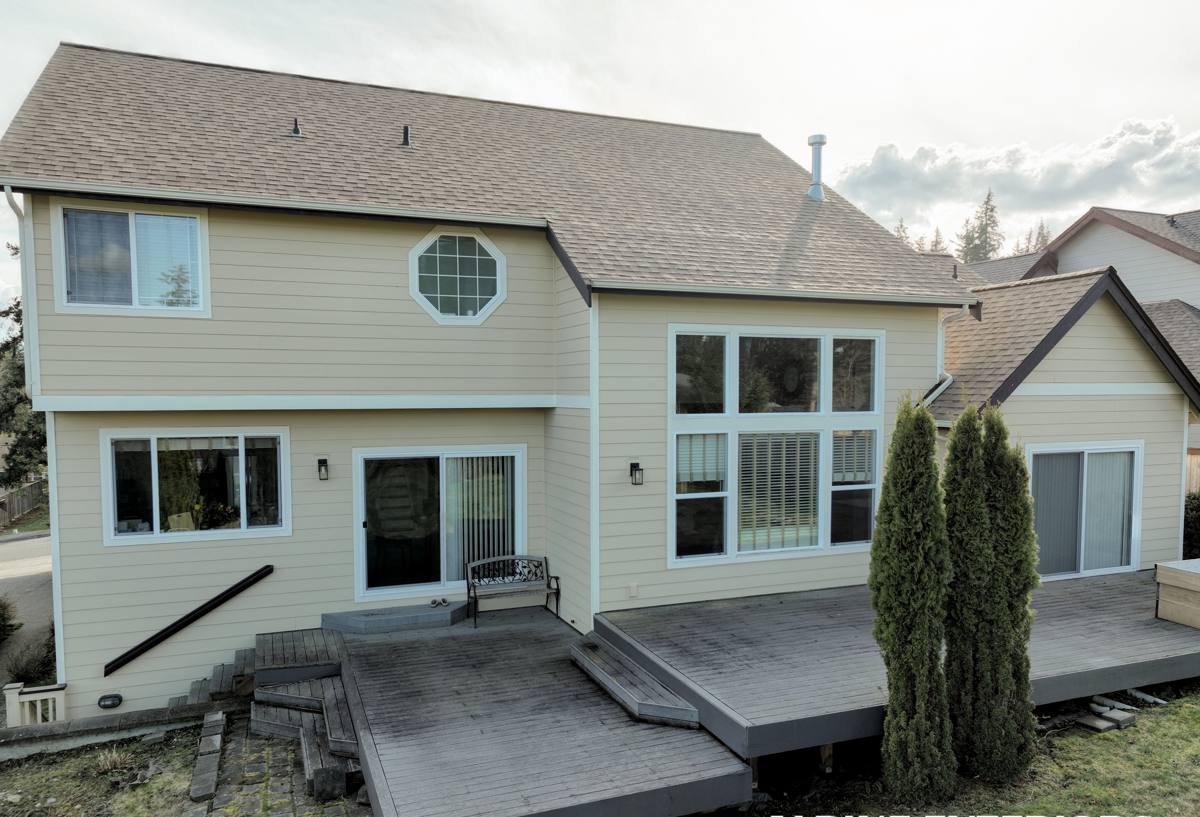
Composite decking is a blend of wood fiber and polymer (plastic), engineered to resist the moisture absorption and rot that solid wood is prone to. It doesn't need annual staining or sealing, and it holds up better against the kind of surface moisture that's constant in a Sandy Point winter. That said, not all composite is built the same way, and the difference matters more here than it would somewhere drier.
Capped vs. Uncapped Composite
Uncapped composite is the older generation of the product — the polymer and wood fiber are blended all the way through the board, but the surface is still somewhat exposed to moisture, staining, and mold growth over time. Capped composite adds a polymer shell around the board (on some products, all four sides) that acts as a barrier against water absorption, salt residue, and surface staining.
Why We Standardize on Capped Boards for This Area
Given the salt air and the amount of moisture this area sees over a typical year, we standardize on fully capped composite for decks in Sandy Point and the surrounding Blaine shoreline. The upfront cost difference is modest compared to the difference in how the board performs after five winters of driving rain and salt film. This isn't a knock on uncapped products — they have their place in drier climates — it's a call about what actually holds up on this stretch of coastline.
What a Correct Installation Looks Like Here
Composite boards are only as good as what's underneath them. A huge share of the deck problems we get called out to fix aren't board failures — they're substructure or fastener failures that show up as board movement, soft spots, or staining before the boards themselves are actually done.
Substructure and Fasteners
In a salt-air environment, standard galvanized fasteners corrode faster than they would inland. We use stainless steel or coated fasteners rated for coastal exposure, and we run joist tape over framing before boards go down — it protects the wood joists from the moisture that composite boards will still shed onto the framing below, even though the boards themselves don't absorb it. Joist spacing also needs to match the composite manufacturer's span rating; composite has different flex characteristics than solid lumber, and undersized framing shows up later as bounce or sag.
Drainage and Airflow Underneath
The ledger board — where the deck attaches to the house — is the single most common point of water intrusion on any deck, and it's where driving rain does the most damage if flashing isn't done correctly. We flash the ledger properly and make sure there's a gap and slope that lets water get out from under the deck instead of pooling against the house. Airflow underneath the deck also matters for keeping moss and algae from taking hold on the underside and around fastener heads — a deck that can't breathe stays damp longer, and damp surfaces are exactly what moss needs.
Moss, Algae, and Salt Film: The Maintenance Reality
Composite decking cuts down on maintenance dramatically compared to wood, but "low maintenance" doesn't mean "no maintenance," especially this close to the water. Here's how the two compare in Sandy Point conditions specifically:
| Task | Wood Decking | Capped Composite |
|---|---|---|
| Annual staining/sealing | Required, often yearly given rain exposure | Not required |
| Moss/algae removal | Frequent scrubbing, surface can pit over time | Occasional wash-down, surface resists staining |
| Salt residue buildup | Can accelerate splintering and graying | Rinses off easily, doesn't penetrate surface |
| Fastener/hardware check | Recommended every 1-2 years | Recommended every 1-2 years |
| Board replacement risk | Higher — rot, splitting, warping | Low when installed correctly |
The biggest maintenance item that doesn't go away with composite is simply keeping the surface clean of moss and organic debris — leaves, needles, algae film — since a slick composite deck in December is still a slick deck. A seasonal rinse and occasional soft-wash keeps most Sandy Point decks looking and performing the way they should.
Our Process for a Sandy Point Composite Deck
Every deck we build or replace in this area follows the same sequence, adjusted for the specific site:
- Site and structure evaluation — we check existing framing, ledger condition, and grading underneath before quoting anything, since older homes in this area often have substructure that needs attention regardless of what decking goes on top.
- Drainage assessment — we look at how water currently moves around and under the deck footprint, since standing water is what feeds moss growth and accelerates hardware corrosion.
- Demo and framing work — old decking comes out, framing gets repaired or replaced as needed, and joist tape and flashing go in before any composite touches the structure.
- Composite board installation — hidden fastener systems where the product allows for it, correct expansion gaps, and coastal-rated hardware throughout.
- Railing, stairs, and fascia — matched to the composite system so the whole structure weathers evenly rather than mixing materials that age at different rates.
- Final walkthrough — we go over basic seasonal care with the homeowner so the deck stays looking right through its first few Whatcom County winters.
Cost Factors to Expect
Composite decking costs vary widely based on size, existing conditions, and the board tier you choose. Rather than quote a number that won't hold up across different properties, here's what actually moves the price:
| Factor | Why It Matters |
|---|---|
| Deck size and shape | Square footage and the number of angles/cutouts drive material and labor time |
| Existing substructure condition | Homes with rot or undersized framing need repair or replacement before boards go down |
| Board tier (capped vs. uncapped) | Capped composite costs more upfront but performs better in salt air and rain |
| Railing and stair complexity | Composite or metal railing systems add cost versus a simple picket rail |
| Site access | Waterfront lots with limited equipment access can add labor time |
| Height and permitting | Elevated decks may require engineering review and permits through the county |
We walk every site in person before giving a number, because a quote based on square footage alone almost never matches what a Sandy Point property actually needs once framing and drainage are factored in.
Why It Matters to Hire a Crew That Already Works This Area
Composite decking installation isn't complicated in the abstract — manufacturers publish install guides for a reason. But a crew that's only worked drier, inland jobs will make different assumptions than one that's spent time on Sandy Point and along the Blaine shoreline specifically. That shows up in the small decisions: which fastener grade to use without being asked, how much of a gap to leave for a board that will see more moisture cycling than the spec sheet assumes, where moss is likely to take hold based on which direction a deck faces relative to the water and prevailing wind.
It also matters for permitting. Whatcom County has its own permit requirements for decks, and waterfront or near-waterfront properties can carry additional considerations depending on setback and elevation. A crew that's pulled permits in this jurisdiction before knows what to expect and won't leave that step as a surprise partway through the job.
A Quick Checklist Before You Hire
Whether you're getting quotes from us or comparing options, these are worth confirming before signing anything:
- Is the composite fully capped, and does the quote specify the actual product line and color, not just "composite decking"?
- Does the quote address the substructure — joists, ledger, flashing — or only the visible boards?
- What fastener and hardware grade is being used, and is it rated for coastal/salt-air exposure?
- Is a permit being pulled where required, and is that included in the quote or handled separately?
- Does the contractor carry current licensing and insurance, and can they show it without being asked twice?
- What does the manufacturer's warranty actually cover, and does the installer's workmanship warranty match it?
A composite deck is a long-term investment, and getting the framing, drainage, and hardware right the first time matters more here than in a milder climate — those details are what separate a deck that looks the same in ten years from one that starts showing problems in three. If you're weighing options for a deck in Sandy Point or elsewhere around Blaine, we're happy to walk the site and give you a straight, no-pressure estimate using the form below.