 Blaine Siding
 Point Roberts Puts Siding Through More Than Most Homes Ever See
Point Roberts sits on its own piece of land — a U.S. exclave surrounded on three sides by water and connected to the rest of Whatcom County only by a drive through Canada. That geography is charming for the people who live there, but it's rough on exterior building materials. Homes here face salt-laden air off the surrounding waters, wind-driven rain that hits siding sideways instead of straight down, and a moss season that can run most of the year in shaded or north-facing spots. Add in the fact that Point Roberts is a peninsula with fewer year-round contractors making the trip, and it's easy for siding problems to go unnoticed until they're expensive.
We install siding throughout the Blaine area, and Point Roberts homes consistently show a specific pattern of wear: fastener corrosion, moss buildup at shaded corners and under eaves, and paint or caulk failure years before it should happen. None of that is unusual for the location — it's just what salt air and sustained moisture do to a building envelope over time. The fix isn't a different paint color. It's siding designed for this climate, installed the way the manufacturer actually specifies.
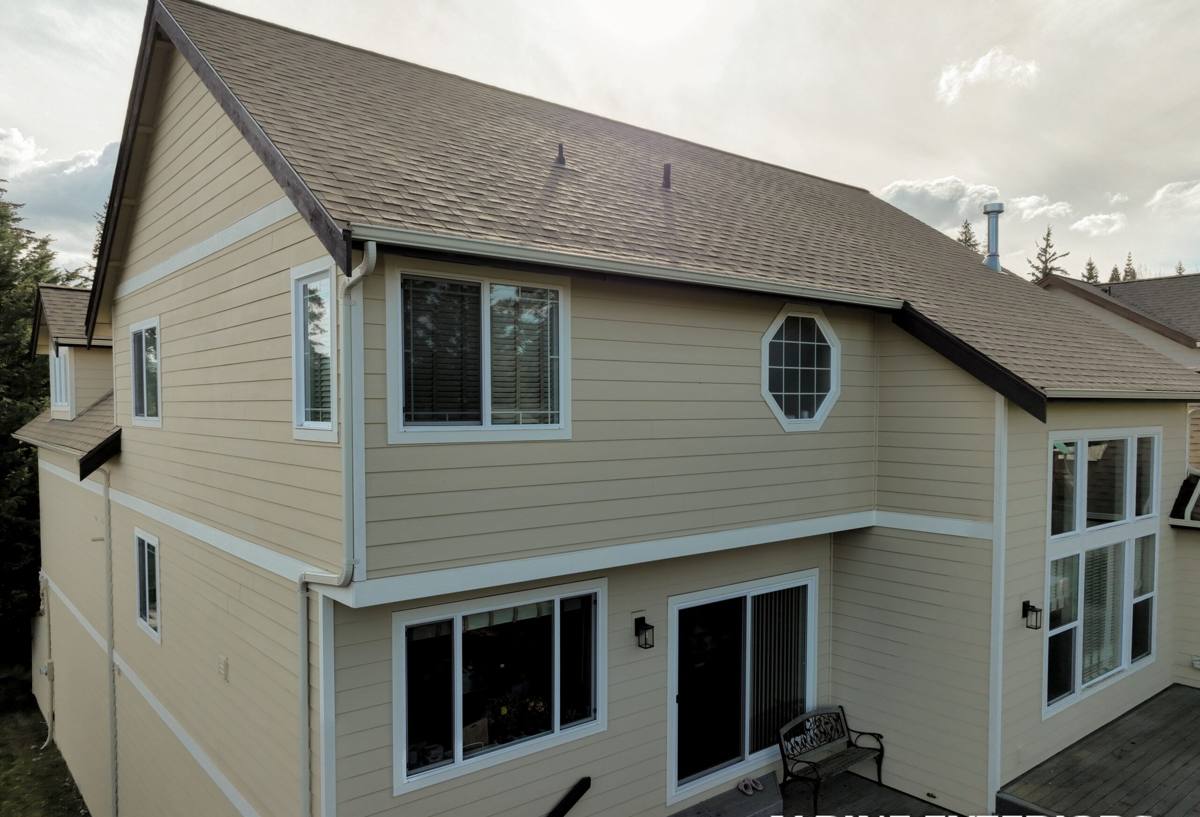
What This Climate Actually Does to Siding
Salt Air
Airborne salt from the surrounding water settles on exterior surfaces and accelerates corrosion of metal fasteners, flashing, and hardware. On siding with a weak factory finish, salt exposure also speeds up chalking and color fade, especially on south- and west-facing walls that take direct sun on top of the salt exposure.
Driving Rain
Point Roberts gets its share of wind off the water, and wind-driven rain doesn't behave like a normal shower — it gets pushed sideways and upward into laps, seams, and trim joints that were never designed to shed water from that angle. Siding systems that rely on caulk alone at these joints, rather than proper flashing and drainage planes, are the ones that fail first.
Moss and Trapped Moisture
Shaded walls, tree-lined lots, and the long damp stretch of a Pacific Northwest winter give moss and algae everything they need. Moss itself doesn't destroy siding, but it holds moisture against the surface far longer than open air would, which is what leads to rot in wood-based products and coating breakdown on painted surfaces.
Signs a Point Roberts Home Needs Replacement, Not Just Repair
Not every siding problem means a full tear-off. But there's a point where patching becomes a waste of money, because the underlying material is compromised or the system was never built to handle this environment in the first place. Watch for:
- Soft, spongy, or crumbling spots when you press on the siding, especially near the bottom courses and around windows
- Persistent moss or dark streaking that comes back within a season of cleaning
- Paint that's peeling or bubbling rather than just fading
- Visible warping, cupping, or boards separating at the seams
- Rust streaks running down from nail heads or fasteners
- Gaps opening up at corners, trim, or butt joints
- A noticeable jump in heating costs, which often points to a compromised weather barrier behind the siding
If you're seeing two or more of these, it's worth having someone look at what's underneath the siding, not just the surface.
Why We Only Install James Hardie Fiber Cement
We don't install vinyl, LP SmartSide, Cemplank, Allura, primed spruce, or cedar. That's a deliberate standard, not a lack of options. Each of those products has real strengths, but each also has a trade-off that shows up faster in a salt-air, high-moisture environment like Point Roberts than it would somewhere drier and further inland.
| Material | How It Handles Salt Air & Moisture | Where It Struggles Locally |
|---|---|---|
| Vinyl | Won't rot, but fasteners and trim hardware still corrode; finish can chalk and fade under sun plus salt exposure | Expands and contracts with temperature swings, which stresses seams over time; not repainted when it fades |
| Cedar / wood | Naturally attractive, but wood fiber absorbs moisture and feeds moss and rot without diligent maintenance | Needs frequent refinishing; shaded, damp walls are exactly where wood siding fails first |
| LP SmartSide (engineered wood) | Better moisture resistance than raw wood, but still wood-strand based and dependent on caulking and coating staying intact | Edge swelling and coating failure are the common complaints once moisture gets past the finish |
| James Hardie fiber cement | Non-combustible, dimensionally stable, and factory-finished with ColorPlus coating that's engineered to hold color and resist moisture | Requires correct installation (clearances, fastening, flashing) to perform as designed — which is on us, not the product |
Hardie also makes an HZ5 product line specifically engineered for higher-moisture, marine-influenced climates like ours — thicker moisture-resistant formulation, built for regions that see sustained rain and humidity rather than dry heat. That's the version we use for Point Roberts and the rest of the Blaine area. It carries a strong transferable warranty, which matters more here than in a milder climate, because the material is actually being tested by the conditions it was engineered for.
What a Correct Siding Replacement Involves
Fiber cement performs well in this climate, but only if it's installed to spec. A rushed or corner-cutting install will fail here faster than it would somewhere drier, because there's no margin for error when wind-driven rain is involved. A correct job includes:
- Full tear-off and inspection of the sheathing underneath — this is where hidden moisture damage from the old siding usually shows up
- Repair or replacement of any rotted sheathing or framing before new material goes on
- A continuous weather-resistant barrier installed with proper overlaps and sealed penetrations
- Correct flashing at every window, door, and roofline intersection — not caulk used as a substitute for flashing
- Manufacturer-specified fastening pattern and clearances, including gaps at the ground, roofline, and deck attachments to prevent wicking
- Factory-applied ColorPlus finish, which holds up to salt air and UV exposure far better than a field-applied coat
- Proper caulking only at the joints designed to be sealed — not as a substitute for flashing elsewhere
Most siding failures we see in this area trace back to one of these steps being skipped, not to the material itself.
Our Process for Point Roberts Projects
- Site visit and assessment. We look at the current siding, check for moisture damage at the sheathing, and note the specific exposure conditions on your walls — which sides take the worst of the salt air and driving rain.
- Written estimate and product plan. You get a clear scope, the specific Hardie products and colors involved, and a straightforward cost breakdown.
- Permitting. Point Roberts is unincorporated Whatcom County, so permits are pulled through the county the same as anywhere else in the area — we handle that process.
- Logistics and scheduling. Because Point Roberts is only reachable by a drive through Canada or by water, we plan crew scheduling and material delivery as a single coordinated trip rather than piecemeal, which keeps the job moving instead of stalling on missing materials.
- Tear-off, repair, and install. Old siding comes off, any damaged sheathing gets addressed before it's covered back up, and the new system goes on to manufacturer spec.
- Final walkthrough. We go over the finished work with you before calling the job done.
Cost Factors for a Point Roberts Siding Job
Every home is different, so we won't quote a number without seeing the site, but these are the main variables that move the price:
| Factor | Why It Matters |
|---|---|
| Home size and number of stories | More surface area and higher walls mean more material and labor time |
| Condition of the sheathing underneath | Hidden rot found during tear-off has to be repaired before new siding goes on |
| Trim, corners, and accessory detail | Complex rooflines and lots of window/door trim add labor beyond flat wall area |
| Plank profile and finish selection | Lap width, texture, and ColorPlus color options carry different material costs |
| Site access | Tight lots, waterfront setbacks, or limited staging space can affect labor time |
| Delivery and scheduling logistics | Point Roberts' location affects how materials and crews are staged for the job |
Why a Crew That Already Works Point Roberts Matters
A contractor unfamiliar with Point Roberts will often underestimate two things: the border logistics and the climate exposure. Scheduling a crew and a full material delivery for a location reachable only through Canada takes planning most companies don't bother with for a single small job — which is part of why homes here sometimes go years between proper maintenance. And a crew that hasn't worked this specific stretch of coastline may not recognize how much worse salt air and moss exposure are here compared to a few miles inland.
We work Point Roberts regularly, which means we already know how to plan the trip, what Whatcom County permitting looks like for the area, and which exposures on a given lot need the most attention. That translates into fewer surprises mid-project and a siding system that's actually built for the conditions it has to survive.
Get a Free Estimate
If your Point Roberts home is showing moss buildup, paint failure, or soft spots in the siding, it's worth getting a straightforward assessment before those problems reach the sheathing. Reach out for a free, no-pressure estimate — we'll take a look, explain what we find, and lay out exactly what a correct James Hardie installation would involve for your home.