 Blaine Siding
 Why Peace Arch Homes Take a Beating on Their Siding
Homes near the Peace Arch border crossing sit in one of the more demanding pockets of Whatcom County when it comes to exterior wear. You've got salt-laden air rolling in off the surrounding saltwater, wind-driven rain that doesn't just fall straight down but gets pushed sideways into wall assemblies, and a marine climate that keeps north- and shade-facing walls damp for weeks at a stretch. Add in the tree cover common to many Blaine properties and you get long stretches of the year where siding simply doesn't get a chance to fully dry out.
None of that is unusual for this part of Washington. But it does mean siding choices and installation details that work fine forty miles inland can fail early here. We've built our approach around what this specific stretch of coastline actually does to a house, not around a generic siding job.
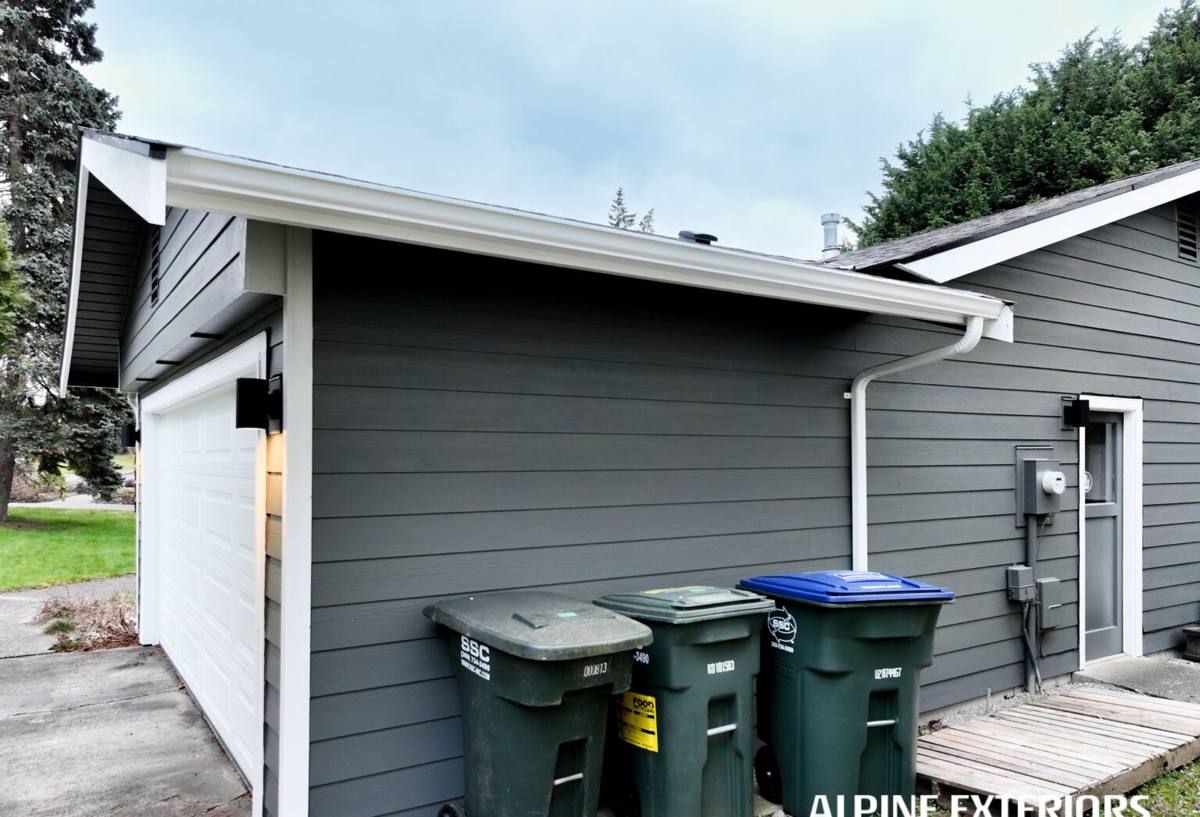
What Siding Actually Needs to Survive Here
Three climate factors drive almost every decision we make on a Peace Arch project:
Salt Air
Airborne salt accelerates corrosion on fasteners, flashing, and any metal trim, and it can degrade cheaper paint finishes faster than inland exposure would. Siding material and the hardware behind it both need to be chosen with that in mind.
Driving Rain
Storms moving through this corridor frequently push rain horizontally, which means water gets tested at every seam, corner, and penetration on the wall — not just the top surfaces. A siding system is only as good as its weakest joint in these conditions.
A Long Moss Season
Cool temperatures, shade, and near-constant moisture give moss and algae a long window to establish themselves, especially on north walls and anywhere siding sits close to landscaping or overhanging trees. Moss holds moisture against the surface, which is exactly what you don't want happening for months at a time.
Put together, this means the siding on a Peace Arch home needs to resist moisture intrusion at the seams, hold its finish without chalking or fading in salt air, and shed water fast enough that moss doesn't get a permanent foothold.
Why We Install James Hardie Fiber Cement — and Nothing Else
We standardized on James Hardie fiber cement siding for every home we side, including projects in the Peace Arch area, and we don't install vinyl, LP SmartSide, Cemplank, Allura, or unprimed wood siding. That's not a marketing position — it's a decision based on what holds up in this climate over decades, not just through the first few winters.
Fiber cement is non-combustible, dimensionally stable, and doesn't swell or rot the way wood-based products can when they stay damp for extended periods. James Hardie's ColorPlus factory-applied finish is baked on under controlled conditions rather than field-applied, which matters directly here: a finish that's cured properly resists the fading and chalking that salt air and UV exposure cause over time far better than a job-site paint job does. Hardie also engineers regional product lines (HZ5 for this climate zone) specifically for cold, wet, marine-influenced conditions like ours, and backs the product with a strong transferable warranty.
We're not going to tell you every alternative product is unusable — some have real strengths. But when we weigh moisture behavior, long-term appearance, and how a product performs specifically in salt air and sustained dampness, Hardie is what we're willing to put our name on.
What a Correct Installation Actually Involves
Fiber cement performs exactly as well as its installation. A good product installed loosely, with the wrong fasteners or without proper clearances, will fail early regardless of what brand is on the box. In a driving-rain, salt-air environment, these details aren't optional extras — they're the difference between siding that lasts decades and siding that starts showing problems in five years.
- Correct starter strip and butt-joint flashing so water is directed out and away, not trapped behind the plank
- Minimum clearance maintained between siding and grade, decks, roofs, and hardscaping so splashback and standing moisture don't sit against the bottom edge
- Stainless steel or hot-dip galvanized fasteners driven properly, not overdriven or underdriven — critical when salt air is actively working on any exposed metal
- Proper caulking and sealing at penetrations (vents, hose bibs, light fixtures, electrical) using products rated for the exposure
- Correct nailing pattern and fastener spacing per Hardie's published installation instructions, not a generalized "siding" approach
- Rain screen or drainage plane detailing behind the siding where the wall assembly calls for it, so any moisture that does get behind the cladding has somewhere to go
Skipping any one of these doesn't usually show up right away. It shows up two, five, or ten years later as trapped moisture, staining, fastener bleed, or premature paint failure — often after the workmanship warranty on a rushed job has already expired.
Our Process for Peace Arch Projects
1. On-Site Assessment
We look at the specific exposure of your home — which walls take the worst of the wind-driven rain, where shade and tree cover create moss risk, and what condition the existing wall assembly and sheathing are in before we ever talk product selection.
2. Tear-Off and Substrate Check
Old siding comes off and we inspect the sheathing and framing underneath for hidden moisture damage. In a climate like this, catching a rot pocket now is far cheaper than covering it up and finding it again in five years.
3. Weather Barrier and Flashing
We install or verify the weather-resistive barrier and flashing details at every window, door, corner, and penetration before a single piece of siding goes up. This is the layer that actually keeps water out — the siding is the second line of defense, not the first.
4. Hardie Installation to Spec
Panels or lap siding go up following James Hardie's fastening and clearance specifications, matched to the HZ5 product line appropriate for this climate zone.
5. Final Walkthrough
We walk the finished job with you, checking seams, trim, and caulking, and go over what routine maintenance looks like for your specific site conditions.
Cost Factors on a Peace Arch Home
Every home is different, but these are the variables that most affect what a fiber cement siding project actually costs in this area:
| Factor | Why It Matters Here |
|---|---|
| Home size and wall complexity | More corners, dormers, and trim details mean more flashing and cut work |
| Existing siding removal and disposal | Tear-off scope varies with layers and substrate condition found underneath |
| Sheathing or framing repair | Marine-climate moisture damage found during tear-off adds material and labor |
| Siding profile (lap vs. panel vs. shingle style) | Different Hardie profiles carry different material and install labor costs |
| Trim and accessory scope | Corner boards, window trim, and fascia work add to overall project cost |
| Site access and exposure | Tree cover, tight lots, and border-area terrain can affect staging and schedule |
We give straightforward, itemized estimates so you know what's driving the number — not a flat per-square-foot figure that hides the details.
Maintaining Fiber Cement in a Moss-Prone, Salty Climate
One reason we push clients toward fiber cement in this area is that it holds up to routine cleaning far better than softer materials do. Still, a little seasonal attention goes a long way:
- Rinse siding annually, and more often on shaded or north-facing walls, to knock back early moss and algae growth before it establishes
- Keep gutters clear so overflow isn't running down and pooling behind siding at the top edge
- Trim back landscaping and tree branches to improve airflow and sun exposure on chronically damp wall sections
- Inspect caulking at trim and penetrations every year or two and re-seal where it's cracked or pulling away
- Watch for any staining or dark streaking near the bottom edge, which can signal splashback or a clearance issue worth addressing early
None of this is heavy maintenance — it's the kind of upkeep that, done consistently, is what lets a correctly installed Hardie system reach its full lifespan in a climate that's genuinely tough on exteriors.
Why It Matters That Your Crew Already Works This Area
Siding crews that mostly work drier, inland climates don't always think in terms of wind-driven rain angles, salt-air fastener corrosion, or where moss actually takes hold on a shaded wall — because they don't have to, most of the time. Around Blaine and the Peace Arch area, those aren't edge cases; they're the baseline conditions every job has to be built around.
Working this area regularly means we've seen where water actually finds its way in on homes with this exposure, which wall orientations need extra attention, and which installation shortcuts show up as problems years down the road. That's the kind of judgment that doesn't come from a spec sheet — it comes from doing the work here, repeatedly, and paying attention to what happens after the job is done.
Get a Straightforward Estimate
If your home's siding is showing its age or you're planning ahead for a replacement, we're happy to take a look and walk you through what we're seeing — no pressure, no hard sell. Reach out for a free estimate on James Hardie fiber cement siding for your Peace Arch-area home.