 Blaine Siding
 Siding Replacement in Nooksack: Why This Isn't a Cosmetic Job
Nooksack is one of the smaller communities in our Whatcom County service area, and homes here deal with the same demanding weather pattern that shapes exterior work across the whole county: salt-tinged marine air that pushes inland on wind and weather systems, driving rain that comes in sideways rather than straight down, and a moss season that can stretch for most of the year on shaded walls. Siding replacement in a climate like this isn't about picking a fresh color and moving on. It's a chance to correct whatever let the old siding fail in the first place, so the new wall assembly actually holds up through another few decades of wet Pacific Northwest weather.
We install James Hardie fiber cement siding exclusively, on replacement jobs and everything else. That standard comes from watching, job after job, which materials hold up in this climate and which ones quietly fail behind a coat of paint. When we tear off old siding in Nooksack, we're not just swapping one product for another — we're rebuilding the water-management system behind the wall, and that's the part of a replacement job that actually determines how long it lasts.
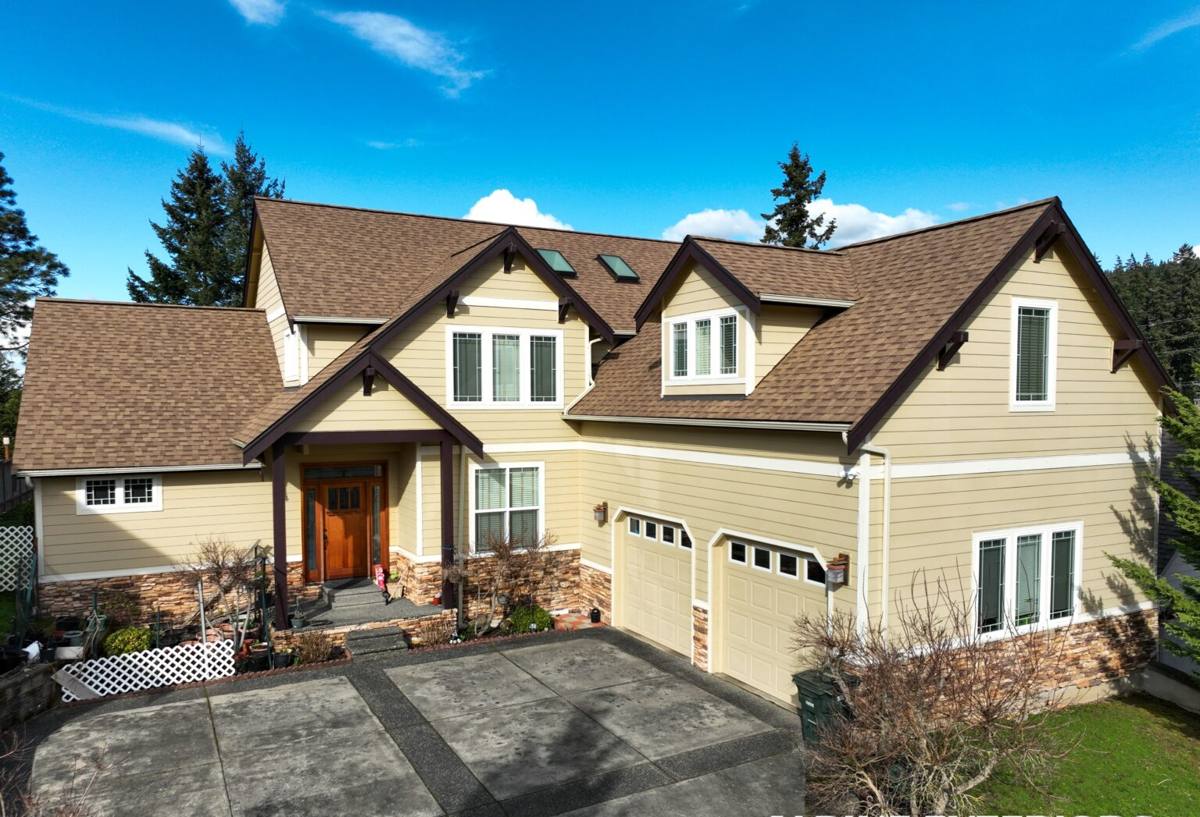
What Whatcom County Weather Does to Siding Over Time
Salt-Tinged Marine Air
Even away from the immediate shoreline, salt-laden air moves through Whatcom County on prevailing winds and settles into places you wouldn't expect. Over years, it accelerates corrosion in fasteners, flashing, and any exposed metal trim, and it breaks down lower-grade paints and finishes faster than a dry inland climate would. A siding product that isn't built to resist that kind of slow chemical wear starts showing it in fastener rust and finish failure well before the panel itself gives out.
Driving Rain
Rain in this region rarely falls straight down. Wind pushes it sideways into wall assemblies, lap joints, and window and door trim, which puts a different kind of stress on a house than a simple annual rainfall total suggests. A siding system that would perform fine in a calm, dry climate can still fail here specifically because water gets driven in from the side, at seams and terminations that a straight-down rain would never reach.
A Long Moss Season
Mild temperatures combined with near-constant moisture give moss and mildew a growing season that can run most of the year on north-facing or tree-shaded walls. Any siding material with even a little surface porosity becomes a place for organic growth to take hold, and once it does, it holds moisture against the wall longer than a clean, sealed surface would. In Nooksack's more rural, tree-lined lots, this shows up early on the shaded sides of a house.
Signs a Nooksack Home Needs Full Siding Replacement, Not Just a Repair
Not every siding problem calls for tearing the whole wall down to the studs. But there's a point where patching stops being a real fix and starts being a way to delay a bigger job — and delaying it usually costs more once moisture has had time to work into the sheathing and framing behind the siding.
- Soft, spongy, or crumbling siding, especially near the ground, around window trim, or at butt joints
- Visible warping, cupping, or bowing across multiple boards or panels, not just one or two spots
- Paint that won't hold anymore even after repeated repainting, especially on shaded walls
- Rust staining or corroded fasteners showing through the surface
- A musty smell or visible mold/mildew on interior walls that back up to exterior siding
- Siding that's original to a home more than a couple of decades old, especially wood-based or engineered wood products
- Repeated caulking and patch repairs on the same sections year after year
| Sign | Repair May Be Enough | Full Replacement Is the Better Call |
|---|---|---|
| Damage scope | One or two isolated boards or panels | Damage spread across multiple walls or elevations |
| Substrate condition | Sheathing and framing underneath are dry and sound | Any soft, discolored, or rotted sheathing found on inspection |
| Age of siding | Newer installation with an isolated defect | Original siding well past its expected service life |
| Moisture history | No history of leaks or interior moisture signs | Recurring leaks, staining, or musty odors |
| Underlying materials | Correctly installed house wrap and flashing | Missing or degraded moisture barrier behind the siding |
What a Correct Siding Replacement Involves
Full Tear-Off and Substrate Inspection
A real replacement starts with removing the old siding down to the sheathing, not installing new material over what's already there. That's the only way to actually see what's happened to the wall assembly underneath — soft sheathing, rusted fasteners, or a house wrap that's torn or missing in places all show up at this stage, and all of it needs to be addressed before a single new board goes up. Covering over a compromised substrate just locks the problem inside the wall for a few more years.
Moisture Barrier and Rain Screen
A correctly detailed water-resistive barrier, lapped so every seam sheds water downward and outward, is the layer that actually keeps moisture out of the wall — the siding itself is the second line of defense, not the only one. On replacement jobs in a wet climate like ours, we also build in a rain screen gap behind the siding, a small drainage cavity that lets any moisture that does get past the surface drain and evaporate instead of sitting against the sheathing.
Fastening and Flashing to Spec
Hardie publishes specific fastener types, spacing, and flashing details for a reason, and skipping or shortcutting them is one of the more common causes of early siding failure we find when we tear off someone else's work. Every window, door, and penetration needs flashing that directs water back out of the wall rather than into it, and every joint needs to be sealed or lapped correctly rather than just caulked and hoped for.
Why We Replace Old Siding with James Hardie Fiber Cement — and Nothing Else
We used to install a wider range of siding products. We narrowed that down to one after years of tear-offs and service calls showed us a consistent pattern: some materials hold up to Whatcom County's wet, salt-tinged climate, and others quietly fail behind their finish long before a homeowner expects to replace them again.
- Non-combustible core: Fiber cement doesn't feed a fire the way wood-based siding products can, which matters for both safety and, in many cases, insurance.
- Factory-applied ColorPlus finish: The color is baked on under controlled factory conditions instead of brushed on in the field, so it resists fading, chalking, and moisture damage longer than most field-applied finishes.
- Climate-engineered HZ5 formulation: Hardie's HZ product line is engineered specifically for regions with sustained moisture and freeze-thaw cycling, which describes Whatcom County's weather well.
- Dimensional stability: Fiber cement doesn't swell, cup, or warp after repeated wetting the way engineered wood products can.
- Strong transferable warranty: Hardie backs the product with one of the stronger warranty structures in the industry, provided the installation follows their spec.
We don't install LP SmartSide, vinyl siding, Cemplank, Allura, primed spruce, or cedar. Each has a place in the market, and plenty of homeowners are satisfied with them. But on a replacement job, where the whole point is to stop redoing this work every decade, we've made a professional call to install one system we fully stand behind rather than offer a cheaper option that quietly shifts maintenance risk back onto the homeowner.
Our Siding Replacement Process in Nooksack, Start to Finish
- On-site inspection and estimate: We walk the exterior, look for the signs described above, and give you a straightforward assessment of what full replacement will involve on your specific home.
- Tear-off: Old siding comes off down to the sheathing, with care taken around windows, doors, and trim details.
- Substrate repair: Any soft or damaged sheathing, framing, or trim found underneath gets repaired or replaced before moving forward — this is the step that gets skipped on corner-cutting jobs and causes problems years later.
- Moisture barrier and rain screen installation: New house wrap is installed and properly lapped, with a rain screen gap built in behind the new siding.
- James Hardie installation: Siding goes up to manufacturer spec — correct fastener type and spacing, properly flashed openings, and sealed joints and transitions.
- Final walkthrough and cleanup: We review the finished work with you and clear the site of old material and debris.
What Affects the Cost and Timeline of a Siding Replacement
Every Nooksack home is a little different, so we won't quote a number without seeing the house, but a few factors consistently move the price and schedule more than others:
- Total square footage and number of stories: More wall area and taller walls mean more material, more labor, and more staging or scaffolding.
- Condition of what's underneath: Sound sheathing keeps a project on schedule; rotted sheathing or framing found during tear-off adds time and cost to fix properly.
- Trim and architectural detail: Homes with more corners, dormers, or decorative trim take longer to flash and finish correctly than a simple rectangular footprint.
- Siding profile and accessories: Lap siding, shingle-style panels, and board-and-batten each install a little differently, and trim, soffit, and fascia work can be bundled into the same project.
- Old material removal and disposal: Tear-off and haul-away of the old siding is part of the labor and cost of any true replacement.
- Access and site conditions: Tight lot lines, mature landscaping, or steep grades around the foundation can slow staging and add time.
Why Hiring a Crew That Already Works in Nooksack Matters
A contractor who regularly works across Whatcom County has actually seen how salt air, driving rain, and moss behave on real houses over a full year, not just how a product performs on a spec sheet. That experience shows up in practical decisions on a replacement job: which walls stay damp the longest, where a rain screen and extra flashing attention pay off, and which fastener and detail choices are worth the extra time so you're not dealing with a callback after the next big storm. Nooksack's rural, tree-lined lots aren't identical to more exposed or more urban parts of the county, and a crew that's worked here before plans around that instead of applying a one-size-fits-all approach.
Questions to Ask Before Hiring for Siding Replacement
- Are you licensed and insured to do exterior work in Washington State?
- Does your estimate include full tear-off and disposal of the old siding, or just installation over what's there?
- How do you handle sheathing or framing damage discovered once the old siding comes off?
- What siding product do you install, and why did you settle on that one?
- Will you install a rain screen gap and correctly lapped house wrap as part of the job?
- Can you walk me through your fastener spacing and flashing details before work starts?
- What does your warranty cover, and is it transferable if I sell the home?
If your Nooksack home is showing any of the signs above, or you're just tired of patching siding that keeps failing in the same spots, we're glad to take a look and give you a straightforward, no-pressure assessment. Reach out using the form below to schedule a free estimate.