 Blaine Siding
 Fiber Cement Siding for the Nooksack Area, Installed by a Crew That Works Blaine Every Week
Homes in and around Nooksack sit inland from the water but still catch the same weather system that defines this corner of Whatcom County: long wet winters, a moss season that runs longer than most homeowners expect, and enough wind-driven rain to find every weak seam in a wall. Add in the salt-tinged air that drifts inland off the Strait of Georgia and Semiahmoo Bay on windy days, and you've got a climate that is genuinely hard on exterior materials. Siding here doesn't get an easy life. It needs to shed water, resist moisture wicking, and hold its finish through repeated freeze-thaw cycles and months of shade-driven dampness under fir and cedar canopy that's common on rural and semi-rural lots in this area.
We install James Hardie fiber cement siding exclusively, and this page covers what that looks like specifically for Nooksack-area homes — what the climate demands, what a correct installation involves, and why a crew that already works this part of Whatcom County matters more than it sounds like it should.
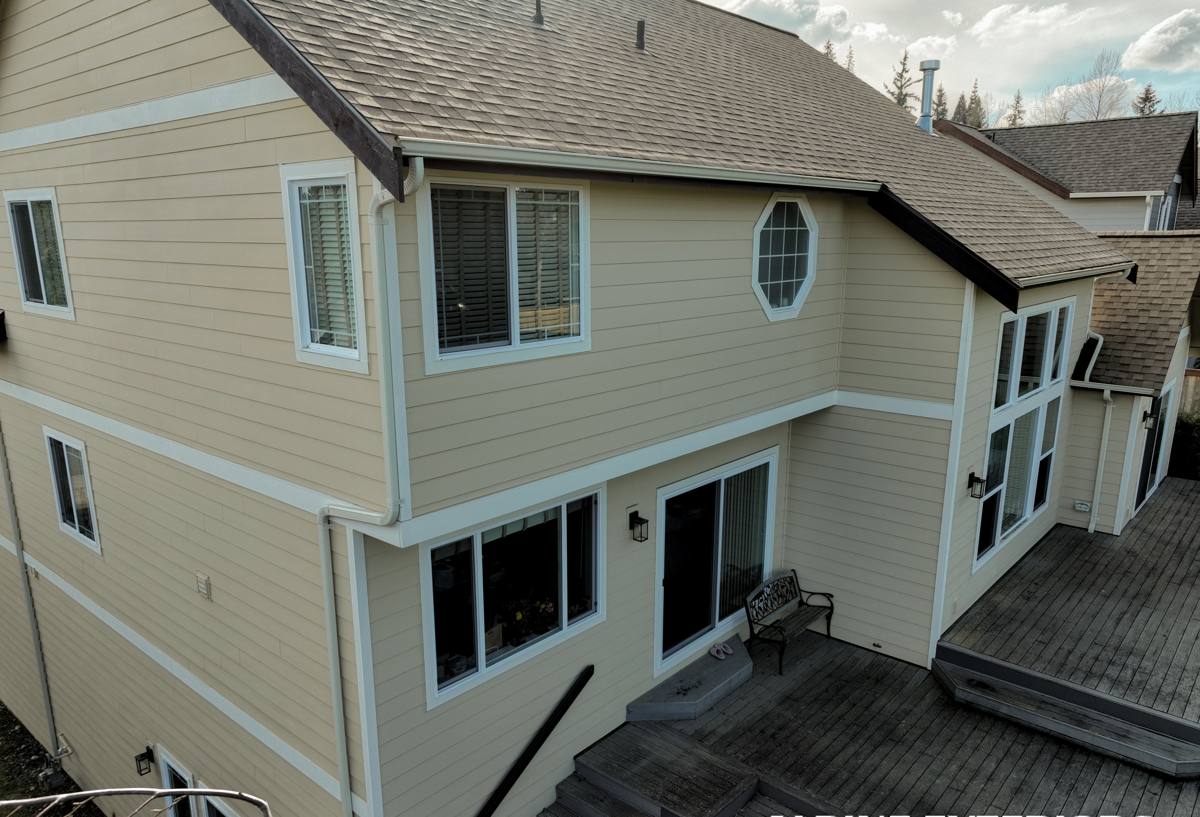
What the Local Climate Actually Does to Siding
Moss and Sustained Dampness
Whatcom County's moss season isn't a two-week nuisance — it's a standing condition from roughly October through April, longer on north-facing walls or anywhere shaded by mature trees. Moss and algae need three things to establish: moisture, organic debris, and a surface they can grip. Wood-based siding products give them all three. Fiber cement doesn't feed moss growth the way wood or wood-composite products can, and a factory-applied finish resists the kind of surface breakdown that gives spores something to hold onto.
Wind-Driven Rain
Storms coming off the Strait don't just fall straight down — they push rain sideways into walls, especially on west and southwest exposures. That kind of driving rain finds gaps at butt joints, trim intersections, and anywhere flashing was skipped or done wrong. The siding material matters less here than the installation detailing, but the material still has to tolerate repeated wetting without swelling, delaminating, or losing paint adhesion.
Salt Air, Even Inland
Nooksack sits back from the water, but this is still a coastal county, and salt-laden air travels further than people assume, especially during winter storm patterns. Salt accelerates corrosion on fasteners and metal flashing and speeds up the breakdown of lower-grade paint films. It's a slower, quieter version of what fully waterfront homes deal with, but it's a real factor in material selection.
Freeze-Thaw and Temperature Swings
Whatcom County doesn't get brutal winters, but it does get repeated freeze-thaw cycling — cold nights, damp days, occasional hard frosts. Materials that absorb moisture and then freeze are prone to cracking and checking over time. This matters more for wood and some composite products than for cement-based siding, but it's part of why we're specific about which product line goes on which exposure.
Why We Only Install James Hardie Fiber Cement
We get asked why we don't offer vinyl, LP SmartSide, or other fiber cement brands as options. The honest answer is that we standardized on one product because it's the one we trust to perform correctly, for the long term, in this exact climate — and because offering multiple product lines means diluting the expertise that makes an install actually last.
- Non-combustible core — fiber cement doesn't feed a fire the way wood-based or vinyl products can, which matters on rural Whatcom County lots near tree cover.
- ColorPlus factory finish — baked-on finish applied under controlled conditions holds color and resists fading, chalking, and moss adhesion better than field-applied paint on wood trim.
- Climate-engineered HZ5 formulation — Hardie's HZ5 product line is engineered for freeze-thaw and moisture-cycling climates, which is exactly what Whatcom County delivers.
- Dimensional stability — fiber cement doesn't swell and shrink with moisture the way wood does, so joints, caulk lines, and paint film stay intact longer.
- Real warranty backing — a manufacturer warranty that's transferable and tied to a specific, correctly documented installation, not a vague promise.
We're not going to tell you competing products are junk — most have legitimate uses. But we've made a professional call that installing one product line correctly, every time, beats offering five options and being mediocre at all of them.
What a Correct Installation Involves Here
Fiber cement siding is only as good as the water management system behind it. In a climate with this much sustained rain exposure, the details most homeowners never see are the ones that determine whether the siding lasts 30+ years or starts failing at year eight.
Weather-Resistive Barrier and Rainscreen
A correctly installed weather-resistive barrier (WRB) goes down first, lapped properly from bottom to top so water sheds outward instead of behind the barrier. On many Nooksack-area homes — especially those with significant tree shade or west-facing exposure — we recommend a rainscreen gap behind the siding. That small air space lets any moisture that does get behind the panels drain and dry instead of sitting against the sheathing.
Flashing at Every Penetration
Windows, doors, hose bibs, light fixtures, deck ledgers — every penetration through the siding plane is a potential entry point for wind-driven rain. Correct flashing (not just caulk) at each of these is non-negotiable, and it's the single most common thing we find missing or done wrong when we're called out to look at a failing install from another crew.
Fastener Spacing and Type
Hardie specifies fastener type, spacing, and placement for a reason — get it wrong and you get panel cracking, blow-off in wind events, or corrosion staining down the road. We use corrosion-resistant fasteners appropriate for this climate, placed to Hardie's published specs, not shortcuts that speed up the job.
Caulking and Joint Treatment
Butt joints and trim intersections need the right sealant, applied correctly, or they become the first failure point in driving rain. We follow Hardie's joint treatment guidance rather than relying on caulk to cover for a poor fit.
Our Process for a Nooksack-Area Project
- On-site assessment — we walk the exterior, check existing siding and sheathing condition, note tree cover, drainage patterns, and exposure on each wall.
- Moisture check — where there's any sign of past water intrusion, we check sheathing condition before quoting, since hidden rot changes the scope.
- Product and line selection — HZ5 panel or lap siding selection based on exposure, with trim and accent choices from the Hardie lineup.
- Written estimate — clear scope, product specifications, and timeline, no vague allowances.
- Tear-off and prep — old siding removed, sheathing repaired as needed, WRB and rainscreen installed correctly before any Hardie product goes up.
- Installation to Hardie spec — fastener pattern, flashing, joint treatment, and clearances all done to manufacturer requirements so the warranty is intact.
- Final walkthrough — we go over the finished work with you before calling the job done.
Why a Local Crew Matters
A crew that already works Blaine and the surrounding Whatcom County communities knows this climate without having to learn it on your house. That means knowing which exposures need extra flashing attention, understanding how far salt air actually reaches inland, and having a realistic sense of how long moss takes to establish on a given wall orientation. It also means we're not driving in from out of the area for a warranty callback — if something needs attention after the job, we're already local.
There's also a practical scheduling advantage: local crews aren't juggling long drive times between jobs, so weather windows for tear-off and install day get used efficiently instead of wasted in transit.
Cost Factors for a Nooksack-Area Siding Project
Every home is different, so we don't quote sight-unseen, but these are the factors that most commonly move a project's scope and cost:
| Factor | Why It Matters |
|---|---|
| Sheathing condition | Hidden moisture damage found during tear-off adds repair scope before new siding goes up |
| Home size and wall complexity | More corners, dormers, and trim details mean more labor and material |
| Siding profile (lap vs. panel vs. shingle) | Different Hardie profiles have different material and labor costs |
| Existing exterior removal | Full tear-off of old siding vs. a simpler strip-down changes labor time |
| Access and site conditions | Tree cover, slopes, and setback affect staging and safety requirements |
| Trim and accent scope | Window trim, corner boards, and fascia replacement add to the project |
Signs Your Current Siding Needs Attention
- Persistent moss or algae growth that returns quickly after cleaning
- Soft spots, bubbling, or visible warping, especially near the bottom of walls
- Paint that's peeling or chalking heavily rather than just fading
- Gaps opening up at seams, corners, or trim joints
- Rising energy bills that suggest air and moisture infiltration
- Visible rot or staining around windows, doors, or penetrations
Any one of these on its own might be minor. Several together, especially on a home that's had wood or older composite siding for a couple decades, usually means it's worth a real assessment before another wet season sets in.
Ready to Talk About Your Home
If you're in the Nooksack area and dealing with siding that's losing the fight against moss, moisture, or age, we'd rather give you a straight assessment than a sales pitch. Reach out for a free, no-pressure estimate — we'll look at your home's actual exposure and condition and tell you honestly what it needs.