 Blaine Siding
 Building a Deck in Everson: What Whatcom County Weather Demands
Everson sits a few miles inland from the Whatcom County coastline, but the weather that shapes a deck build here isn't any gentler for it. Rain moves through the Nooksack Valley for most of the year, humidity lingers longer than it does on more open ground, and yards with mature trees or fence lines stay shaded and damp long after a storm has passed. A deck built for Everson has to shed water and dry out fast, not just survive an occasional downpour.
Closer to the water — Blaine, Birch Bay, and the rest of the county's coastline — salt air is the dominant stress on fasteners and finishes. In Everson, the driving rain and the county's long moss season do similar damage from a different angle: less salt corrosion, more sustained ground moisture and organic growth working into joints, ledger boards, and anywhere water is allowed to sit instead of drain.
Rain, Humidity, and a Long Moss Season
Moss doesn't just grow on roofs. Left unchecked, it colonizes deck boards, the tops of railings, and anywhere debris collects against a structure. It holds moisture against wood and composite surfaces alike, which accelerates rot in untreated lumber and can dull or stain even low-maintenance decking if it's never cleaned off. A deck designed with drainage and airflow in mind — proper board spacing, gaps at the perimeter, joists that aren't buried in mulch or soil — fights moss and mildew far better than one built without those details in mind.
Freeze-Thaw Cycles and Ground Movement
Whatcom County doesn't see the deep freezes of the nearby mountains, but Everson still gets enough freeze-thaw cycling each winter to move soil around footings that weren't set deep enough or poured correctly. A marginal footing shows itself within a few winters — as squeaking, slight racking, or a railing post that's no longer quite plumb. Getting footing depth and concrete work right the first time matters more here than it does in a drier, more stable climate.
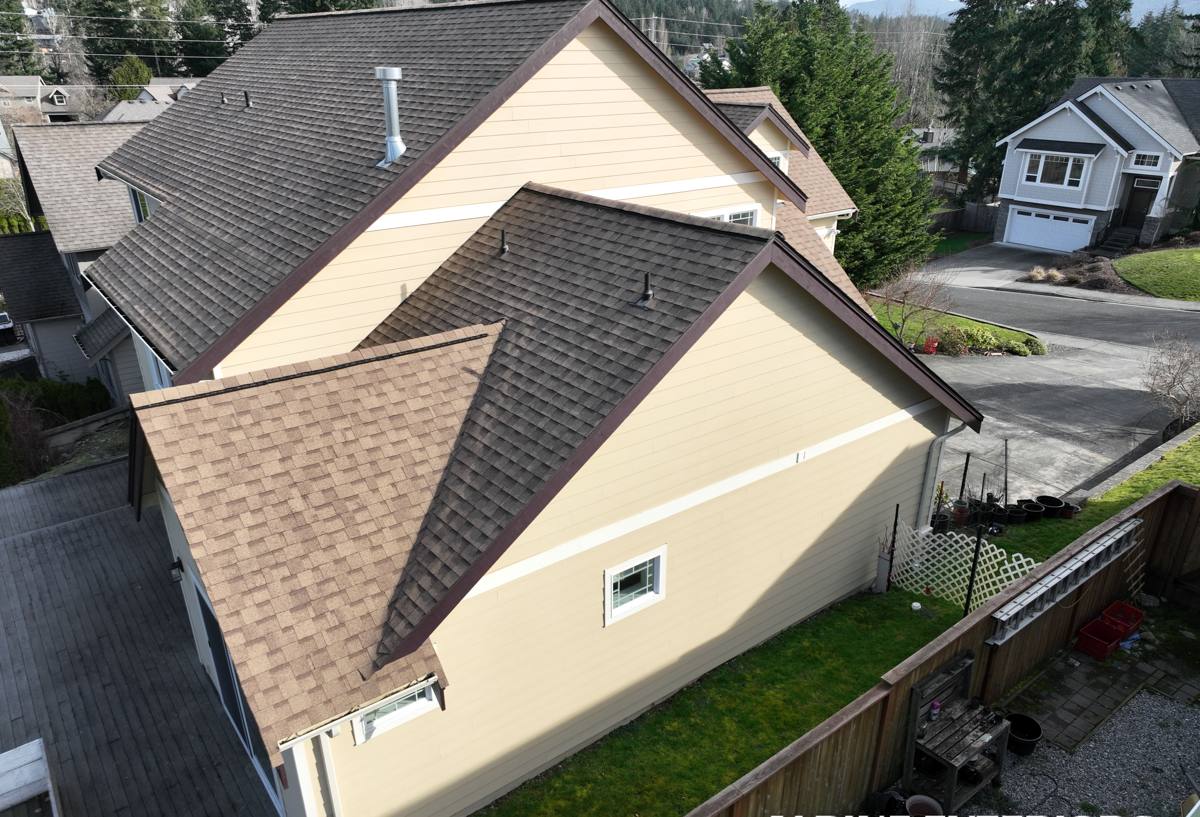
What a Correctly Built Deck Looks Like Here
Footings and Framing
Everything under the decking is what determines whether the structure is still solid in fifteen years. That means footings sized and set to local frost depth and soil conditions, ledger boards flashed correctly where they attach to the house (this is one of the most common failure points we find on older decks), and joists and beams sized for the actual span and load rather than for whatever is fastest to install. Galvanized or stainless fasteners rated for treated lumber and outdoor exposure aren't optional in this climate — the wrong hardware corrodes and streaks the wood around it within a couple of wet seasons.
Choosing a Decking Material
There's no single right answer — it depends on budget, how much upkeep you're willing to do, and how the deck will be used. Pressure-treated wood is the least expensive option up front and looks good for years if it's cleaned and resealed on a regular schedule, but that maintenance isn't optional in a climate this wet; skip it and moss, graying, and splintering show up quickly. Composite and PVC decking cost more initially but don't need staining or sealing, and they resist the moisture and moss growth that wood struggles against. Cedar sits in between: naturally more rot-resistant than treated lumber, with a look a lot of homeowners want, but it still needs periodic cleaning and sealing to hold its color and stay protected from the rain.
| Material | Upfront Cost | Maintenance | How It Handles This Climate |
|---|---|---|---|
| Pressure-Treated Wood | Lowest | Annual cleaning, reseal every 1-2 years | Prone to moss and graying without upkeep; solid if maintained |
| Cedar | Moderate | Cleaning and sealing every 1-2 years | Naturally rot-resistant; still needs care to stay sealed |
| Composite | Moderate to High | Occasional wash, no staining or sealing | Resists rot and moisture well; shaded areas can still need moss cleaning |
| PVC / Capped Composite | Highest | Occasional wash | Most moisture- and mold-resistant option available |
Other Cost Factors
Material is only part of what determines the total cost of a custom deck. Size and layout matter — multi-level decks, built-in benches, or complex framing around trees and slopes all add labor. Height off the ground changes what code requires for railings and stairs. And whether the project is a straightforward replacement of an existing footprint or a new deck built from scratch, with new footings and possibly new permitting, makes a real difference in both cost and timeline. We walk through all of this with you during the estimate so there aren't surprises once the work starts.
Common Issues We Find on Existing Everson Decks
When we're called out to look at a deck that's showing problems, a handful of issues come up again and again in this area:
- Ledger boards that were never flashed, letting water track behind the siding and into the rim joist
- Undersized or shallow footings that have shifted or heaved over time
- Moss and organic buildup trapped between boards installed with no gap or drainage
- Rusted or incompatible fasteners staining the wood and weakening connections
- Railings and stair stringers that were never properly anchored and have started to flex
Most of these trace back to shortcuts taken during the original build, not to the age of the deck itself. A deck built correctly the first time, with this climate in mind, shouldn't need major structural work for decades.
Covered Decks and Partial Roofs: Worth Considering Here
Given how much of the year Whatcom County spends under rain, a covered deck or a roof extension over part of the space is worth thinking about at the design stage, even if it adds to the project. A covered section keeps furniture, grills, and foot traffic areas dry through most of the year and cuts down on how much direct weathering the decking underneath takes. It's not a fix-all, though — a roof over a deck changes how water sheds off the structure, and it has to be flashed and vented correctly where it ties into the house, or you've traded one moisture problem for another. If you're set on a fully open deck instead, that's a perfectly reasonable choice too; it just means the decking material and drainage details underneath carry more of the weather-resistance burden on their own.
Our Custom Deck Process
Site Visit and Design
We start by walking the property with you — looking at drainage, sun and shade patterns, how the space will actually be used, and where the house attachment point makes sense. That's also when we talk through material and layout options honestly, including what each one will actually cost you in upkeep over time, not just at installation.
Permits and Setbacks
Most new decks and many deck replacements in Whatcom County require a building permit, and there are setback rules depending on your property and how the deck attaches to the house. We handle that process as part of the job rather than leaving it on the homeowner to sort out — it's part of doing the work correctly, not an extra step tacked on.
Build, Flashing, and Final Check
Framing, footings, and ledger flashing get done to code, not to whatever will pass a quick glance. Once the deck is built, we walk it with you before calling the job finished, checking that railings, stairs, and finish details are solid and match what was discussed at the start.
Railings, Fascia, and Finish Details
The details that get skipped on a rushed deck job are usually the ones that show the most in a climate like this. Fascia boards that aren't properly capped or flashed will show water staining and rot faster than the structural lumber behind them. Railing posts need to be through-bolted into the framing, not just screwed to the rim joist, both for safety and because a loose post works itself looser every time it gets rained on and dries out again. Stair stringers and treads see the most foot traffic and the most direct weather exposure, so the fastener and material choice there matters as much as anywhere else on the structure. Whether you want simple wood balusters, metal or cable railing, or a low-maintenance composite rail system is largely a style and budget decision — all of them hold up fine here as long as the posts and connections underneath are done right.
Maintenance Checklist for a Whatcom County Deck
Whatever material you choose, a little seasonal attention goes a long way in this climate:
- Sweep debris off the deck regularly, especially in fall when leaves and needles collect between boards
- Clean moss and algae off the surface at least once a year, before it has a chance to stain or hold moisture
- Check that gaps between boards are still clear and not packed with dirt or organic debris
- Inspect ledger board flashing and the point where the deck meets the house for any signs of water intrusion
- Reseal or stain wood decking on the schedule the product calls for, rather than waiting until it looks visibly gray or dry
- Test railings and stair stringers by hand each spring for looseness or flex
Why Hire a Crew That Already Works in Everson
A deck built by someone unfamiliar with this area's rain patterns, soil, and permitting process is more likely to miss the details that matter here — the flashing, the footing depth, the drainage and airflow under and around the boards. We work throughout Whatcom County, from the coastline near Blaine to inland communities like Everson, and we build every deck the same way: sized and framed for the load, flashed and fastened for the moisture, and finished so it looks right and holds up through the wet season instead of just through the first summer.
If you're planning a new deck or need to replace one that's showing its age, we're happy to take a look and walk you through your options honestly. Fill out the form below for a free, no-pressure estimate.