 Blaine Siding
 What Everson Homes Need From a Composite Deck
Everson sits inland from Blaine along the Nooksack River in Whatcom County, and while it doesn't face the coast directly, the region's weather doesn't spare it. Homes here still deal with driving rain that comes through sideways during a storm, damp air that lingers for days at a time, and a moss and algae season that stretches far longer than most homeowners expect. A deck is an outdoor structure with no roof protecting it, so it takes the brunt of all of that, season after season, in a way siding and windows don't.
Composite decking is a good answer to that kind of exposure, but "composite decking" covers a wide range of products, and not all of them are built the same way or hold up the same way once they're outside in Whatcom County weather year-round. This page covers what a composite deck actually needs to do in Everson's climate, what a correct installation looks like, and how our process works for a deck built specifically for this part of the county — not a generic build that happens to land here.
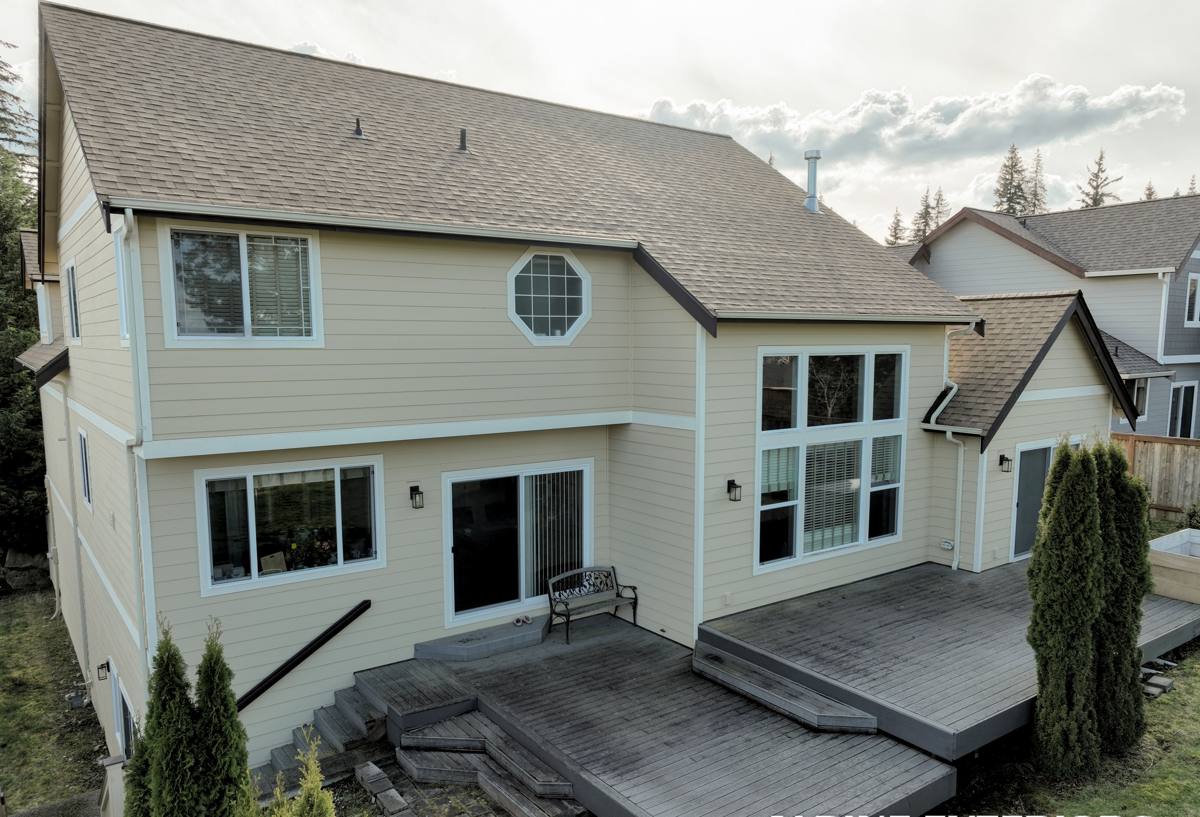
What the Local Climate Actually Does to a Deck
Long Stretches of Damp, Grey Weather
Whatcom County's wet season runs long, and Everson gets its share of it — overcast skies, steady drizzle, and humidity that doesn't fully let up for weeks at a stretch. Wood decking absorbs that moisture, swells, and eventually checks or rots at the fasteners. Composite decking doesn't absorb water the same way wood does, but the quality of the board and how it's built matter a lot for how well it actually resists that moisture over years rather than just the first season or two.
A Genuinely Long Moss Season
Anywhere shaded, damp, and cool for extended stretches grows moss well, and a deck surface checks every one of those boxes for months at a time. Moss and algae take hold in the grain of a low-quality or uncapped board far more readily than on a properly capped surface, and once established, they hold moisture against the board and make the surface slick and unsafe underfoot. Board selection and surface texture both affect how much of a problem this becomes over time.
Driving Rain and Wind-Driven Moisture
Storms coming through this part of Whatcom County often bring rain at an angle, not straight down, which pushes water under railings, into fastener holes, and against the edges of boards in ways calm rain doesn't. That matters more for the substructure — the framing underneath the visible decking — than it does for the boards on top, since wind-driven moisture finds its way into gaps and seams that a straight-down rain would never reach.
Freeze-Thaw Cycling
Everson sees more nights near or below freezing than areas right on the coast, and while it's not an extreme freeze climate, the repeated freeze-thaw cycling through the wet months matters. Water that gets into a crack, a fastener hole, or a poorly sealed cut end can expand when it freezes and widen that damage a little more each cycle. A deck built with that in mind — sealed cut ends, correct fastener placement, proper drainage — holds up through winter after winter instead of degrading a little more each year.
What "Composite Decking" Actually Means
Composite decking is generally a blend of wood fiber and plastic, but the ratio, the plastic type, and how the board is finished vary significantly between manufacturers and even between product lines from the same manufacturer. Two distinctions matter most for a climate like this one:
Capped vs. Uncapped
Capped composite boards have a plastic shell wrapped around a wood-plastic composite core. That cap is what actually blocks moisture absorption, resists staining, and slows UV fade — it's doing most of the protective work. Uncapped composite is the older style of the product, with the wood-plastic blend exposed on all sides, which means it absorbs moisture more readily and is more prone to mold, mildew, and surface wear in a wet, mossy climate like this one. We standardize on capped composite for that reason.
Board Density and Core Construction
Not all capped boards are built the same underneath the cap. Denser cores generally resist deflection and moisture wicking at cut ends better than lighter-weight cores, which matters over a long service life outdoors. This is part of why two composite boards that look similar in a showroom can perform very differently after five or ten Whatcom County winters.
What a Correct Composite Deck Build Involves
The decking boards get most of the homeowner's attention, but the substructure and fastening details are what actually determine whether the deck holds up over time. A build done right for Everson conditions includes:
- Framing material rated for ground contact and sustained moisture exposure, since damp conditions here are the rule, not the exception
- Joist spacing set to the specific composite product's span rating, not a generic wood-framing standard, since composite spans differently than lumber
- Hidden or corrosion-resistant fasteners rated for the board manufacturer's system, so the deck surface stays clean and the fastening holds over years, not just seasons
- Proper gapping between boards for drainage and airflow, so water and moss don't have a place to sit and accumulate
- Sealed or capped cut ends wherever a board is trimmed on site, since a cut edge is the one place an otherwise well-protected board can absorb moisture
- Flashing at the ledger board where the deck attaches to the house, so wind-driven rain doesn't work its way into the structure at that connection point
- Ventilation underneath the deck surface so moisture has somewhere to go instead of sitting trapped against the framing
Skip any one of these and the boards on top can look fine for a while even as the structure underneath is already having problems — which is exactly why the substructure gets as much attention from us as the visible decking does.
Composite vs. Other Decking Materials for This Climate
| Material | Moisture Behavior | Moss/Algae Resistance | Maintenance |
|---|---|---|---|
| Capped composite | Resists absorption well; performance depends on cap quality | Good on capped, textured surfaces | Periodic rinse; no staining or sealing needed |
| Uncapped composite | Absorbs moisture more readily than capped | More prone to buildup in the grain | Low, but surface wear shows sooner |
| Pressure-treated wood | Absorbs moisture; prone to swelling and checking | Grows moss readily if not treated | Regular staining, sealing, and cleaning |
| Cedar | Naturally moisture-resistant but still absorbs over time | Moderate; better than treated pine untreated | Sealing and cleaning to maintain appearance |
| Cellular PVC | Does not absorb moisture | Good, similar to capped composite | Low; costs more upfront than composite |
Every option on that table can be installed correctly or incorrectly — the material choice matters, but the installation details around it matter just as much for how the deck actually performs here.
Our Process for an Everson Deck Project
- Site visit and assessment — we look at drainage around the existing structure or planned footprint, sun and shade exposure, and how the deck ties into the house, since all three affect material and design decisions.
- Material selection — we walk through capped composite options and, where it makes sense, PVC or wood alternatives, with an honest read on cost, appearance, and long-term performance for your specific yard.
- Structural design — framing, joist spacing, and ledger attachment are specified to the chosen product's requirements and to local code, not built to a generic template.
- Installation — proper fastening, gapping, sealed cut ends, and ledger flashing are handled as standard practice, not upsells.
- Final walkthrough — we go over basic care with you before we leave, so you know what a properly built composite deck actually needs from you going forward, which is very little.
Maintaining a Composite Deck in This Climate
Composite decking is lower-maintenance than wood, but "low-maintenance" doesn't mean "no attention required," especially with a moss season as long as this one. A few habits go a long way:
- Rinse or sweep the surface periodically to keep organic debris from sitting long enough to feed moss and algae growth
- Keep the gaps between boards clear so water and airflow can move through as the deck was designed to handle
- Trim back plants or landscaping that shade the deck surface or trap moisture against its edges
- Check railing posts and fastener points once a year for any early sign of movement or corrosion
- Address any soft framing or standing water under the deck right away — that's a structural issue, not a cosmetic one, and it doesn't improve on its own
Why It Matters That We Already Work in Everson
A crew that mostly builds in drier or milder parts of the state can still put together a composite deck that looks right on installation day. What's harder to pick up without local experience is how this specific stretch of Whatcom County behaves over years — how long the moss season really runs, how far wind-driven rain travels under a railing during a storm, and which composite lines actually hold their color and surface after several wet winters here rather than just in a manufacturer's brochure.
Working in Everson and the surrounding area regularly means we're not guessing at those answers or learning them at your expense. We've built to these conditions before, seen how different products age here, and can tell you plainly what a deck in this climate actually needs versus what's just an add-on.
Get a Straight Answer About Your Deck
Whether you're replacing an aging wood deck, planning a new build, or just want an honest opinion on what composite decking would take on your Everson property, we're glad to walk the site with you and lay out the options plainly. Reach out below for a free, no-pressure estimate.