 Blaine Siding
 Building a Deck That Can Handle Point Roberts
Point Roberts sits out on its own point of land at the southern tip of a peninsula, surrounded on three sides by the Strait of Georgia and cut off from the rest of Whatcom County by the international border. That location gives homeowners water views most inland properties in the county can't match — but it also means decks here take a harder beating than decks built even a few miles away in Blaine. Salt-laden wind, driving winter rain, and a moss season that can stretch from October into May all work against wood and hardware that wasn't specified for this exposure. We build and repair decks throughout Point Roberts, and this page covers what actually holds up out here versus what looks fine for a year or two and then starts failing.
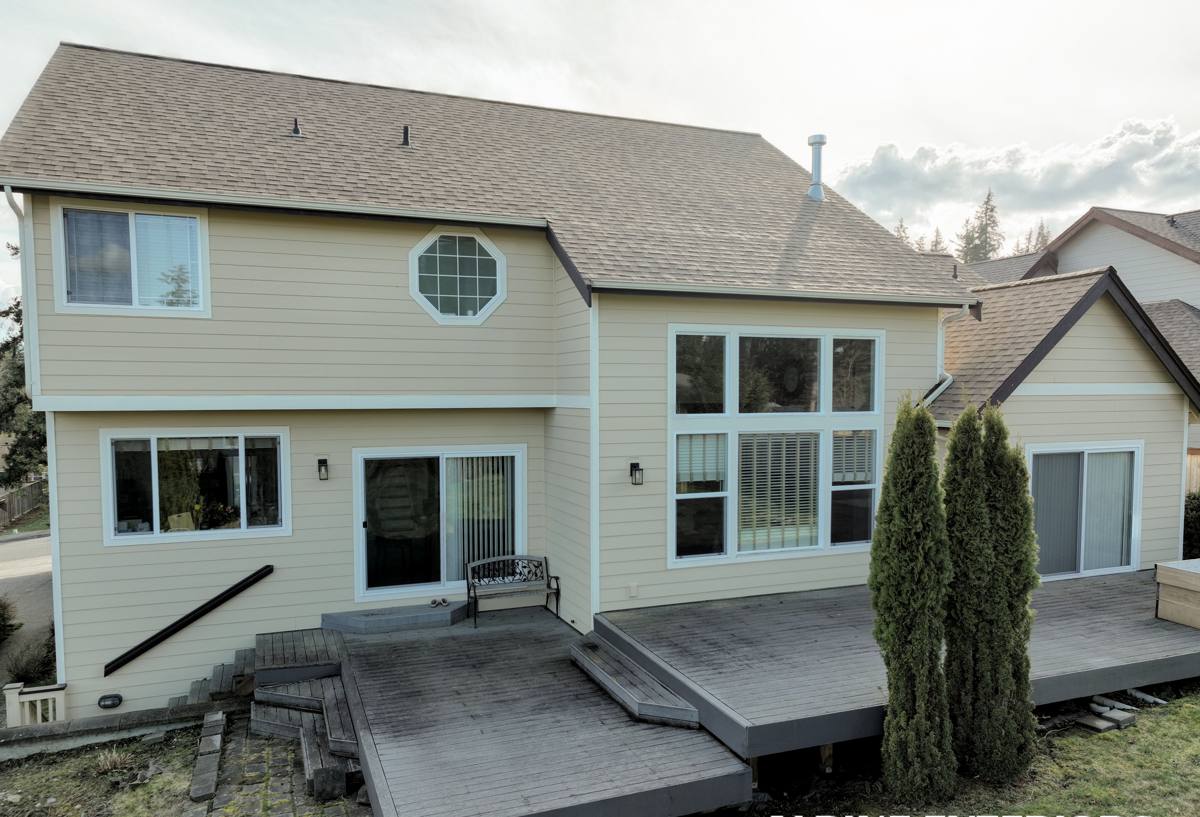
What This Climate Actually Does to a Deck
It helps to understand the specific ways Point Roberts weather attacks a deck, because it changes almost every material and fastening decision on the project:
- Salt air accelerates corrosion on any exposed metal — nails, screws, joist hangers, bolts — long before the wood itself would fail. A fastener that rusts loosens its grip on the wood around it, which is often the real reason an older deck starts to feel spongy or wobbly at the railing or stairs.
- Driving, wind-blown rain off the water doesn't fall straight down, so it finds its way under flashing, into end grain, and behind ledger boards that would stay dry in a more sheltered yard just a mile or two inland.
- Long moss season means any horizontal wood surface that stays shaded and damp — under trees, on the north side of a house, or in low-airflow spots near the ground — starts growing moss within a season or two, which holds moisture against the boards and turns decking into a slip hazard.
None of that means a deck can't last for decades in Point Roberts. It means the design, materials, and fastening details have to account for the exposure from the start, rather than being treated as an afterthought once problems show up.
Choosing Decking Material for This Location
There's no single "best" decking material for every Point Roberts property — it depends on sun exposure, budget, and how much upkeep you're willing to do. Here's how the common options actually perform in this climate:
| Material | How it holds up here | Upkeep | Typical lifespan |
|---|---|---|---|
| Pressure-treated fir/pine | Affordable and strong if fasteners and flashing are correct; more prone to moss and checking in shaded, damp spots | Annual cleaning, re-sealing every 2-3 years | 15-20 years with maintenance |
| Cedar | Naturally rot- and insect-resistant, ages to a silver-gray; still needs the same moss and moisture management as any wood | Cleaning and optional staining every 2-4 years | 20-25 years |
| Capped composite | Doesn't absorb water or feed moss the way raw wood does; performs well in salt air since the surface won't corrode or rot | Occasional washing, no sealing or staining | 25-30+ years, backed by manufacturer warranty |
| PVC decking | Fully synthetic and very stable in wet, salty conditions; can get slick if an algae or moss film is allowed to build up unwashed | Occasional washing | 25-30+ years, backed by manufacturer warranty |
Cost tends to run in roughly that same order — pressure-treated lumber is the least expensive up front, while composite and PVC cost more per square foot but trade labor-intensive upkeep for a longer, more predictable service life. For a shaded, water-facing deck that's inconvenient to get up on a ladder and reseal every couple of years, that trade-off often pays for itself.
What's Under the Boards Matters More Than the Boards
Framing and Fasteners
We spec stainless steel or heavy hot-dip galvanized fasteners and structural hardware on every deck we build in Point Roberts — not the standard-duty coated screws that hold up fine in a drier, inland yard. The joist hangers, ledger bolts, and post bases are the parts that actually hold the structure together, and they're also the parts most likely to corrode quietly out of sight until a railing or stair starts to feel loose.
Ledger Attachment and Flashing
Where the deck attaches to the house is the single most common failure point we find on older decks out here, because driving rain pushes water sideways behind a ledger board that isn't flashed correctly. Correct flashing — with the housewrap and siding lapped properly over it, never tucked in behind it — is what keeps that rain out of the rim joist and wall framing for the life of the deck.
Footings
Whatcom County frost depth and soil conditions vary across different Point Roberts lots, so footings get sized and set to code for the specific site rather than a one-size-fits-all approach. A sandy, well-draining lot near the water can call for different footing depth and diameter than a lot with heavier clay soil a few streets back.
Railings, Stairs, and Guardrail Code
Any deck more than a modest height off grade needs a code-compliant guardrail, and elevated or exterior stairs need handrails sized and positioned to current building code. Baluster spacing, rail height, and stair rise and run all get checked at inspection, and getting them right the first time avoids a costly rebuild after the fact. In a location with driving rain and salt-laden wind, hardware corrosion resistance matters just as much at the railing posts and stair stringers as it does in the framing below the boards.
Design Choices That Fight Moss Before It Starts
The biggest lever against moss isn't the decking material — it's airflow and drainage underneath and between the boards. We build in board gapping sized correctly for the material, slope the frame slightly so water actually runs off instead of pooling, and keep skirting and landscaping from sealing off airflow under low decks. On decks tucked under trees or against the north side of a house, we'll talk through the trade-offs honestly: more sun exposure isn't always possible, but better drainage and easier cleaning access usually are.
Our Deck Building Process
- On-site assessment — we look at sun and shade exposure, drainage, soil, and how the deck will tie into the house before recommending any materials.
- Design and material selection — sized, laid out, and specified for your site and budget, with an honest rundown of the upkeep each option actually requires.
- Permitting — we handle the Whatcom County permit application and inspections that apply to construction in Point Roberts.
- Framing — footings, posts, beams, and joists built with corrosion-resistant hardware and a correctly flashed ledger attachment.
- Decking and railing — installed to code with proper fastening, gapping, and guardrail spacing for the material chosen.
- Final walkthrough — we go over the care and cleaning specific to your material so it's clear what upkeep, if any, is on you going forward.
Permits and the Realities of Building in an Exclave
Point Roberts is part of Whatcom County and follows Whatcom County building code and permitting, but its geography adds a real logistical wrinkle: it's only reachable by road through Canada. That affects scheduling material deliveries, coordinating inspections, and simply getting a crew and equipment on site — none of it is difficult once a contractor is set up for it, but it's a different rhythm than a job in Blaine or Ferndale. A crew that already works Point Roberts regularly has that logistics worked out; a crew that doesn't may end up passing those delays and extra trips on to you in the schedule or the price.
Maintenance Checklist for Point Roberts Deck Owners
Whatever material your deck is built from, a few habits go a long way toward getting the full lifespan out of it in this climate:
- Sweep debris off the deck regularly so wet leaves and needles aren't left sitting on the boards
- Rinse or wash the deck at least once a year, more often in shaded areas, to keep moss from taking hold
- Check hardware — railing connections, stair stringers, the ledger area — for rust or looseness each fall
- Keep gutters and downspouts near the deck clear so runoff isn't dumping extra water onto or under it
- Reseal wood decking on the manufacturer's recommended cycle rather than waiting until it's visibly gray and dry
- Trim back vegetation that's shading the deck or blocking airflow underneath it
Why Local Experience Matters for This Job
A deck built for a sheltered, inland lot with generic hardware and a standard fastening schedule can look identical to one built correctly for Point Roberts on the day it's finished. The difference shows up three, five, ten years later, when the version with the wrong fasteners and flashing is dealing with soft spots and rust stains, and the one built for salt air, driving rain, and a long moss season is still solid. We've built and repaired decks throughout this stretch of Whatcom County long enough to know which details actually matter out here and which ones are just extra cost with no real benefit to you.
If you're planning a new deck or replacing one that's showing its age, we're happy to come take a look and walk through your options — no pressure, no obligation. Fill out the form below for a free estimate.