 Blaine Siding
 Siding in Custer Has to Work Harder Than It Looks
Custer sits inland from the water compared to homes right on Semiahmoo Bay or the Blaine waterfront, but that distance doesn't buy much protection. This corner of Whatcom County still sits in the direct path of weather systems moving off the Strait of Georgia and the Salish Sea, and the same salt-laden air, wind-driven rain, and shaded, slow-drying tree lines that punish coastal homes reach the farmland and wooded lots around Custer too. Add in a growing season that barely pauses and you get siding conditions that are demanding almost year-round, not just during storm season.
Homeowners here often assume that because they're not oceanfront, their siding gets an easier ride. In practice, the combination of moisture that lingers under tree cover, wind that pushes rain sideways into wall assemblies, and humidity that never fully dries out in winter is just as tough on a wall system as direct coastal exposure — sometimes tougher, because shaded, wooded properties dry out slower than open, breezy waterfront lots.
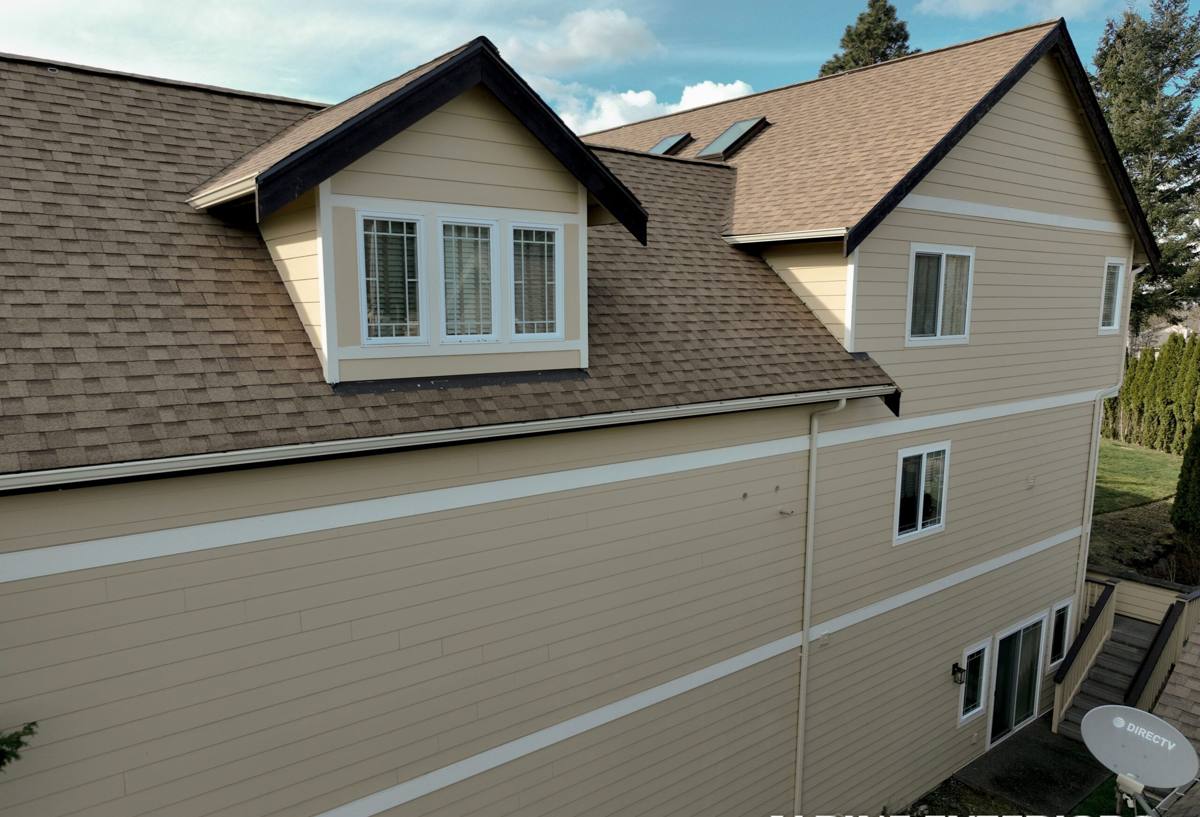
What Blaine-Area Homes Actually Need From Their Siding
Moisture Management Over Looks
The single biggest factor in how long siding lasts around Custer isn't color or style — it's how the material and the installation handle water that gets past the surface. Every siding product will get wet at some point. The question is whether it dries out cleanly or holds moisture against the wall sheathing.
Resistance to Biological Growth
Whatcom County's long, cool, wet stretches from fall through spring create ideal conditions for moss, algae, and mildew on exterior surfaces. Siding that stays damp for extended periods — especially on north-facing walls, under eaves, or near mature trees — becomes a growth surface faster than siding that sheds water and dries quickly.
Stability Through Wide Seasonal Swings
Custer sees real temperature and humidity swings across the year — soggy winters, drier summer stretches, and everything in between. Siding that expands, contracts, warps, or delaminates with those swings opens gaps at seams and fasteners, which is exactly where water intrusion starts.
Why We Install James Hardie and Nothing Else
We standardized on James Hardie fiber cement siding for every project we take on, including here in Custer, and we don't install vinyl, LP SmartSide, Cemplank, Allura, primed spruce, or cedar. That's not a marketing position — it's a decision based on how those materials perform, or fail to perform, in exactly the conditions this area produces.
Fiber cement is manufactured from cement, sand, and cellulose fibers, which makes it non-combustible and dimensionally stable in a way wood-based and vinyl products can't match. It doesn't rot the way wood siding can when moisture gets trapped behind it, it doesn't soften or deform in heat the way vinyl can, and it doesn't rely on a factory or field-applied primer that has to be perfectly maintained to keep moisture out, the way primed wood products do. James Hardie backs its siding with a strong transferable warranty and a factory-applied ColorPlus finish engineered to resist fading and cracking — but the real value is in the base material's behavior over decades in a wet marine climate, not just the paint job on top of it.
James Hardie also engineers specific product lines — its HZ5 and HZ10 systems — for different climate zones across the country, which lets us match the exact formulation to Whatcom County's rainfall and humidity profile rather than installing a generic all-climate product.
James Hardie vs. the Alternatives, Side by Side
| Material | Moisture Behavior | Moss / Algae Resistance | Long-Term Maintenance |
|---|---|---|---|
| James Hardie Fiber Cement | Won't rot; engineered for wet climates | Dense, factory-finished surface resists growth buildup | Occasional wash; repaint only if desired, decades out |
| Vinyl Siding | Sheds surface water but traps moisture behind panels; can warp | Grows moss/algae readily in shaded, damp spots | Panels crack and fade; can't be easily repaired or repainted |
| LP SmartSide | Engineered wood strand product; vulnerable if seams/edges aren't sealed and maintained | Prone to moisture-related growth if coating fails | Requires ongoing caulking and repainting to hold up |
| Cedar / Primed Spruce | Natural wood; absorbs moisture, swells, and can rot without diligent upkeep | High — organic material feeds growth in damp climates | Frequent refinishing, sealing, and spot repair needed |
This table reflects general material behavior, not a claim that every installation of these products fails — installation quality matters for any siding. But it explains why, for the climate around Custer and Blaine, we've chosen to specialize in one system rather than offer several.
What a Correct James Hardie Installation Involves
Fiber cement siding is only as good as the installation behind it. A large share of the siding failures we get called out to inspect trace back to installation shortcuts, not the material itself. On a Custer home, a correct install includes:
- A continuous weather-resistant barrier installed over the sheathing before any siding goes up, with all seams properly lapped and taped
- Correct flashing at every window, door, deck ledger, and roofline intersection — the points where most water intrusion actually starts
- Proper fastener placement and spacing per James Hardie's published installation specifications, not "close enough" nailing
- Manufacturer-required gaps between boards, trim, and adjoining surfaces to allow for material movement and drainage
- A drainage plane or rainscreen approach where wall conditions call for it, so incidental moisture can escape rather than sit against the sheathing
- Sealed and primed cut edges wherever factory-finished boards are field-cut
James Hardie's product warranty assumes installation to their written specifications. Skip steps here and you can end up with a product that's rated for decades performing far below that in practice — which is exactly the outcome we're trying to prevent by controlling installation quality end to end.
Our Process, Start to Finish
- On-site assessment. We walk the exterior, check existing siding and sheathing condition, and look at drainage patterns specific to the lot — tree cover, roof runoff, and sun/shade exposure all factor in.
- Product and color selection. We go through James Hardie's HZ5/HZ10 lines and ColorPlus color options relevant to this climate zone, and talk through trim and accent choices.
- Written estimate. A clear scope and price before any work starts — no surprise change orders for things we should have caught up front.
- Tear-off and substrate check. Old siding comes off and we inspect the sheathing underneath for hidden moisture damage before anything new goes up.
- Weather barrier and flashing. This step gets the most attention, because it's the layer that determines whether the wall stays dry for the next 30-plus years.
- Hardie board installation. Installed to manufacturer spec, including fastener pattern, gapping, and edge sealing.
- Final walkthrough. We review the finished job with the homeowner before calling it complete.
Maintenance a Custer Homeowner Should Actually Expect
One of the real advantages of fiber cement in this climate is how little ongoing maintenance it demands compared to wood or vinyl — but "low maintenance" isn't "no maintenance." A realistic upkeep routine looks like:
- An annual visual walk-around, especially after the wet season, checking for caulking gaps at trim and penetrations
- Periodic soft washing to clear moss, algae, or grime buildup — particularly on shaded, north-facing walls or areas under tree cover
- Keeping gutters clear and downspouts directed away from the foundation so wall-level moisture stays low
- Trimming back vegetation that holds moisture against the siding or blocks sun and airflow
- Prompt attention to any impact damage — fiber cement resists dings well, but a cracked board should be addressed before water gets behind it
What Drives Cost on a Custer Siding Project
Every home is different, so we won't publish a flat number that doesn't apply to your house — but these are the factors that typically move the price on a James Hardie project in this area:
| Factor | Why It Matters |
|---|---|
| House size and wall complexity | More corners, gables, and dormers mean more cutting, flashing, and labor time |
| Condition of existing sheathing | Hidden rot or water damage found during tear-off adds repair scope before new siding can go up |
| Product line and profile | Lap siding, shingle-style panels, and board-and-batten carry different material and labor costs |
| Trim and accent detail | Custom trim packages and color combinations add finishing time |
| Access and site conditions | Tree cover, tight lot lines, or difficult staging areas affect how efficiently a crew can work |
We walk each of these with the homeowner during the estimate so there's a clear picture of where the cost comes from — not just a bottom-line number.
Why a Crew That Already Works This Area Matters
Siding installation isn't one-size-fits-all across Washington. A crew that mostly works drier inland climates can do technically fine work and still miss details that matter specifically here — flashing details around features exposed to driving coastal rain, drainage approaches suited to shaded, slow-drying lots, and product choices matched to a marine-influenced humidity profile. Working regularly in Custer, Blaine, and the surrounding Whatcom County communities means we're applying the same lessons learned on the last job to the next one, rather than treating each house as a brand-new climate problem.
It also means faster response for warranty questions, follow-up service, or simply someone who already knows the area's weather patterns when you're deciding what to do about aging siding. That local continuity is a big part of why installation quality holds up over the decades a James Hardie system is designed to last.
If you're weighing a siding replacement or new construction siding for a home in or around Custer, we're glad to walk the exterior with you and put together a free, no-pressure estimate — use the form below to get started.