 Blaine Siding
 Blaine Harbor Roofs Work Harder Than Most
Blaine Harbor sits close enough to open water that every roof in the neighborhood deals with a combination most inland homes never face at the same time: salt-laden air off the water, driving rain that comes in sideways during winter storms, and a moss season that can run eight months out of the year in Whatcom County's damp, mild climate. Any one of those on its own is manageable. Together, they shorten the useful life of shingles, accelerate fastener corrosion, and hide damage in places a quick look from the ground won't catch.
When a storm rolls through with 40-50 mph gusts off the Strait, the damage isn't always the dramatic kind. More often it's a handful of lifted shingle tabs, a strip of flashing worked loose at a chimney or vent, or granule loss that won't show up as a leak for another year or two. Repairing that correctly the first time is what keeps a small storm event from turning into a bigger interior repair bill down the road.
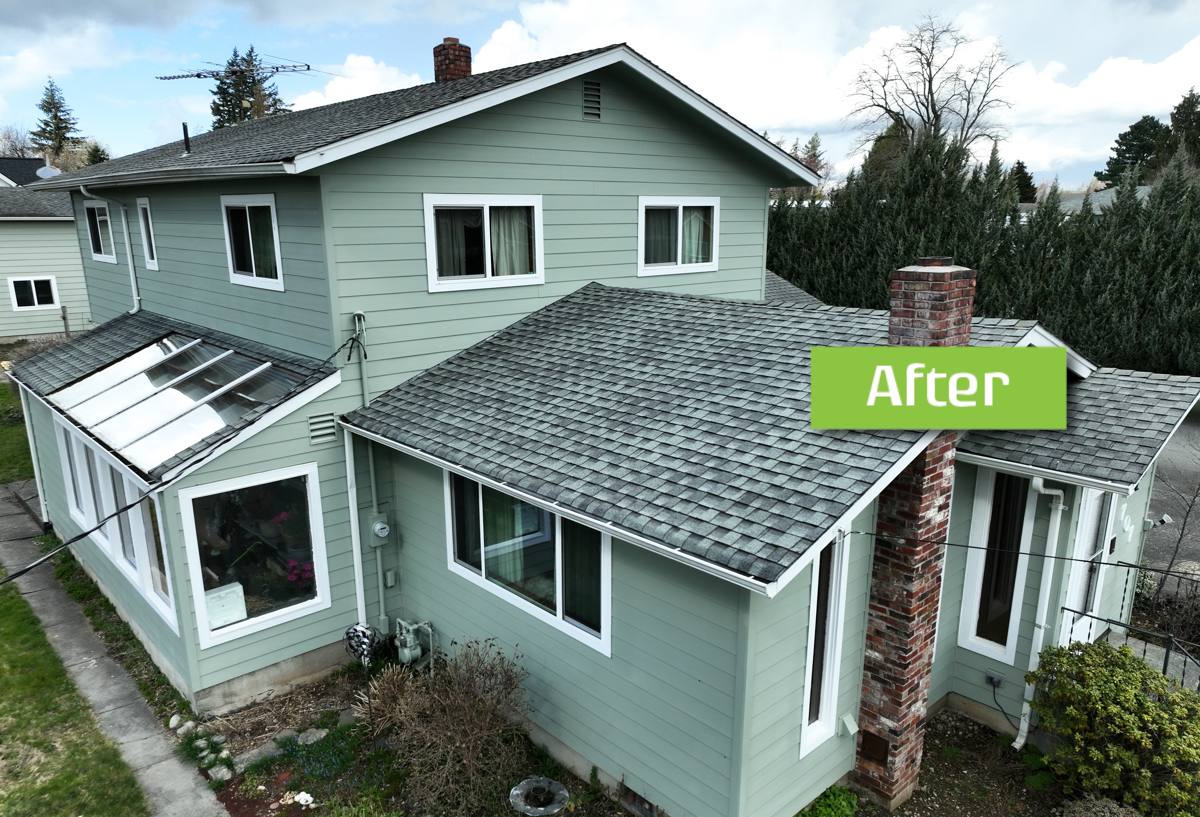
What Actually Counts as Storm Damage
Homeowners often assume "storm damage" means something dramatic — a tree limb through the roof, or shingles scattered across the yard. Sometimes it is that obvious. More often it's subtler, and it's exactly the subtler damage that gets missed until it's caused a secondary problem like a soft spot in the decking or a stain on a bedroom ceiling.
Common storm-related issues we find on Blaine Harbor roofs
- Shingle tabs lifted or creased by wind uplift, especially along ridge lines and roof edges facing the water
- Flashing pulled away from chimneys, skylights, and sidewalls where wind-driven rain finds the smallest gap
- Granule loss from hail or heavy debris impact, which accelerates UV and salt-air breakdown underneath
- Fastener backout — nails working loose as sheathing gets wet, dries, and shifts over multiple storm cycles
- Gutter and downspout separation that redirects water against fascia and roof edges instead of away from the house
- Ridge cap damage, since ridges take the brunt of wind loading on any roof in this area
None of these are always visible from the driveway. That's the reason a real inspection after a significant wind event matters more here than in areas with calmer weather patterns.
Our Storm Damage Repair Process
We approach storm repair the same way every time, whether the call comes in the day after a windstorm or weeks later once a slow leak has been noticed.
1. Ground and roof-level inspection
We start by walking the roof, not just looking at it from below. Wind damage in Blaine Harbor tends to concentrate on the sides facing the water and along ridge and hip lines, so we check those areas closely along with valleys, penetrations, and gutter lines.
2. Photo documentation
Every area of concern gets documented before any repair work starts. This matters for your own records and, if you're filing a claim, gives your insurance adjuster a clear, dated account of the damage rather than a verbal description after the fact.
3. Honest scope of work
We tell you plainly whether you're looking at a spot repair, a partial re-roof of a damaged section, or — if the roof was already near the end of its service life before the storm hit — a full replacement. We don't pad a small repair into a bigger job, and we don't undersell a repair when the underlying roof is too far gone to patch reliably.
4. The repair itself
Depending on scope, this means replacing damaged shingles and matching them as closely as possible to existing coloring, resetting or replacing flashing with proper step and counter-flashing technique, securing or replacing backed-out fasteners, and clearing and resealing any compromised roof-to-wall transitions.
5. Final walk-through
We go over what was done, what we found, and what (if anything) is worth keeping an eye on going forward — particularly for a roof that's showing its age but wasn't bad enough to warrant full replacement yet.
Salt Air and Moss: The Two Slow Problems Behind the Fast Ones
Storm damage rarely happens to a roof in a vacuum. In Blaine Harbor, two background conditions make storm damage worse than it would be somewhere drier and further from the water.
Salt air and metal fasteners
Salt in the air accelerates corrosion on exposed nail heads, metal flashing, and gutter hardware. A fastener that might hold tight for fifteen years inland can start showing rust and backing out well before that this close to Semiahmoo Bay and Drayton Harbor. That's why we favor corrosion-resistant fasteners and flashing metals for repair work in this area rather than treating it as a generic inland repair.
Moss and moisture retention
Whatcom County's long wet season keeps roofs damp for extended stretches, which is exactly the condition moss needs to establish. Moss holds moisture against the shingle surface, which works against the granules and the asphalt mat underneath over time, and it can lift shingle edges just enough for wind to get a grip during the next storm. A roof with heavy moss growth is more vulnerable to storm damage than a clean one, which is why moss treatment is often part of a sensible long-term maintenance conversation, not a separate cosmetic issue.
Repair or Replace? The Honest Factors
Not every storm-damaged roof needs the same answer. The right call depends on the roof's age, the extent of the damage, and what's happening underneath the surface layer.
| Factor | Leans toward repair | Leans toward replacement |
|---|---|---|
| Roof age | Under 12-15 years, no widespread wear | Nearing or past typical asphalt shingle lifespan |
| Damage extent | Isolated to one slope or section | Spread across multiple slopes or the whole roof |
| Decking condition | Solid, no soft spots found | Soft, delaminated, or water-stained sheathing |
| Shingle match | Close match available for spot repair | Discontinued or badly weathered shingle line |
| Moss/moisture history | Minor, treatable growth | Long-term moss damage already degrading the mat |
| Insurance scope | Adjuster approves targeted repair | Adjuster approves full slope or full roof |
We'll walk you through where your roof lands on this list before recommending either path — there's no benefit to us in overselling a replacement, and no benefit to you in underfixing a roof that's already past the point where patching makes sense.
Materials We Use for Storm Repairs
Repair materials matter more in a coastal, wet climate than in a drier one, since the margin for error on flashing and fastener choice is smaller.
| Component | What we use and why |
|---|---|
| Shingles | Matched as closely as possible to existing product; where an exact match isn't available, we discuss visible-mismatch trade-offs honestly rather than surprising you later |
| Flashing | Corrosion-resistant metal, properly layered (step and counter-flashing) rather than relying on sealant alone to hold a joint together |
| Fasteners | Corrosion-resistant nails appropriate for coastal exposure, set to proper depth rather than over- or under-driven |
| Underlayment (where exposed) | Synthetic underlayment when a repair opens up enough roof area to warrant it, for better moisture resistance than felt in a wet climate |
| Sealants | Used to finish and protect a mechanically sound repair, not as a substitute for correct flashing work |
We don't chase the cheapest available material for a storm repair just to close the job faster. A repair done with the wrong-grade fastener or flashing in this climate tends to fail again within a few storm seasons, which costs you more in the long run than doing it right the first time.
Working With Your Insurance Claim
Most storm damage repair in Blaine Harbor involves an insurance claim at some point, and a smooth claim comes down to documentation and a scope of work that matches what actually happened to the roof.
- We document damage with dated photos before touching anything, so there's a clear record independent of memory
- We write repair estimates in plain terms that describe the actual damage and the actual fix, not inflated line items
- We're available to speak with your adjuster directly about what we found on the roof if that helps move your claim along
- We won't tell you to claim damage that isn't there, and we won't downplay damage that is — both create problems for you later
What to Do Right After a Storm
The days immediately following a wind or rain event are when quick, careful action matters most.
- Check attic spaces and ceilings for new water stains, even faint ones — they show up before a visible drip does
- Look at gutters and downspouts for granules collecting at the bottom, a sign of accelerated shingle wear
- Note any shingles or debris found in the yard, and where on the roof they likely came from
- Avoid getting on the roof yourself after a storm — wet, wind-loosened shingles are unstable footing
- Call for an inspection sooner rather than later; a small lifted shingle left through another storm cycle often becomes a bigger repair
- Keep any photos you take yourself — they add to the record even if we do our own documentation afterward
Why Local Storm Repair Experience Matters in Blaine Harbor
A roofer who mostly works drier, inland parts of Whatcom County will approach a storm repair differently than one who works Blaine Harbor regularly. The difference shows up in small decisions — which fastener grade to use so close to the water, how aggressively to plan for moss regrowth in the repair area, where wind uplift tends to concentrate on this particular exposure. None of that is guesswork when it's based on repeatedly working roofs in this specific stretch of coastline.
It also matters for follow-through. Storm damage repair isn't always a one-visit job — sometimes a repair needs a follow-up check after the next heavy rain to confirm it's holding, or a moss treatment conversation six months later as part of ongoing maintenance. A crew that's local to the area is positioned to be there for that, not just for the initial patch.
Get an Honest Look at Your Roof
If a recent storm has you wondering whether your roof needs attention, we're glad to take a look. The estimate is free, there's no pressure to move forward with anything, and you'll get a straight answer about what we find — whether that's a small repair, a bigger scope, or simply confirmation that your roof came through fine. Use the form below to get started.