 Blaine Siding
 Why Semiahmoo Homes Need a Different Approach to Metal Roofing
Semiahmoo sits right where the Strait of Georgia meets Drayton Harbor, which means homes here take on a combination of weather stress you don't see even a few miles inland in Blaine. Salt-laden air off the water, near-constant winter rain, and long stretches of shade and moisture that keep moss active most of the year all work against a roof at the same time. Metal roofing can handle this environment better than almost any other material, but only when it's specified and installed with these specific conditions in mind. A metal roof detailed the same way you'd detail one in Spokane or eastern Washington will not perform the same way out here.
We work on homes throughout Whatcom County, and Semiahmoo's waterfront and near-waterfront properties are some of the more demanding roofs we see. That's not a knock on the neighborhood — it's just physics. Salt accelerates corrosion, wind off the water drives rain sideways into laps and fasteners, and the tree cover and marine humidity that make the area beautiful also keep roof surfaces damp longer than they'd stay in a drier climate. Getting a metal roof right here means treating those three factors as the design brief, not as afterthoughts.
What Salt Air Actually Does to a Roof
Salt air is corrosive to metal, full stop. It doesn't matter how good the base material is if the fasteners, flashing, or cut edges are left exposed to it. The failures we see on older metal roofs near the water almost always start in the same places: exposed fastener heads, unsealed cut edges, and dissimilar metals in contact with each other setting up galvanic corrosion. None of that is a flaw in metal roofing as a material — it's a flaw in how a given roof was detailed for a marine environment.
What Correct Marine-Grade Detailing Looks Like
- Fasteners and trim rated for coastal exposure, not standard-grade hardware
- Factory-painted or coated panel edges, with field-cut edges sealed rather than left bare
- No direct contact between incompatible metals (for example, uncoated steel touching copper) without an isolating barrier
- Concealed-fastener panel systems where budget allows, since fewer exposed penetrations means fewer future corrosion points
- Regular rinsing recommended to owners as basic maintenance — salt residue left to sit does more damage than salt air passing through
None of this is exotic. It's standard practice for coastal roofing, but it only gets applied consistently by a crew that installs in this environment regularly and treats it as the default, not an upgrade.
Driving Rain and Wind-Driven Water Intrusion
Whatcom County gets plenty of rain, but what matters more for a roof near the water is the angle it arrives at. Wind off the Strait pushes rain sideways and upward under eaves, around chimneys, and into lap seams that would shed water fine in a calmer inland setting. A roof that's watertight in a straight-down rain test can still leak in a wind-driven storm if the underlayment, flashing laps, and panel overlaps weren't built for lateral water pressure.
Where Wind-Driven Leaks Actually Start
In our experience, the vast majority of metal roof leaks trace back to one of a handful of spots, not general panel failure:
- Valleys where two roof planes meet and water concentrates under wind pressure
- Roof-to-wall transitions and step flashing that wasn't lapped correctly
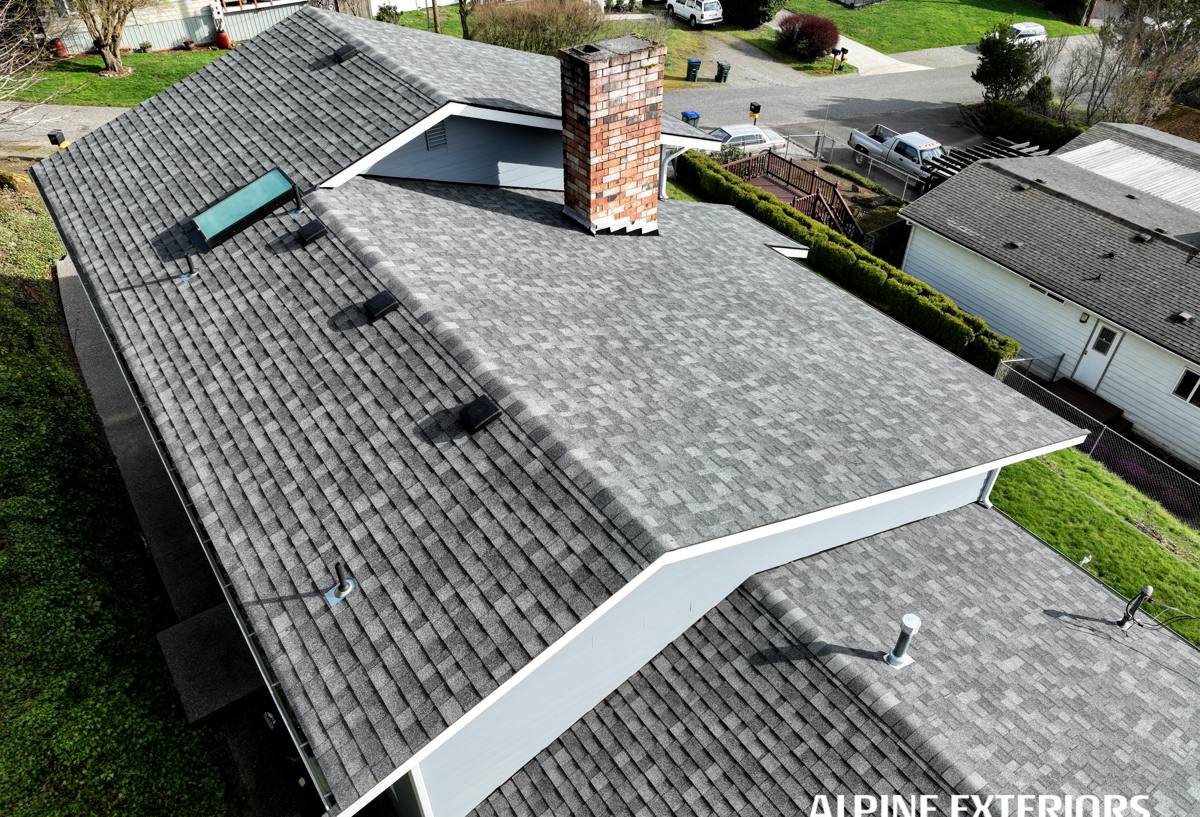
- Penetrations for vents, chimneys, and skylights with undersized or aging boot flashing
- Eave and rake edges where wind can lift water back under the panel
Proper underlayment matters as much as the visible metal here. A synthetic, self-adhered underlayment at eaves, valleys, and penetrations gives the roof a second line of defense if wind ever pushes water past the panel laps — which, on a property exposed to the Strait, it eventually will during a strong system.
Moss, Shade, and the Long Wet Season
Whatcom County's growing season for moss is long, and Semiahmoo's tree cover and marine humidity extend it further. Moss doesn't just sit on a roof looking bad — on the wrong roofing material, it holds moisture against the surface, works into laps and seams, and can lift shingles or shorten the life of the assembly underneath. Metal roofing is one of the better materials for moss resistance because it's a hard, smooth, non-porous surface with nothing organic for moss to root into the way it can with wood shakes or shingle granules.
That said, metal roofing isn't moss-proof on its own — moss can still take hold in debris that accumulates in valleys, behind chimneys, or wherever leaves and needles pile up and stay wet. The panel material resists it far better than shingles do, but shade and standing debris will still grow moss on anything eventually.
What Actually Reduces Moss on a Metal Roof
- Keeping valleys, gutters, and low-slope transitions clear of needles and leaf litter
- Trimming back overhanging branches where practical, to cut down on shade and debris both
- Choosing panel profiles and colors that shed debris rather than trap it in tight ribs
- Periodic gentle rinsing rather than pressure washing, which can damage coatings and force water under laps
Panel Types and What We Recommend for This Area
Not every metal roofing product is a good fit for a coastal, high-moisture property, and we tell homeowners that directly rather than pushing whatever's easiest to install. Standing seam and quality steel or aluminum panel systems are what we generally recommend for Semiahmoo properties, because they offer the fewest exposed fasteners, the most consistent factory coatings, and the longest track record in marine climates.
| Panel Type | Fastener Exposure | Best Fit for This Area | Trade-Offs |
|---|---|---|---|
| Standing seam (concealed fastener) | None on field panels | Excellent — fewest penetration points for salt corrosion or wind-driven water | Higher material and labor cost |
| Exposed-fastener steel/aluminum panel | Screws through panel face | Good, if marine-grade fasteners and gaskets are used and maintained | Fasteners need periodic inspection and eventual replacement |
| Aluminum panel systems | Varies by profile | Very good — naturally corrosion-resistant, doesn't rust | Softer material, more careful handling during install |
| Steel panel with premium coating (e.g., PVDF-type finishes) | Varies by profile | Good — coating quality matters more here than most inland jobs | Coating quality varies widely by manufacturer; we vet this before recommending a product |
We won't put a budget-grade painted finish or thin-gauge panel on a waterfront property and call it good, because we know how that plays out in five or ten years near the Strait. That's a standard we hold ourselves to, not a claim about any specific brand being bad — it's simply that coastal exposure punishes weak coatings and thin material faster than an inland roof ever would.
How Our Process Works on a Semiahmoo Roof
Every metal roofing job we do near the water follows the same sequence, adjusted for the specific house.
1. Site and Exposure Assessment
We look at how exposed the roof is to wind off the water, how much tree cover and shade it gets, and where the existing roof (if there is one) shows signs of moss, corrosion, or past leaks. This tells us where to concentrate extra underlayment, flashing, and fastener attention.
2. Tear-Off and Deck Inspection
If we're replacing an existing roof, we check the decking for moisture damage once the old material is off. Long-term dampness from moss or old leaks sometimes means sections of deck need to be replaced before a new roof goes on — we won't cover over a compromised deck just to save a step.
3. Underlayment
Synthetic, self-adhered underlayment goes down at eaves, valleys, and all penetrations at minimum, with full coverage on more exposed roofs. This is the roof's backup layer if wind-driven rain ever gets past the panels.
4. Flashing and Panel Installation
Valleys, roof-to-wall transitions, and penetrations get detailed first and carefully, since these are where nearly every leak originates. Panels go on with marine-grade fasteners and sealed cut edges, following manufacturer specs for lap and overlap dimensions appropriate to a high-wind, high-rain site.
5. Final Walkthrough
We walk the finished roof with the homeowner, point out anything they should watch for (debris accumulation spots, gutter outlets, etc.), and go over basic maintenance expectations specific to a Semiahmoo property.
Maintenance: What Keeps a Metal Roof Performing Here
Metal roofing is low-maintenance compared to most materials, but "low-maintenance" doesn't mean "no maintenance," especially this close to salt water and under tree cover.
- Clear valleys and gutters of debris at least twice a year, more often under heavy tree cover
- Rinse accumulated salt residue periodically, particularly on roof faces most exposed to wind off the water
- Have flashing and sealant at penetrations checked every few years — these are the components that age fastest, not the panels themselves
- Address any minor coating damage (from a fallen branch, for example) promptly, since exposed bare metal corrodes fastest in salt air
- Watch for granular moss buildup in shaded valleys and remove it before it holds moisture against the surface
Why It Matters That We Already Work in This Area
A roofing crew that mostly works dry, inland jobs can install a technically correct metal roof and still miss the details that matter most in a place like Semiahmoo, simply because those failure points don't come up often in their regular work. We're a Blaine-based company, so this coastal, marine-exposed, moss-prone environment isn't the exception for us — it's most of what we see day to day in Whatcom County. That familiarity shows up in small decisions: which valleys get extra underlayment, which fastener grade actually holds up here, which panel profiles shed debris instead of trapping it, and where on a given property wind off the water is going to hit hardest.
It also means we're not learning on your roof. We've seen what goes wrong on metal roofs in this specific climate, and we build our process around avoiding those failure points from the start rather than fixing them under warranty a few years later.
Getting Started
If you're weighing metal roofing for a Semiahmoo property, whether it's new construction, a full replacement, or you're comparing it against other materials for a home that's taken a beating from moss or old leaks, we're glad to come take a look. We'll give you a straightforward read on your roof's exposure, what panel system makes sense for your situation and budget, and a clear estimate — no pressure, no upsell on things you don't need. Use the form below to request your free estimate.