 Blaine Siding
 Why Roofs in Lynden Wear Out Faster Than the Warranty Sticker Suggests
Most asphalt shingle warranties are written for a climate that doesn't exist in Whatcom County. Manufacturers test and rate their products assuming moderate rainfall and average sun exposure. Lynden gets neither. Between the wet, overcast winters, the driving rain that comes in sideways off passing fronts, and the moisture-laden air moving inland from the Strait of Georgia and Boundary Bay, roofs here are under near-constant damp pressure for eight or nine months of the year. Add in the shade from mature trees common on many area lots, and you get exactly the conditions moss and algae need to take hold.
None of that means a roof is doomed. It means the roofing system underneath the shingles or panels — the decking, the underlayment, the flashing, the ventilation — has to be built for this specific climate, not a generic one. A roof replacement done right in Lynden looks different in the details than the same job done in a dry inland climate, even if the shingles on top look identical.
Signs Your Lynden Home Needs a Replacement, Not Just a Repair
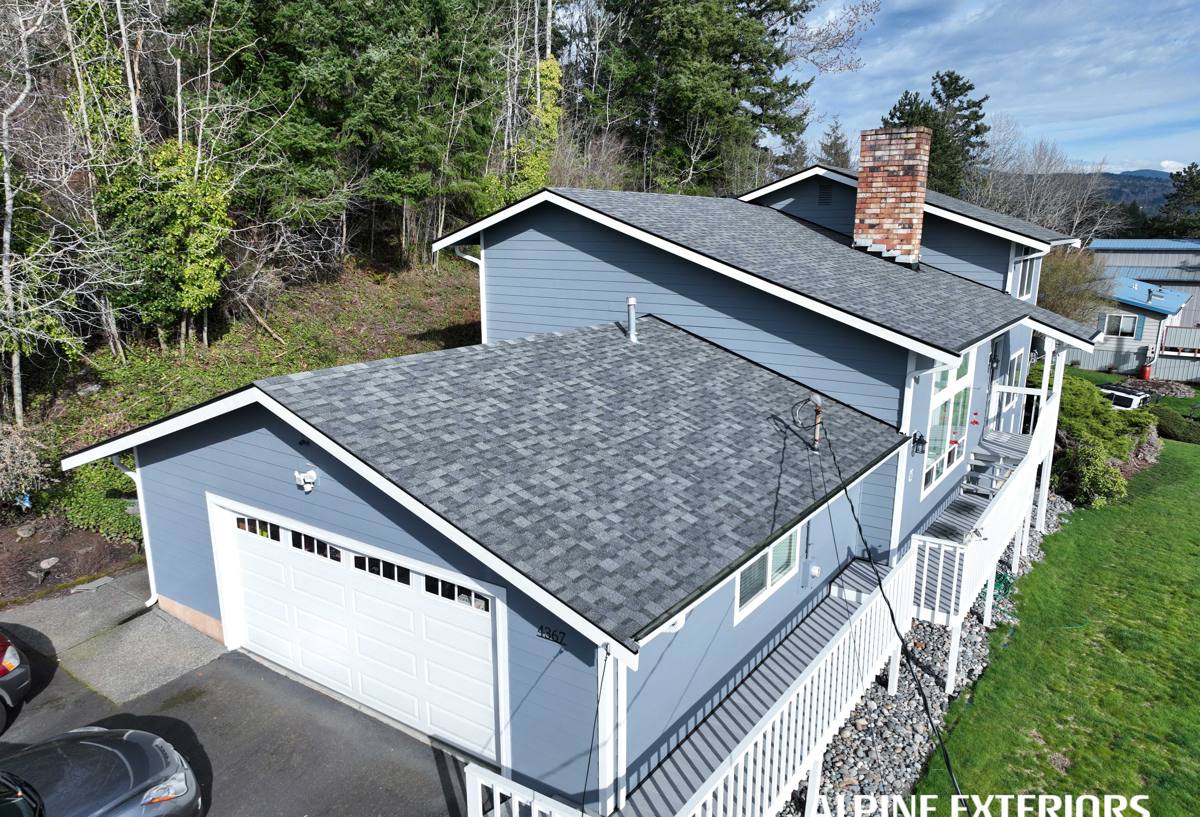
Homeowners often ask us to patch a leak, and sometimes a patch is genuinely the right call. But certain signs point to a system that's past the point where repairs make financial sense.
- Granules collecting in gutters or at downspout outlets, especially after a windy rain — a sign shingles are losing their protective surface
- Moss established in thick mats rather than a light surface film, particularly on north-facing slopes that stay shaded most of the day
- Shingles that are cupping, curling at the edges, or visibly cracked in multiple areas rather than one isolated spot
- Soft or spongy decking underfoot, which usually means moisture has already worked its way past the shingles
- Daylight visible through the roof deck from inside the attic, or water staining on attic rafters
- A roof approaching or past 20-25 years old (asphalt) with no major upgrades to underlayment or ventilation since original installation
If you're seeing more than one of these at once, that's usually the system telling you it's due, not just one shingle telling you it had a bad day.
What a Correct Roof Replacement Actually Involves
A roof replacement isn't just stripping old shingles and nailing down new ones. In a climate that sees as much driving rain and moss pressure as this region does, the parts you don't see matter more than the parts you do.
Tear-Off and Deck Inspection
We remove the existing roofing down to the deck rather than layering over it. That's the only way to actually see the plywood or plank sheathing underneath — and in older Lynden homes, it's common to find sections that have softened from long-term moisture intrusion around old flashing or valleys. Any compromised decking gets replaced before anything new goes down; installing new roofing over a weak deck just hides the problem for a few more years.
Underlayment Built for Wind-Driven Rain
Standard felt underlayment is not enough protection for a climate where rain regularly comes in at an angle instead of straight down. We use synthetic underlayment as the field layer for better tear resistance and water shedding, and we install self-adhering ice-and-water membrane at the vulnerable spots — eaves, valleys, around chimneys and skylights, and any roof-to-wall transitions — where wind-driven water and ice damming are most likely to find a way in.
Flashing That Doesn't Cut Corners
Flashing failures are the single most common cause of "new roof, same old leak." We install new flashing at every penetration and transition rather than reusing old pieces, and in areas closer to open water and prevailing coastal winds, we pay attention to corrosion-resistant materials and fastener choices so salt-influenced moisture in the air doesn't quietly eat away at metal components over the coming years.
Moss Prevention Built In, Not Bolted On
Where it fits the roof design, we install zinc or copper strips near the ridge. Rain washing over these strips carries trace metal ions down the roof plane, which suppresses moss and algae regrowth for years without chemical treatments. It's a small addition during installation that saves a lot of maintenance headaches later.
Choosing a Roofing Material for Whatcom County Weather
There's no single "best" roofing material — there's a best fit for your home, your budget, and how much long-term maintenance you're willing to take on. Here's how the common options actually compare under our conditions.
| Material | Moisture & Moss Performance | Typical Lifespan | Maintenance Burden |
|---|---|---|---|
| Architectural asphalt shingle | Good with proper underlayment and zinc strips; moss-resistant granule options available | 25-30 years | Periodic moss/debris removal |
| Standing seam metal | Excellent — sheds water fast, minimal surface for moss to grip | 40-50+ years | Low; occasional fastener/sealant checks |
| Cedar shake | Requires diligent upkeep in this climate; prone to moss and rot without regular treatment | 20-30 years with maintenance | High |
| Composite/synthetic shake | Good moisture resistance without cedar's rot risk | 30-50 years | Low to moderate |
We're upfront that we steer most Lynden homeowners away from natural cedar shake unless they're committed to a real maintenance schedule. It's not that cedar is a bad product — it's that our climate's moisture load makes the ongoing care it needs a bigger commitment than most homeowners realize going in, and the failure mode when that care lapses (rot, moss undermining the shakes) is expensive to fix. Architectural asphalt and metal both hold up with far less babysitting.
Ventilation and Moisture Control: The Part Homeowners Never See
A shockingly large share of "roof problems" are actually attic ventilation problems. When warm, moist air from inside the house gets trapped in the attic instead of exhausting through ridge and soffit vents, it condenses on the underside of the deck. Over a wet Whatcom County winter, that condensation cycle can rot decking from the inside — a completely different failure path than a leak from outside, but just as damaging.
During a replacement, we evaluate your intake (soffit) and exhaust (ridge or roof) ventilation as a system, not an afterthought. Balanced ventilation also helps regulate attic temperature in summer and reduces the ice-damming risk that hits shaded, north-facing roof sections during cold snaps.
Our Roof Replacement Process
- On-site inspection — we get on the roof and in the attic, not just a ground-level look, and document deck condition, ventilation, and problem areas
- Written estimate — clear scope, material options, and pricing, with the trade-offs explained in plain language
- Scheduling around weather windows — we plan tear-off for stretches of dry forecast whenever the season allows, and protect open sections if weather shifts mid-job
- Tear-off and deck repair — full removal, deck inspection, and replacement of any compromised sheathing
- Underlayment, flashing, and ventilation upgrades — installed to the standards described above
- New roofing installed — to manufacturer specification, including proper nailing patterns and exposure for wind resistance
- Cleanup and magnetic sweep — job site and yard cleared of debris and stray fasteners
- Final walkthrough — we review the finished roof with you before calling the job done
Why a Crew That Already Works in Lynden Matters
Roofing quality depends a lot on local knowledge that doesn't show up in a brochure. A crew that regularly works this part of Whatcom County knows which roof orientations in the area collect moss fastest, understands what the local permitting process requires before work starts, and has relationships with local material suppliers that keep a job moving instead of stalled waiting on a delivery from out of the area. We've built our process around this specific climate — not a generalized national playbook — because the difference between a roof that lasts 15 years and one that lasts 30 usually comes down to details specific to where it's built, not the shingle brand on the invoice.
We also carry proper insurance and stand behind our workmanship, which matters more in a climate this demanding — a roof that's installed even slightly wrong here tends to show it sooner than it would in a drier region.
Maintaining Your New Roof
A correctly installed roof still benefits from basic upkeep. This isn't a demanding list, but skipping it entirely shortens the life of even the best installation.
- Clear gutters and downspouts at least twice a year so water actually leaves the roof instead of backing up under the edge
- Trim back overhanging branches to reduce shade and debris buildup, both of which accelerate moss growth
- Do a visual check after major windstorms for lifted shingles, dented flashing, or displaced ridge caps
- Keep an eye on attic ventilation — blocked soffit vents (often from insulation or debris) undo the benefit of good ventilation design
- Have moss growth addressed early rather than left to spread; a light film is a quick fix, a thick mat is a bigger job
Get a Straight Answer About Your Roof
If you're not sure whether your roof needs a full replacement or just targeted repair, that's exactly what an on-site look settles — no pressure, no upsell script, just an honest read on where your roof actually stands. Reach out for a free estimate and we'll walk the roof with you and lay out what we find.