 Blaine Siding
 Sandy Point Sits Right at the Edge of the Weather
Sandy Point is about as exposed as residential siding gets in Whatcom County. Homes here sit close to open water, which means near-constant salt-laden air, wind-driven rain that hits walls sideways instead of falling straight down, and a shaded, damp off-season that lets moss and algae get a foothold on anything that stays wet too long. That combination is hard on siding in ways that inland Blaine neighborhoods don't deal with nearly as much.
Salt air is corrosive to metal fasteners and trim, and it accelerates the breakdown of coatings that aren't built to handle it. Driving rain finds every gap, seam, and undersized flashing detail and pushes water behind the siding instead of just running down the face of it. And the long gray, wet stretch of the Pacific Northwest winter gives moss and mildew months at a time to establish themselves on north-facing and shaded walls. None of this is unusual for a Whatcom County coastal community — it's just the reality of building this close to the water, and it's exactly what a siding system for a Sandy Point home needs to be engineered around.
Why We Only Install James Hardie Here
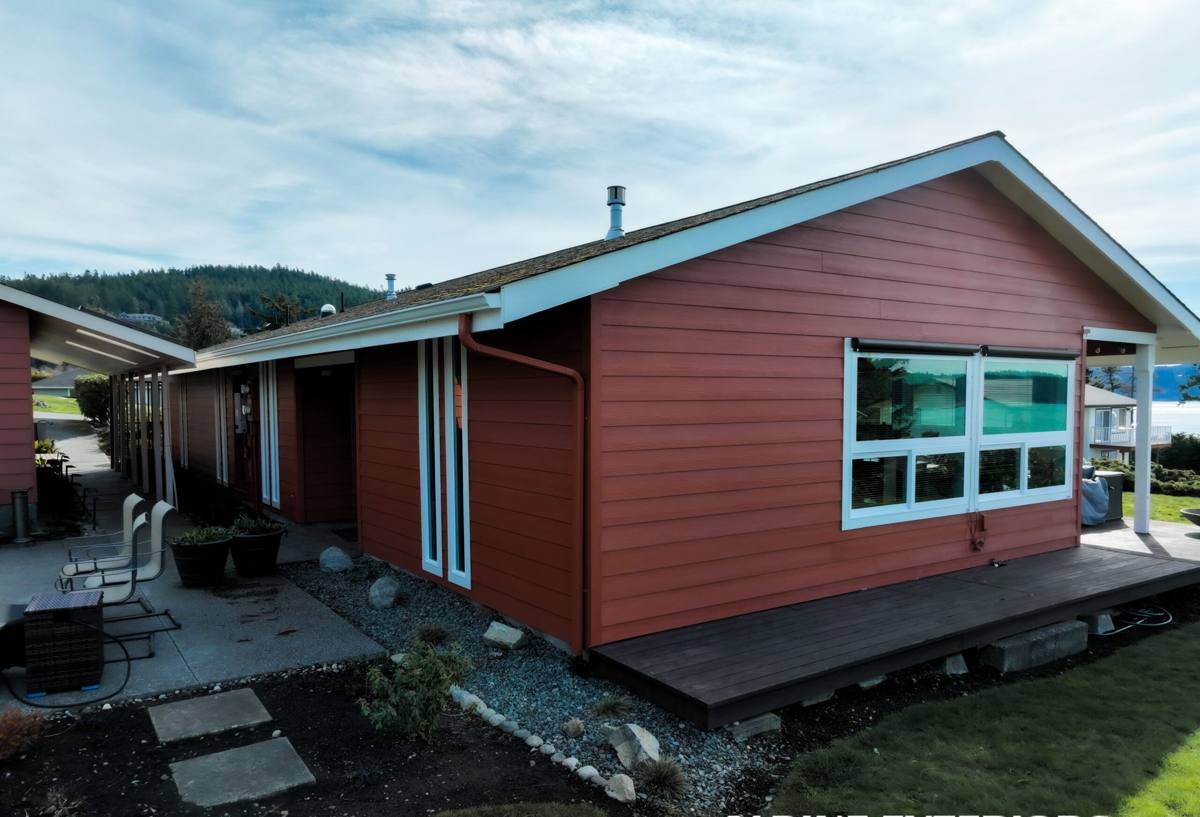
We standardized on James Hardie fiber cement for every job we take on, including in Sandy Point, because it's built to handle exactly this kind of exposure. Hardie siding is engineered from cement, sand, and cellulose fiber — it doesn't rot, it isn't a food source for moss or mildew the way wood is, and it holds up to sustained moisture exposure far better than wood-based or foam-core products. It's also non-combustible, which matters to insurers and to homeowners thinking about wildfire smoke and ember exposure during dry summer stretches.
James Hardie also makes climate-specific product formulations, and for a location like Sandy Point we spec the HZ5 line, engineered for wetter, harsher climate zones. The factory-applied ColorPlus finish is baked on and warranted against fading and chipping in a way that field-applied paint on wood or engineered wood siding simply isn't. That matters here — repainting a home on a bluff or waterfront lot in Sandy Point isn't a weekend project, and a finish that holds its color for years without a repaint is worth real money over the life of the siding.
What We Don't Install, and Why
We don't install vinyl, LP SmartSide, cedar, primed spruce, or other fiber cement brands like Cemplank or Allura. Vinyl expands, contracts, and can warp or crack in sustained wind exposure, and its seams and J-channels give wind-driven rain more places to work its way behind the wall. Wood-based products, including engineered wood siding, need a dry season to recover in — Sandy Point often doesn't give them one. We're not saying these products have no place anywhere; we're saying that for the specific exposure this neighborhood sees, we don't think they hold up well enough to put our name on the installation, so we don't offer them.
What a Correct Sandy Point Installation Actually Involves
Fiber cement siding is only as good as the details behind it. In a high-exposure coastal location, the parts you don't see matter more than the parts you do:
- Weather-resistive barrier and rainscreen gap: A properly lapped moisture barrier with a drainage gap behind the siding lets any water that does get past the face wall drain and dry out instead of sitting against the sheathing.
- Flashing at every penetration: Windows, doors, hose bibs, light fixtures, and roof-to-wall intersections all need correctly lapped flashing — this is where wind-driven rain finds its way in if it's skipped or done wrong.
- Fastener spacing and type: Hardie's installation instructions specify fastener type, spacing, and placement, and it matters more in high-wind exposure like Sandy Point than in a sheltered inland lot. Corrosion-resistant fasteners are a must this close to salt air.
- Proper clearance at grade and roof lines: Siding needs clearance above grade, decks, and roof surfaces so it isn't sitting in standing water or trapped moisture.
- Caulked and sealed joints per manufacturer spec: Not every joint gets caulked — Hardie specifies where sealant is needed and where it isn't, and getting this wrong can trap moisture instead of shedding it.
This is also why we don't treat installation as a generic process. A Sandy Point wall facing open water needs more attention to flashing and drainage detail than a wall on the same house facing away from the wind — and a crew that hasn't worked this neighborhood before doesn't always know that going in.
How Our Process Works
1. On-Site Assessment
We look at your home's specific exposure — which walls take the worst of the wind and rain, what condition the existing siding and sheathing are in, and whether there's any hidden moisture damage that needs to be addressed before new siding goes on. Covering up a moisture problem with new siding just hides it.
2. Prep and Weather Barrier
Old siding comes off, sheathing gets inspected and repaired where needed, and a new weather-resistive barrier goes on with a drainage gap behind the Hardie panels — this is the step that gets skipped by crews trying to save time, and it's the one that matters most in a location like this.
3. Installation to Manufacturer Spec
Hardie siding, trim, and fastening go in following James Hardie's published installation requirements for HZ5 climate zones, with attention to flashing, fastener corrosion resistance, and joint sealing specific to coastal exposure.
4. Final Walkthrough
We walk the finished job with you, wall by wall, before calling it done.
Comparing Siding Options for a Sandy Point Exposure
| Factor | James Hardie Fiber Cement | Vinyl | Wood / Engineered Wood |
|---|---|---|---|
| Salt air resistance | Strong — non-organic, factory finish holds up | Moderate — can chalk, fade, and become brittle over time | Weak — finish breaks down faster near salt air |
| Moss / moisture resistance | Strong — not a food source for organic growth | Moderate — moss grows on the surface but material itself doesn't rot | Weak — vulnerable to rot and moss if moisture gets in |
| Wind-driven rain performance | Strong when installed with proper rainscreen/flashing | Moderate — seams and channels are more vulnerable | Depends heavily on maintenance and coatings |
| Finish longevity | Factory ColorPlus, warranted against fade/chip | Color molded in but can fade and chalk | Needs periodic repainting or restaining |
| Fire resistance | Non-combustible | Combustible | Combustible |
This isn't a claim that every alternative product fails — it's why, for the specific exposure a Sandy Point home deals with, we've made Hardie our standard and don't offer the alternatives.
Living With It: Maintenance in This Climate
Fiber cement is low-maintenance, not no-maintenance. In a salt air and moss-prone environment like Sandy Point, a little seasonal attention keeps it looking right for the long haul:
- Rinse the exterior periodically to clear salt residue, especially on walls facing open water.
- Keep gutters clear so overflow isn't running down the face of the siding and feeding moss growth.
- Trim back vegetation and tree cover on shaded, north-facing walls where moss tends to establish first.
- Check caulking at trim and penetrations every year or two and re-caulk as needed — caulk is a maintenance item even on a low-maintenance product.
- Address any impact damage (branches, debris in a windstorm) promptly rather than letting a cracked panel sit exposed.
Why Local Experience with This Neighborhood Matters
A crew that's worked in Sandy Point before knows which walls on a typical lot here take the worst of the weather, how the local wind pattern off the water affects flashing and drainage decisions, and what the moss cycle looks like through a Whatcom County winter. That's not something you get from a general installation manual — it's something you get from having done the work in this specific place, on homes dealing with this specific exposure. It also means fewer surprises during the job, because we've already seen what this stretch of coastline does to a wall over time.
Get a Straight Answer for Your Home
Every Sandy Point property faces the weather a little differently depending on lot orientation, tree cover, and how close it sits to the water. If you're weighing a siding replacement or just want an honest read on what your current siding is dealing with, we're happy to take a look and give you a straightforward, no-pressure estimate — no upsell, just what your home actually needs.