 Blaine Siding
 Decks Near Dakota Creek Take a Different Kind of Beating
Dakota Creek sits close enough to salt water and thick enough with tree cover that decks in this part of Blaine age differently than decks fifteen minutes inland. You get the salt air drifting up off the bay working into fasteners and connectors, driving rain off Georgia Strait storms soaking every exposed board, and long stretches of shade from the creek corridor's trees that keep wood damp for days after the rain stops. That combination is exactly what grows moss, and moss on a deck isn't just an eyesore — it holds moisture against the boards and turns a walking surface slick and dangerous for a good chunk of the year.
A deck built or repaired without accounting for that combination usually looks fine for a few seasons, then starts failing all at once: soft boards, rusted hardware, a ledger board holding more moisture than it should. Replacing a deck the right way in this specific location means designing around salt exposure, sustained dampness, and moss pressure from day one, not just swapping old boards for new ones on the same frame.
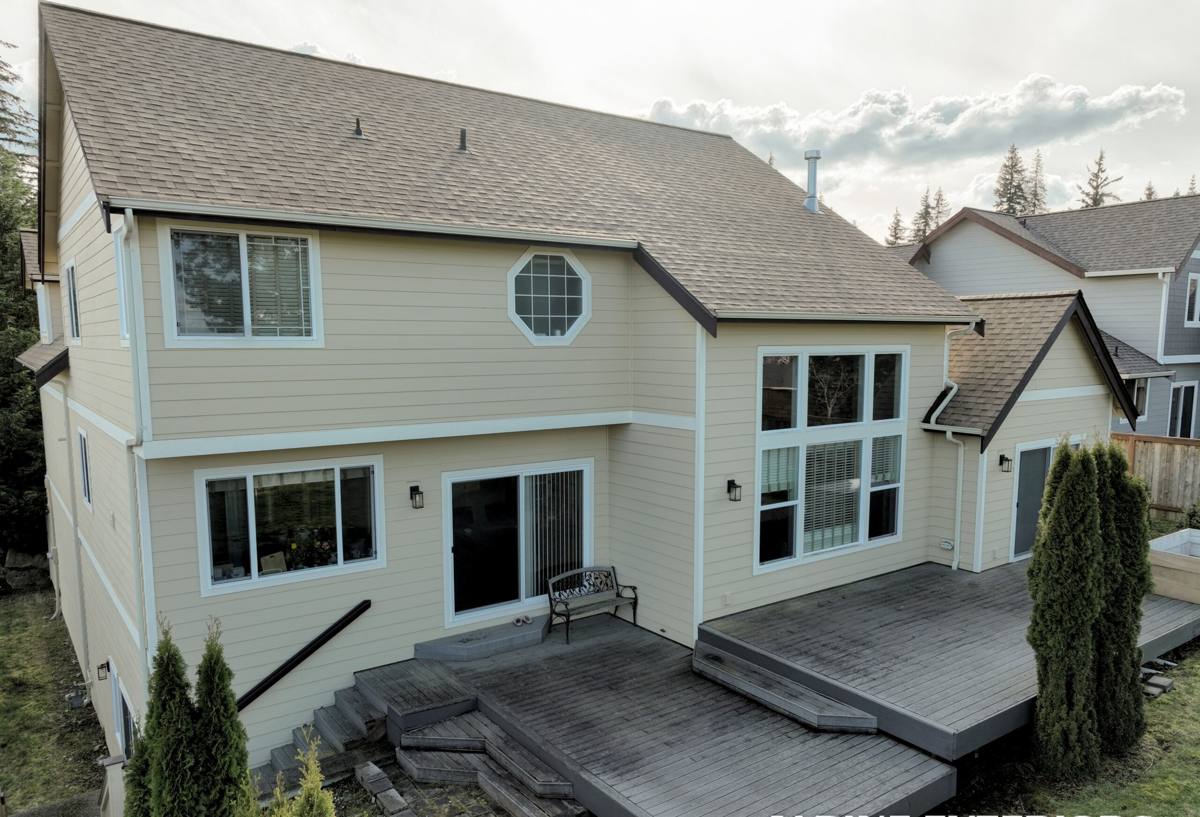
Signs Your Deck Has Crossed from Repairable to Replace
Homeowners often call us wanting a few boards swapped when the real problem is underneath. Here's what actually tells the difference:
- Soft or spongy decking in more than one or two spots usually means moisture has gotten into the board core, not just the surface — this spreads.
- Rust staining around fasteners is a sign the hardware is corroding, which is common near Blaine's salt-influenced air and means the connection strength is dropping, not just the appearance.
- A ledger board that feels damp or shows dark staining where the deck meets the house is one of the most serious signs — this is the connection that keeps the whole deck attached to the structure.
- Persistent moss or algae film that comes back within weeks of cleaning means the deck isn't drying out between rains, which points to a drainage or airflow problem in the framing, not just a surface cleaning issue.
- Visible movement or bounce when you walk across the deck, or wobble in the railing, means the frame or post connections have weakened.
One or two of these can sometimes be repaired in place. Several at once, especially involving the ledger or framing, is usually a sign that a full replacement will cost less over time than chasing repairs on a structure that's already compromised.
What a Correct Deck Replacement Actually Involves
The framing underneath
The decking boards are the part everyone sees, but the framing is what determines whether the deck lasts. Joists, beams, and posts need to be sized correctly for the span and load, and in a damp, shaded site like this, we pay close attention to keeping the underside of the frame ventilated so it can actually dry between rain events instead of staying wet all winter.
Ledger attachment and flashing
Where the deck attaches to the house is the single most important structural connection on the whole project, and it's also the spot most likely to trap water if it's flashed wrong. Correct flashing directs water away from the house framing rather than letting it wick in behind the ledger board — a detail that matters even more here given how much rain this area gets over a typical winter.
Footings and post connections
Footings need to sit below frost depth and bear on solid, undisturbed soil, with post bases that keep the post end off standing water. Ground near creek corridors can hold moisture longer than open, well-drained lots, so we check drainage around each footing location rather than assuming a standard depth is automatically enough.
Hardware and fasteners
Every connector, screw, and joist hanger on a deck replacement should be rated for exterior and, ideally, coastal-adjacent use. Standard interior-grade hardware corrodes faster in salt-influenced air, and a rusted hanger is a hidden failure point — you won't see it until the connection actually lets go.
Choosing Decking Material for This Site
There's no single "best" decking material — the right choice depends on how much shade and moss exposure your specific spot near Dakota Creek gets, and how much upkeep you actually want to do. Here's how the common options stack up for this climate:
| Material | Moisture behavior | Moss/algae resistance | Maintenance | Typical lifespan |
|---|---|---|---|---|
| Pressure-treated wood | Absorbs and releases moisture; needs to breathe and dry | Low without regular cleaning/sealing | Annual cleaning, periodic sealing | 10–15 years with upkeep |
| Cedar | Naturally moisture-resistant but still absorbs over time | Moderate; benefits from cleaning in shaded spots | Regular cleaning, occasional oiling | 15–20 years with upkeep |
| Composite decking | Doesn't absorb water into the core | Better than wood, but surface can still host algae/moss film in deep shade | Periodic washing, no sealing/staining | 25–30 years |
| PVC/capped polymer | Fully moisture-resistant surface | Best resistance to staining and growth | Occasional washing | 25–30+ years |
For a shaded, damp lot near the creek, we usually steer homeowners toward composite or capped polymer if budget allows, simply because they hold up better against sustained shade and moss pressure with less ongoing work. That said, plenty of homeowners are happy with a well-built wood deck as long as they're realistic about the cleaning and sealing schedule it needs to actually last.
Our Deck Replacement Process
- On-site assessment. We check the existing frame, ledger, footings, and drainage before quoting anything — this tells us whether framing needs to be rebuilt or can be reused.
- Design and material selection. We walk through decking, railing, and fastener options based on your budget, how much shade and moss exposure the site gets, and how much maintenance you want to take on.
- Permitting. We handle the permit application through Whatcom County or the City of Blaine as required for the project scope.
- Demolition. Old decking, framing, and hardware are removed, and we inspect the ledger connection and any framing that was hidden underneath before rebuilding.
- Framing and flashing. New joists, beams, posts, and footings go in to code, with ledger flashing installed to direct water away from the house.
- Decking and railing installation. Boards and railing are installed per the manufacturer's fastening pattern — this matters more than people think, since improper fastening is a common cause of early composite and PVC decking failures.
- Final inspection and walkthrough. We confirm the county inspection passes, then walk the finished deck with you and point out anything you'll want to know for upkeep.
Permits and Working Near Dakota Creek
Because Dakota Creek is a waterway, projects near it can fall under additional review beyond a standard building permit, depending on how close the work is to the creek's bank or any associated critical area buffer. Whatcom County evaluates this on a site-by-site basis, so the right move is always to confirm setback and permitting requirements for your specific lot before finalizing a design — we handle that check as part of quoting the job rather than assuming a standard deck permit covers everything. A crew that's done deck work in this specific pocket of Blaine already knows what questions the county typically asks and won't be guessing through that process for the first time on your project.
What Drives the Cost of a Deck Replacement
| Cost factor | Why it matters |
|---|---|
| Deck size and shape | More square footage and complex shapes (angles, multiple levels) increase material and labor |
| Condition of existing framing | Reusable framing lowers cost; rot or undersized framing means a full rebuild |
| Decking material | Wood costs less upfront; composite and PVC cost more upfront but less over the deck's life |
| Height and access | Elevated decks need taller posts, stairs, and sometimes engineered footings |
| Railing style | Cable, glass, and metal railing systems cost more than standard wood or composite balusters |
| Permit and inspection fees | Vary by scope and whether the site requires additional critical-area review |
We give a firm, itemized quote after the on-site assessment rather than a phone estimate, since so much of the cost depends on what's actually happening under the existing deck.
Keeping a New Deck Ahead of Moss Season
A well-built deck in this climate still needs some seasonal attention — the goal is just to make that upkeep light instead of a constant fight. A simple annual routine covers most of it:
- Clear leaves and debris from between boards and off ledger flashing before fall rains set in.
- Keep gutters and downspouts near the deck clear so runoff isn't draining directly onto or under it.
- Wash the deck surface at least once a year to remove the thin algae film that builds up in shaded areas before it turns into established moss.
- Check under the deck periodically for standing water or blocked drainage paths around footings.
- Inspect railing connections and fasteners annually for looseness or corrosion.
- If you chose wood, plan on resealing on the schedule the product calls for — skipping a cycle is when moisture starts winning.
Why Local Experience on Dakota Creek Decks Matters
Deck framing and flashing details that work fine on a dry, sunny lot in eastern Whatcom County don't always hold up on a shaded, damp lot near the creek — the moisture load is just different. A crew that's already worked decks in this specific area knows which framing details actually stay dry here, how much shade a given lot really gets across the seasons, and what the county tends to ask for on projects near the creek corridor. That's the kind of knowledge that only comes from doing the work locally, repeatedly, and seeing how decks in this exact setting hold up five and ten years out — not from a general good-workmanship standard applied anywhere.
If you're weighing repair against replacement, or just want a straight answer on what your deck actually needs, we're happy to come take a look. Use the form below to request a free, no-pressure estimate for your Dakota Creek deck replacement.