 Blaine Siding
 Decks Near the Peace Arch Take a Different Kind of Beating
Homes around the Peace Arch area sit close to the water and close to the border crossing corridor, which means decks here deal with a specific combination of stresses that inland homes rarely see. Salt-laden air off the bay accelerates corrosion on anything metal — nails, screws, joist hangers, railing brackets. Driving rain, often pushed sideways by wind off the Strait, gets up under boards and into end grain instead of just falling straight down and running off. And Whatcom County's long, gray moss season means many decks stay damp for months at a stretch, especially on the shaded or north-facing side of a house.
None of that is unusual for this part of Washington. But it does mean a deck built or repaired without those specifics in mind tends to fail years earlier than it should — usually starting with the parts you can't see from the top: fasteners, flashing, and framing.
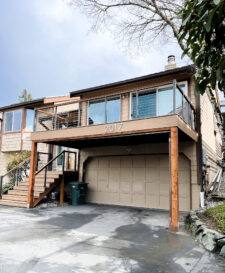
Warning Signs Your Deck Needs Attention
Most deck problems don't start as an emergency. They start small and get ignored because the deck still "feels fine" to walk on. By the time a board actually breaks, the damage underneath is usually well established. Here's what we tell Peace Arch homeowners to check a couple of times a year:
- Soft, spongy, or springy spots when you walk across the boards
- Green or black staining that keeps coming back within weeks of cleaning
- Rust streaks bleeding out from screw heads or metal connectors
- Gaps opening up between the deck and the house, or a ledger board that looks slightly separated
- Railings or stair posts that wiggle more than they used to
- Wood that feels damp or cool to the touch well after the rain has stopped
- A musty smell coming from underneath the deck
Any one of these on its own might be minor. Two or three together, especially near the ledger board or stairs, usually means it's time for a real inspection rather than another round of pressure washing.
What a Proper Deck Repair Actually Involves
It Starts Underneath, Not on Top
A repair that only replaces the visible boards without checking what's underneath is a cosmetic fix, not a structural one. Before we touch decking boards, we check the framing: joists, beams, posts, and especially the ledger board where the deck attaches to the house. That connection carries a huge share of the deck's load, and it's also the single most common failure point on older decks in this climate, because it's where trapped moisture does the most damage and where flashing is most often missing or installed wrong.
Flashing Is Not Optional
A lot of decks built years ago, especially before code updates tightened this up, don't have proper flashing between the ledger board and the house wall. Without it, water works its way behind the ledger every time it rains and slowly rots the framing from the inside. Correcting this — installing proper Z-flashing and making sure it's integrated with the house's water-resistive barrier, not just caulked over — is one of the most important things we address on repair jobs, even when it wasn't the reason the homeowner called.
Fasteners and Connectors Matter More Here
Given the salt air off the bay, we use corrosion-resistant fasteners and structural connectors rated for exterior, coastal-adjacent exposure rather than standard interior-grade hardware. Mixing metals (for example, the wrong screw in an aluminum bracket) can also cause galvanic corrosion that eats through hardware from the inside, so matching fastener and connector materials correctly is part of doing the job right, not an upsell.
Repair vs. Replacement: How We Decide
Not every deck problem calls for a full rebuild, and not every problem should be patched. The honest answer depends on where the damage is and how far it's spread.
| Situation | Usually Repairable | Usually Needs Replacement |
|---|---|---|
| A few individual boards cupping, splintering, or rotting | Yes — swap the affected boards | No |
| Ledger board rot found early, framing still solid | Yes — cut back to sound wood, reflash, sister as needed | Only if rot has spread deep into the framing |
| Multiple joists soft or rotted | Sometimes — sistering can work if damage is contained | Often, if rot is widespread across the structure |
| Posts or footings settling or heaving | Rarely on their own | Yes — this is a foundation-level issue |
| Railings loose or out of code | Yes — usually a straightforward fix | No, unless posts themselves are rotted |
| Deck is 20+ years old with problems in several areas at once | Case-by-case | Often more cost-effective long-term |
We'll always tell you honestly which category your deck falls into, and why — including when a smaller repair now is the right call, and when spending money on repair would just be delaying a rebuild you'll need anyway.
Choosing Materials That Actually Hold Up in This Climate
Whatever we replace gets rebuilt with materials suited to the moisture and salt exposure typical around Blaine, not just whatever is cheapest at the yard.
Framing Lumber
Pressure-treated lumber rated for ground contact where relevant is the baseline for framing repairs. It's not glamorous, but it's the standard that gives repaired framing a fighting chance against the damp conditions that caused the original problem.
Decking Surface
For the visible decking boards, homeowners generally choose between wood and composite, and each comes with real trade-offs worth understanding before you decide:
- Cedar — attractive, naturally resistant to some decay, but needs regular sealing or staining to perform well through a wet Whatcom County winter, and it will gray without upkeep.
- Pressure-treated decking — economical and durable when properly maintained, but requires periodic cleaning and sealing to keep moss and algae from taking hold.
- Composite decking — low maintenance and resistant to rot, but it still needs proper ventilation underneath and correct fastening; poor installation can trap moisture against the framing below, so installation quality matters as much as the product itself.
We'll walk through the honest maintenance expectations of each option for your specific deck rather than just recommending whatever's easiest for us to install.
Moss, Algae, and the Long Wet Season
Whatcom County's moss season isn't a minor cosmetic nuisance — a mossy or algae-covered deck surface gets genuinely slippery, and on stairs or near steps that's a real fall hazard, not just an eyesore. Moss also holds moisture against the wood surface far longer than bare boards would, which speeds up the very rot that leads to the repairs described above.
Part of a proper repair often includes addressing why moss keeps coming back in the first place — usually shade, poor airflow underneath the deck, or standing water from inadequate slope or drainage — rather than just cleaning the surface and expecting the problem to stay gone.
Our Deck Repair Process
- On-site inspection. We check the decking surface, framing, ledger connection, posts, footings, and railings, and probe any wood that looks or feels suspect.
- Honest assessment. We tell you what's actually wrong, what's driving it, and whether repair or replacement makes more sense for your situation and budget.
- Clear scope and pricing. You'll know what's being fixed, with what materials, and why, before any work starts.
- Proper teardown of the damaged sections. We remove compromised material back to sound wood — not just far enough to hide the problem.
- Correct rebuild. Framing, flashing, fasteners, and decking are installed to current standards, even where the original construction wasn't.
- Final walkthrough. We check the repair is solid, safe, and looks right before we consider the job done.
Why Local Experience Around the Peace Arch Matters
A crew that regularly works homes in and around Blaine already knows how the border-area microclimate treats a deck differently than a house fifteen miles inland — where salt exposure is heaviest, which sides of a house stay damp longest through the moss season, and which older construction habits from this area tend to cause ledger and flashing problems down the line. That's the kind of judgment that only comes from doing this work repeatedly in this specific place, not from a general checklist.
It also means straightforward things homeowners actually care about: knowing the area, showing up when scheduled, and standing behind the work because we're not going anywhere — this is where we work.
If your deck is showing any of the signs above, or it's just been a while since anyone looked underneath it, we're happy to take a look. Reach out for a free, no-pressure estimate using the form below.