 Blaine Siding
 Why Birch Point Windows Wear Differently Than Windows Inland
Birch Point sits close enough to the water that its homes take on weather most inland Whatcom County houses never see. Salt-laden air rides in off the water and settles on glass, frames, and hardware year-round. Add Blaine's long stretch of driving rain each fall and winter, plus a moss season that seems to start earlier and last longer every year, and you've got a set of conditions that will find every weak point in a window system — the seal, the flashing, the frame material, all of it.
We've replaced and repaired enough windows in this neighborhood to know the failure patterns are consistent: fogged double panes from broken seals, soft or discolored sills where water has been sitting, hardware that's stiff or corroded from salt exposure, and green film building up on north-facing trim faster than anywhere else we work. None of that means Birch Point homes need exotic solutions. It means the basics — material choice, flashing detail, and a properly sealed installation — matter more here than they do twenty minutes inland.
What "Custom" Actually Means for This Job
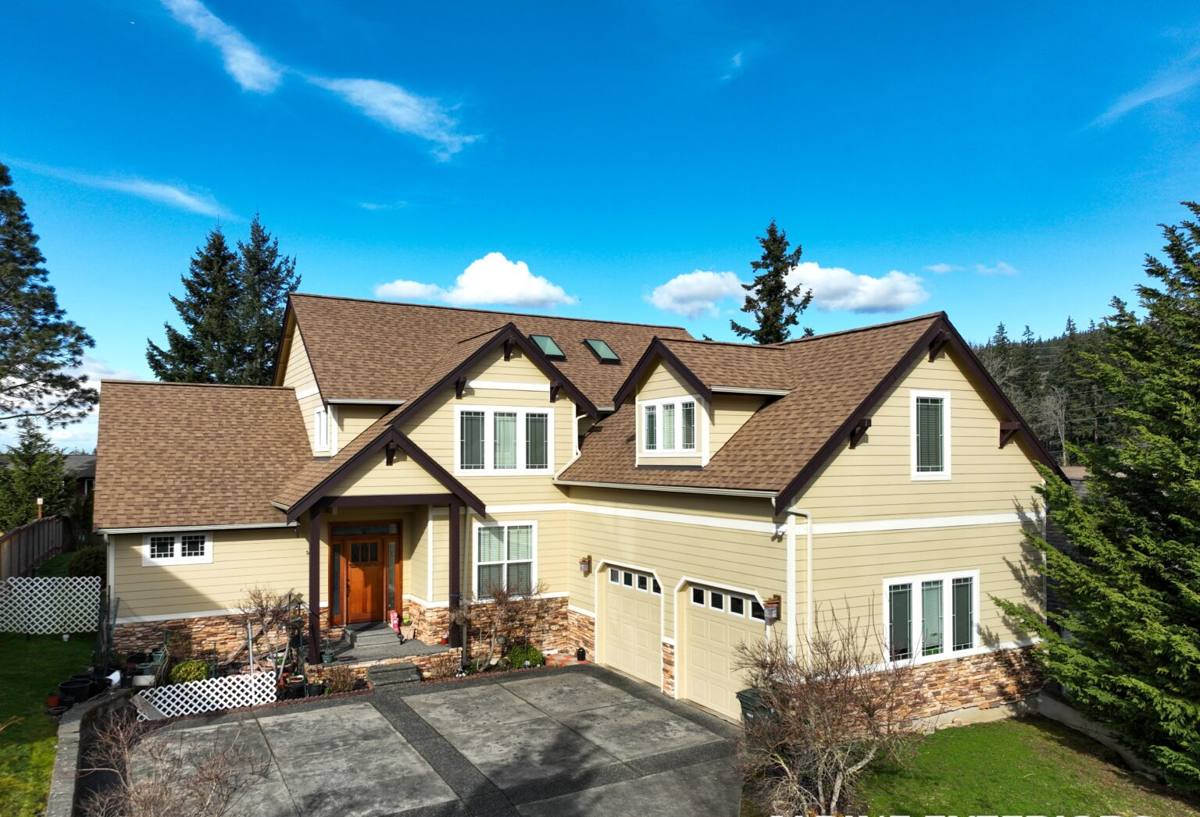
Custom doesn't mean fancy shapes or premium upgrades you don't need. For most Birch Point homes it means the window is built to fit the actual opening in your actual wall — not the nearest stock size with shims and extra caulk making up the difference. Many of these houses have settled or shifted slightly over the decades, and older openings are rarely perfectly square. A custom-sized unit seals tight against a true opening. A stock unit forced into an out-of-square opening relies on caulk to do a job caulk was never meant to do alone.
Custom also covers matching what's already there when you're only replacing some windows now and the rest later — sightlines, grid patterns, and frame color that don't look like a patchwork addition. And it covers choosing the right glass package and frame material for a specific wall's sun and wind exposure, which can vary meaningfully from the water-facing side of a house to the sheltered side.
What We Measure Before We Quote Anything
- Actual opening dimensions at multiple points (top, middle, bottom) — older openings are rarely uniform
- Which direction each window faces and how exposed it is to wind-driven rain
- Condition of the existing sill, header, and surrounding wall framing
- Current signs of moisture intrusion, wood rot, or seal failure
- Existing trim, grid pattern, and exterior color so replacements look intentional, not mismatched
Frame Material: What Holds Up Near the Water and What Doesn't
Frame material is the single biggest decision on a Birch Point window job, because salt air and moisture are unforgiving of the wrong choice. We don't install every material on the market, and that's a standard, not a limitation — some products carry maintenance demands or moisture behavior that doesn't make sense to sign our name to on a coastal job.
| Frame Material | How It Handles Salt Air & Rain | Maintenance Reality |
|---|---|---|
| Vinyl (quality-grade) | Won't corrode, doesn't absorb moisture, handles salt exposure well | Low — occasional cleaning, no repainting ever needed |
| Fiberglass | Very stable in temperature swings and moisture, strong long-term performer near water | Low — durable finish, minor cleaning |
| Wood-clad | Good insulator, but any breach in the cladding exposes wood to moisture and rot | Higher — seams and cladding need periodic inspection |
| Bare aluminum | Conducts cold, prone to condensation, and untreated aluminum can pit under salt exposure over time | Moderate to high depending on finish quality |
For most Birch Point homes, we lean toward vinyl or fiberglass on any wall with direct water exposure, simply because there's less that can go wrong over a fifteen- or twenty-year span. Wood-clad can still make sense on a sheltered elevation where the look matters more than raw weather resistance. We'll walk through the honest trade-offs for your specific walls rather than push one material across the whole house.
Glass and Seals: Where Driving Rain Actually Gets In
Most window "failures" people notice aren't the glass itself — they're the seal around it. Insulated glass units rely on a sealed air or gas space between panes, and that seal is what fails first under repeated wind-driven rain and temperature swings. Once it fails, you get fogging between the panes that no amount of cleaning fixes, because the moisture is trapped inside the unit.
For Birch Point specifically, we pay close attention to two things: the quality of the seal itself, and how well the window's designed to shed water before it ever reaches that seal. A window with good sightlines and a mediocre seal is still a bad long-term investment on a wall that takes rain sideways for months at a time.
Installation Details That Matter More Here Than Elsewhere
A well-built window installed poorly will fail the same way a poorly-built window will. On this stretch of coast, we treat a few installation details as non-negotiable:
Sill Pan Flashing
A sloped, properly lapped sill pan under the window directs any water that gets past the outer seal back outside the wall, instead of letting it sit against the framing. This is the detail we see skipped most often in older or lower-cost installs, and it's usually the reason a homeowner finds soft wood at the sill years later.
Head Flashing and Weather-Resistive Barrier Integration
The flashing above the window needs to tie into the house's weather-resistive barrier correctly, not just sit on top of the siding. Done wrong, water runs behind the flashing instead of over it — invisible from outside until there's damage on the inside.
Sealant Choice and Placement
Not every exterior sealant is rated for the temperature range and salt exposure this area sees. We use sealants suited to marine-adjacent climates, and we leave the correct weep points open so any incidental moisture can drain out rather than pool.
Moss, Algae, and the North Side of the House
Whatcom County's moss season is long, and Birch Point's damp air only extends it. Moss and algae growth around window trim and sills isn't just cosmetic — sustained organic growth holds moisture against wood trim and paint, accelerating rot and finish failure in exactly the spots least visible from the driveway. When we replace windows, we look at the surrounding trim condition too, because a brand-new window set into deteriorating trim just relocates the problem instead of solving it.
Simple choices help here: trim materials that don't feed moss growth as readily, drip caps that keep water moving away from the trim, and window placement details that avoid creating shaded, damp pockets where organic growth thrives.
Our Process for a Birch Point Job
- On-site assessment — we look at every window being considered, the surrounding trim and framing, and any current signs of water intrusion or seal failure.
- Honest recommendation — which windows genuinely need replacing now, which can wait, and which material and glass package fits each wall's actual exposure.
- Precise measurement — custom sizing to the real opening, not the nearest stock dimension.
- Correct installation — sill pan flashing, proper head flashing integration, and marine-grade sealant at every unit.
- Final check and cleanup — operation, seal, and finish checked on every window before we consider the job done.
Signs Your Current Windows Are Already Behind on Maintenance
- Fogging or a milky look between panes that cleaning doesn't remove
- Difficulty opening, closing, or locking that didn't used to be there
- Soft, discolored, or peeling material at the sill or lower frame
- Visible moss or persistent green film on trim, especially on shaded or water-facing walls
- Noticeable draft or cold spot near the frame in windy weather
- Condensation forming on the inside of the glass in cool weather
Why a Crew That Already Works Birch Point Is Worth Choosing
Window installation looks similar on paper anywhere in Whatcom County, but the details that make a job last are learned by seeing how this specific stretch of coast treats a house over years, not by reading a spec sheet. A crew that's already worked Birch Point knows which walls take the worst of the wind-driven rain, how fast moss builds on north-facing trim here compared to more sheltered inland lots, and which flashing and sealant details actually hold up against sustained salt exposure rather than just looking right on installation day.
That local knowledge shows up in small decisions — where we add extra flashing attention, which material we steer you toward on a water-facing wall versus a sheltered one, and what we flag as a maintenance item to watch rather than an emergency. It's the difference between a window install that's technically correct and one that's actually built for this address.
If you're noticing any of the signs above, or you're just planning ahead for windows that are getting close to the end of their life, we're glad to come take a look. The estimate is free, there's no pressure to move forward, and you'll get a straight answer about what your Birch Point home actually needs — use the form below to get started.