 Blaine Siding
 Metal Roofing on the Cherry Point Shoreline
Cherry Point sits out on open water west of Blaine, and that location changes what a roof has to deal with compared to a house a few miles inland. Wind off the Strait of Georgia carries salt, that same wind drives rain sideways into eaves and wall lines, and the tree cover and damp shade across much of Whatcom County keep roofs wet longer than homeowners expect. Asphalt shingles struggle with all three of those conditions at once. Metal, installed correctly, handles them a lot better — but "installed correctly" is doing a lot of work in that sentence, and it's the part that gets skipped when a crew isn't used to shoreline exposure.
This page is about what a metal roof needs to actually hold up out at Cherry Point, not a generic rundown of metal roofing in general. If you're comparing bids, the details below are the ones that separate a roof that looks good for two years from one that's still doing its job in thirty.
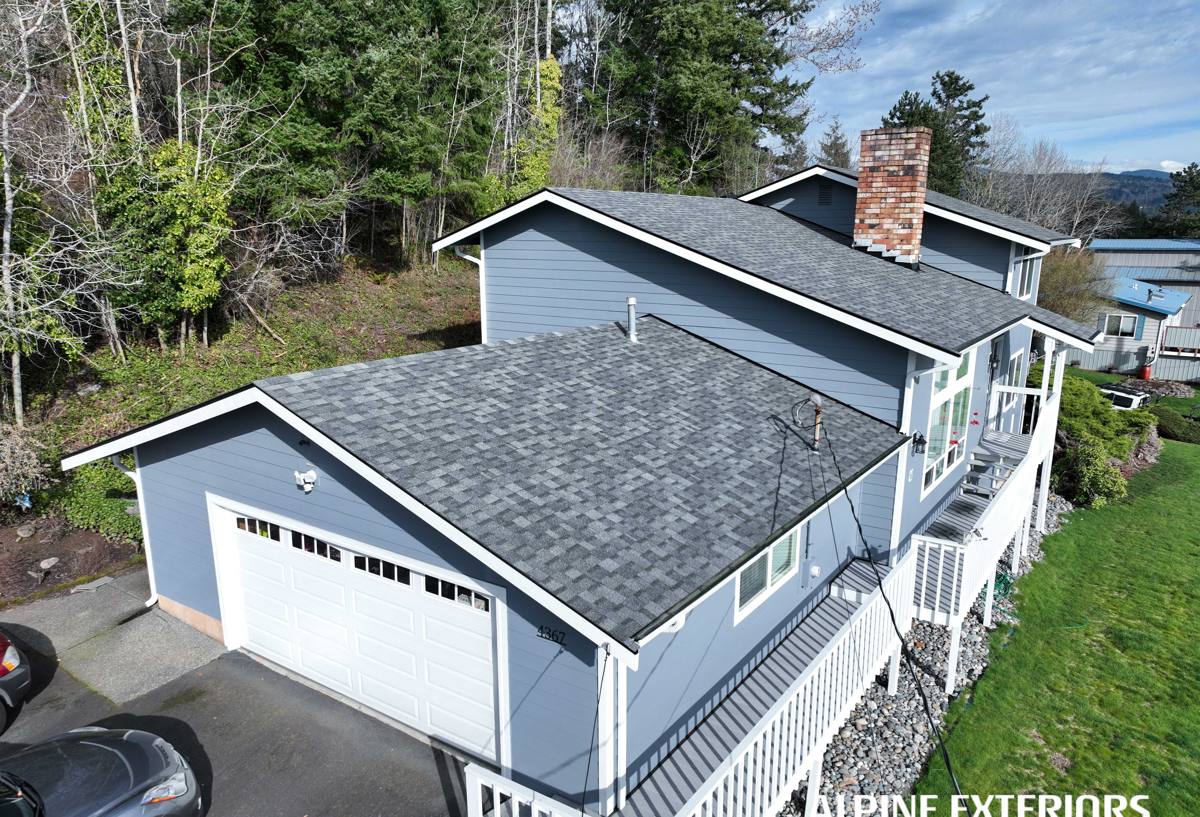
What Salt Air and Wind-Driven Rain Actually Do to a Roof
Corrosion Doesn't Announce Itself
Salt-laden air accelerates corrosion on any exposed metal — fasteners, flashing, cut edges, and cheap coatings all show it first. The damage is usually slow and invisible until a fastener head rusts through or a panel edge starts lifting. On a property this close to open water, we treat corrosion resistance as a baseline requirement, not an upgrade.
Wind Finds the Weak Point
Driving rain doesn't fall straight down out here — it gets pushed sideways into laps, penetrations, and eave edges. A roof system that relies on gravity alone to shed water (gaps that are fine in a calm climate) will let water in at Cherry Point. Fastening pattern, lap direction, and underlayment choice all matter more on an exposed shoreline lot than they do a few miles inland.
The Long Moss Season and What It Costs You
Whatcom County's wet season runs long, and shaded, north-facing roof sections stay damp for weeks at a stretch. On asphalt shingles, that moisture sits in the granules and moss gets a foothold within a couple of seasons — and once moss takes hold, it lifts shingle edges and holds water against the deck. Metal roofing doesn't give moss the same texture to grip, and a smooth, properly-lapped panel sheds standing water instead of holding it. It's not moss-proof — anything with a north slope and tree cover can still collect debris and grow moss in the seams if it's never cleaned — but it removes the shingle-granule surface that moss actually needs to establish itself.
Panel Types: What We Actually Recommend Out Here
Not all metal roofing is the same product wearing different colors. The fastening method and seam design change how the roof performs in wind and salt exposure, and that's the main thing to get right before finish and color even come into the conversation.
| Panel Type | How It's Fastened | Best Fit |
|---|---|---|
| Standing seam | Concealed clips, no exposed fasteners on the field of the panel | Full shoreline exposure, long-term low maintenance |
| Exposed-fastener (corrugated/ribbed) | Screws through the panel face with rubber washers | Outbuildings, budget-conscious projects, less direct exposure |
| Stone-coated steel | Fastened similar to exposed-fastener, with a granule-coated finish | Homeowners who want a shingle look with metal's durability |
For a home with direct or near-direct exposure toward the water at Cherry Point, we lean toward standing seam. The lack of exposed screw heads matters a lot here — every exposed fastener is a future corrosion point and a potential leak path, and salt air shortens the timeline on both. Exposed-fastener panels aren't wrong for every project; on a detached shop or a property set back with more tree buffer, they're a reasonable, less expensive option. We'll tell you honestly which category your roof falls into rather than upselling standing seam on every job.
Steel vs. Aluminum
Steel panels (Galvalume or galvanized steel with a paint finish) are the more common choice and hold up well with the right coating. Aluminum doesn't rust — it can still corrode under the wrong conditions, but it's a step up in salt resistance for properties with the most direct water exposure. We'll walk your specific lot and tell you which makes sense rather than defaulting to one for every job; steel is the right call more often than not, and we're not going to sell you aluminum you don't need.
Why the Coating Matters as Much as the Metal Itself
The base metal only accounts for part of a panel's lifespan — the factory coating is what actually faces the salt air, UV, and rain day to day. A PVDF/Kynar-type finish holds color and resists chalking far longer than a cheaper polyester coating, and it matters more here than in a drier inland climate because the coating is what's standing between the steel and constant moisture. We won't install a panel system with a bargain coating on a shoreline property and call it a long-term roof — it isn't one, and we'd rather tell you that up front than have you find out in year six.
What a Correct Metal Roof Installation Involves
A metal roof is only as good as the details underneath it. On a Cherry Point property, we treat the following as non-negotiable, not optional add-ons:
- Solid, properly-fastened decking — no soft spots, no shortcuts on rotten sheathing
- A high-temp synthetic or self-adhered underlayment rated for the panel type and climate, not builder's felt
- Panel fastening spaced and patterned for wind uplift resistance, not just "enough to hold it down"
- Closed or vented ridge detail matched to the home's attic ventilation, not a generic cap
- Flashing at every valley, wall intersection, and penetration — cut and formed for that specific roof, not a stock piece bent to fit
- Fasteners and trim in a material and coating compatible with the panel, to avoid galvanic corrosion where dissimilar metals touch
- Proper attic ventilation so condensation doesn't build up under the panels from the underside
Skip any one of those and you can still end up with a roof that looks right from the ground and fails from underneath within a few years — usually right around the point where it's no longer covered by a workmanship warranty.
Our Process, Start to Finish
- On-site look — we walk the roof and the property, note the exposure direction, existing ventilation, and any problem areas (valleys, low-slope sections, north-facing shade).
- Honest recommendation — we tell you which panel type and finish fit your specific exposure and budget, and why, in plain terms.
- Written estimate — clear scope, materials, and timeline, no vague allowances.
- Deck and underlayment prep — any damaged sheathing gets replaced before a single panel goes down.
- Installation — panels, flashing, and ventilation detail installed to the standard above, not the minimum.
- Final walkthrough — we go over the finished roof with you before we consider the job done.
Cost Factors for a Cherry Point Metal Roof
Metal roofing costs more upfront than asphalt shingles, and the final number depends on more than just square footage. Broadly, homeowners in this area should expect a wider range than a big-box estimate tool will show, because exposure and roof complexity change the job.
| Factor | Why It Moves the Price |
|---|---|
| Panel type | Standing seam runs higher than exposed-fastener panels due to labor and concealed-clip hardware |
| Roof pitch and complexity | Valleys, dormers, and steep pitches add labor and flashing work |
| Tear-off vs. re-cover | Removing old roofing and repairing deck issues adds cost but avoids covering hidden problems |
| Coating grade | A premium PVDF finish costs more than a basic coating but lasts significantly longer in salt air |
| Ventilation upgrades | Adding or correcting attic ventilation during the reroof is cheaper than fixing it later |
We'd rather walk your roof and give you real numbers than quote a per-square-foot figure that doesn't reflect your actual property. Broadly, expect metal to run more than a comparable asphalt job, with the gap in service life and maintenance often making up the difference over time — but that math depends on the specifics of your roof, and we'll go through it with you.
Why It Matters That We Already Work This Area
A crew that's worked Blaine and the Cherry Point shoreline knows which slopes take the worst of the wind, which properties need extra attention to flashing because of tree cover and shade, and which coating and fastener choices hold up here versus a drier part of the state. That's not something you get from a general contractor working from a spec sheet — it comes from having done the work on homes in this exact exposure and having seen, firsthand, what does and doesn't hold up through a few wet seasons. It also means we're a known, reachable local business if a question comes up five years after the install, not a crew that worked one job here and moved on.
Living With Your Roof After Installation
A correctly installed metal roof is genuinely low-maintenance, but low-maintenance isn't no-maintenance. We recommend an occasional visual check after major storms, keeping gutters and valleys clear of needles and debris so water keeps moving, and calling us if you notice a fastener backing out, a scuff through the coating, or a panel edge that looks lifted. Caught early, those are quick fixes. Left alone through another wet season, they're how a great roofing system turns into a leak.
If you're weighing options for a home or property near Cherry Point, we're happy to come take a look and give you a straight answer about what your roof actually needs — no pressure, no inflated scope. Use the form below to request a free estimate.