 Blaine Siding
 Why Blaine Harbor Decks Take a Different Kind of Beating
A deck built a few miles inland and a deck built near Blaine Harbor are not the same project, even if the plans look identical on paper. Homes close to the water deal with salt-laden air that settles on every horizontal surface, driving rain that comes in sideways off the water more often than it falls straight down, and a wet season that stretches long enough for moss and algae to get a real foothold on anything that stays damp. Add in Whatcom County's mild, cloudy winters — plenty of freeze-thaw cycling but rarely a hard, dry freeze — and you get conditions that are hard on fasteners, hard on wood fiber, and hard on any decking product that wasn't built with moisture in mind.
Composite decking exists largely to solve this problem, but "composite" covers a wide range of products and installation quality, and not every composite deck holds up the same way near the water. This page is about what actually matters when you're putting composite decking on a home in or near Blaine Harbor — not composite decking in general.
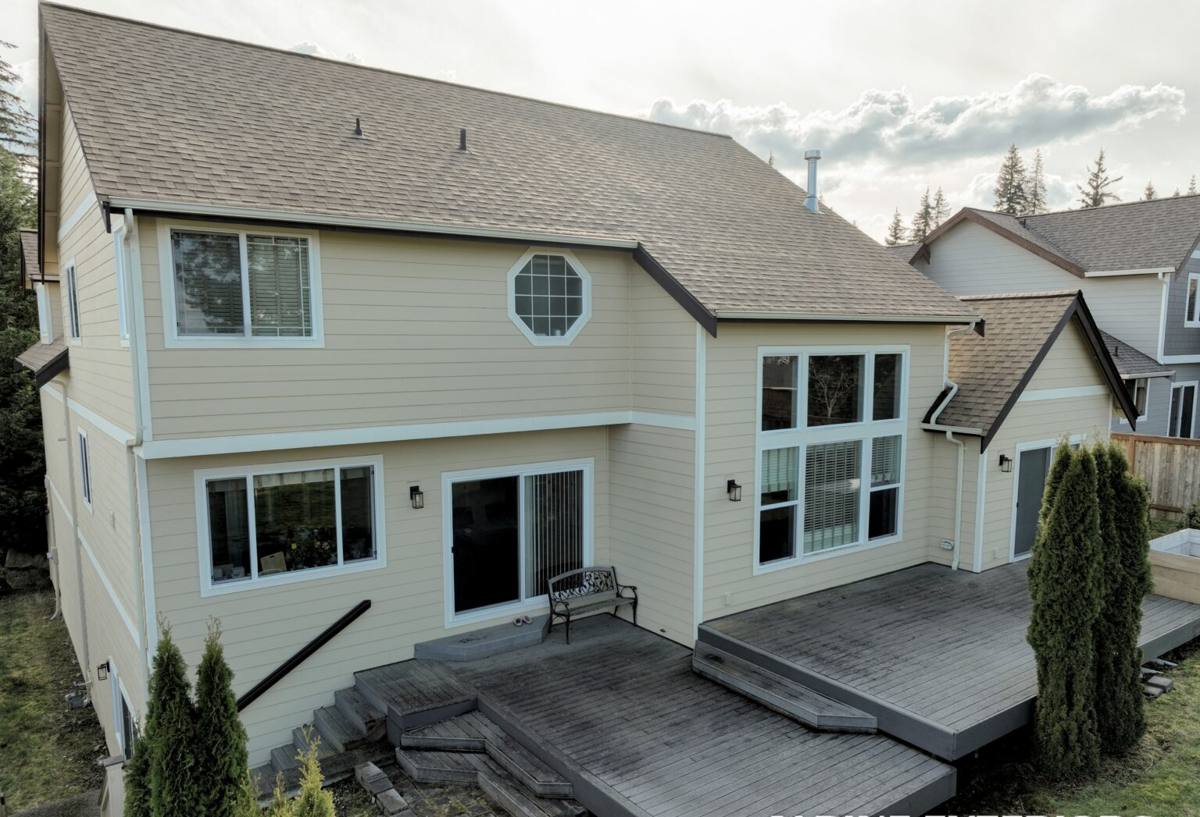
What Composite Decking Actually Means
Composite decking is a blend of wood fiber and plastic, formed into boards that are meant to resist rot, splintering, and insect damage better than solid wood. Most boards on the market today fall into two broad categories, and the difference matters more here than it would somewhere dry and inland.
Capped vs. Uncapped Composite
Capped composite boards have a plastic shell wrapped around a wood-plastic composite core. That cap is what actually keeps moisture, salt, and UV out of the board. Uncapped composite — the older style of product — has no protective shell, and the exposed wood fiber in the core can absorb moisture, swell, and eventually mold or discolor. Near salt water, where boards are exposed to both salt film and near-constant humidity, we don't recommend uncapped composite. The moisture resistance simply isn't there for this environment.
PVC vs. Wood-Plastic Composite
Cellular PVC decking is a related but different product — it's essentially all plastic, with no wood fiber at all. It costs more, but it has no organic material for moisture to affect, which makes it a strong option for docks, boat-adjacent structures, or decks that sit low to grade where moisture exposure is constant. Capped wood-plastic composite is a middle ground: good moisture resistance from the cap, a more traditional wood-grain look, and a lower price point than full PVC. Which one makes sense depends on the deck's height, drainage, sun exposure, and your budget — we'll walk through that trade-off during the estimate rather than defaulting to one product for every job.
What a Correct Composite Deck Build Involves Here
The decking boards themselves get most of the attention, but the substructure underneath is what actually determines whether a deck lasts. This is where corners get cut, and it's also where salt air and rain do the most damage if it's done wrong.
Substructure and Framing
We frame with lumber rated for ground contact or use composite/PVC framing components where the design calls for it, and we keep joist spacing tight enough to match the manufacturer's specification for the board and the direction it's laid. Composite boards flex differently than solid wood, and spacing that's fine for a cedar deck can leave a composite deck feeling springy or, over time, sagging between joists.
Fasteners and Hardware
Everything below the decking — joist hangers, structural screws, hidden fasteners — needs to be corrosion-resistant hardware rated for the exposure. Standard galvanized fasteners can start showing rust streaks within a couple of seasons in salt air; stainless steel or a coated fastener system rated for coastal exposure holds up far longer. This is one of the easiest things for a crew to shortcut because it's invisible once the boards go down, and it's one of the first things we check when we're asked to look at a deck someone else built.
Drainage and Airflow Underneath
Standing water and trapped moisture under a deck are what cause premature framing failure and give moss and mildew a place to establish. We grade and vent the space under low decks, keep skirting from sealing off airflow completely, and make sure water shed by the decking boards actually has somewhere to go instead of pooling against the house or the foundation.
Ledger Attachment at the House
Where the deck attaches to the house, that ledger board and its flashing are the single most common source of hidden water damage on any deck, anywhere. Near the harbor, with more wind-driven rain hitting that wall, proper ledger flashing that sheds water away from the house — not into the rim joist — isn't optional. This is also a point where we coordinate directly with the siding on the house, since a poorly flashed ledger can send water behind siding that's otherwise in good shape.
Comparing Decking Options for a Coastal Property
| Material | Moisture Resistance Near Salt Air | Maintenance | Typical Lifespan |
|---|---|---|---|
| Uncapped wood-plastic composite | Fair — core can absorb moisture over time | Periodic cleaning, some fading/mold risk | 15-20 years |
| Capped wood-plastic composite | Good — cap resists salt film and moisture | Occasional washing | 20-30 years |
| Cellular PVC decking | Very good — no wood fiber to absorb moisture | Low; occasional washing | 25-30+ years |
| Solid wood (cedar, etc.) | Poor to fair without diligent upkeep | Annual sealing/staining recommended | 10-15 years near water |
These are general ranges, not guarantees — actual lifespan depends heavily on installation quality, sun and wind exposure, and how consistently a deck is cleaned. A well-built capped composite deck that's kept clean will often outlast a poorly flashed, poorly fastened deck built with premium materials.
Moss, Salt Film, and Ongoing Care
Even the best composite board benefits from basic care in this climate, and setting expectations up front saves homeowners frustration later.
- Rinse or sweep salt film and organic debris off the surface periodically, especially after windy weather off the water.
- Keep gutters and downspouts near the deck clear so runoff isn't dumping extra water onto the decking or the framing below.
- Address moss or algae early with a mild cleaner rather than letting it establish — composite caps resist staining, but moss left to grow can still leave surface residue.
- Keep planters, mats, and furniture feet from trapping moisture directly against the boards for extended periods.
- Check the underside of the deck once a year for anything that looks like standing water, blocked airflow, or fastener corrosion.
None of this is heavy maintenance — it's the same basic upkeep any exterior surface near the water needs. The point is that "low-maintenance" doesn't mean "zero-maintenance," and we'd rather set that expectation honestly than oversell the product.
How Our Process Works
We start with a walk of the site and an honest look at what's there now — existing framing condition, drainage, sun exposure, and how the deck ties into the house. From there we talk through decking material options based on your budget and how the space will actually be used, not just the highest-margin product on the truck. Once we agree on materials, we handle permitting where required, build and inspect the substructure before a single decking board goes down, and install the decking, railing, and any fascia or trim to the manufacturer's fastening specification — which matters for keeping warranties valid. We clean up thoroughly and walk the finished deck with you before calling the job done.
Because we work in and around Blaine regularly, we're not guessing at what this climate does to a deck over five or ten years — we've seen it, and we build accordingly rather than building to a generic spec sheet.
What to Ask Before Hiring Anyone to Build Your Deck
- Do they specify corrosion-resistant fasteners and hardware for coastal exposure, or just "standard" hardware?
- Will they show you the framing and fastener plan before decking goes down, not just the finished product?
- Do they follow the decking manufacturer's spacing and fastening spec closely enough to keep the product warranty valid?
- How do they handle ledger flashing where the deck meets the house?
- Do they have a plan for drainage and airflow under the deck, especially if it sits low to grade?
- Are they familiar with how salt air and moss affect decks specifically in this area, or is this their first coastal job?
Why Hiring a Crew That Already Works Blaine Harbor Matters
A contractor based further inland can build a technically sound deck and still get the details wrong for this environment — the wrong fastener grade, a ledger flashing detail that works fine in a drier climate but fails here, or a decking product chosen without accounting for how much salt film and rain it'll actually see. We work on homes in Blaine and along the Whatcom County coastline regularly, so the coastal-specific decisions — fastener selection, drainage under the deck, which composite product actually holds up near the harbor — are part of our normal process, not an afterthought.
Siding and decking work on the same house also benefit from being looked at together. A deck ledger tied into siding that's already showing moisture issues, or a deck built right up against siding that needs its own drainage plane repaired, is the kind of thing that's easy to miss if the two trades never talk to each other. Since we do both, we can flag that during the estimate instead of after the fact.
If you're planning a new composite deck or replacing an aging one near Blaine Harbor, we're glad to come take a look and give you a straightforward, no-pressure estimate — use the form below to get started.