 Blaine Siding
 Siding on the Water's Edge: Birch Point's Climate Problem
Birch Point sits right up against the shoreline northwest of Blaine, and that location changes what siding has to survive out here compared to a home a few miles inland. Salt-laden air off the water works on exposed fasteners, caulk joints, and paint film in a way that drier inland air doesn't. Wind carries rain sideways into wall assemblies during winter storms, and the mature tree cover that gives many Birch Point lots their privacy also keeps north and shaded walls damp and shaded for long stretches of the year. Add in Whatcom County's long, low-intensity rain season and you get siding that stays wet longer than it dries — which is exactly the condition moss, mildew, and slow moisture intrusion need to take hold.
None of this means Birch Point is a bad place to own a home. It means the siding has to be chosen and installed with those specific conditions in mind, not treated as an afterthought behind the roof and windows.
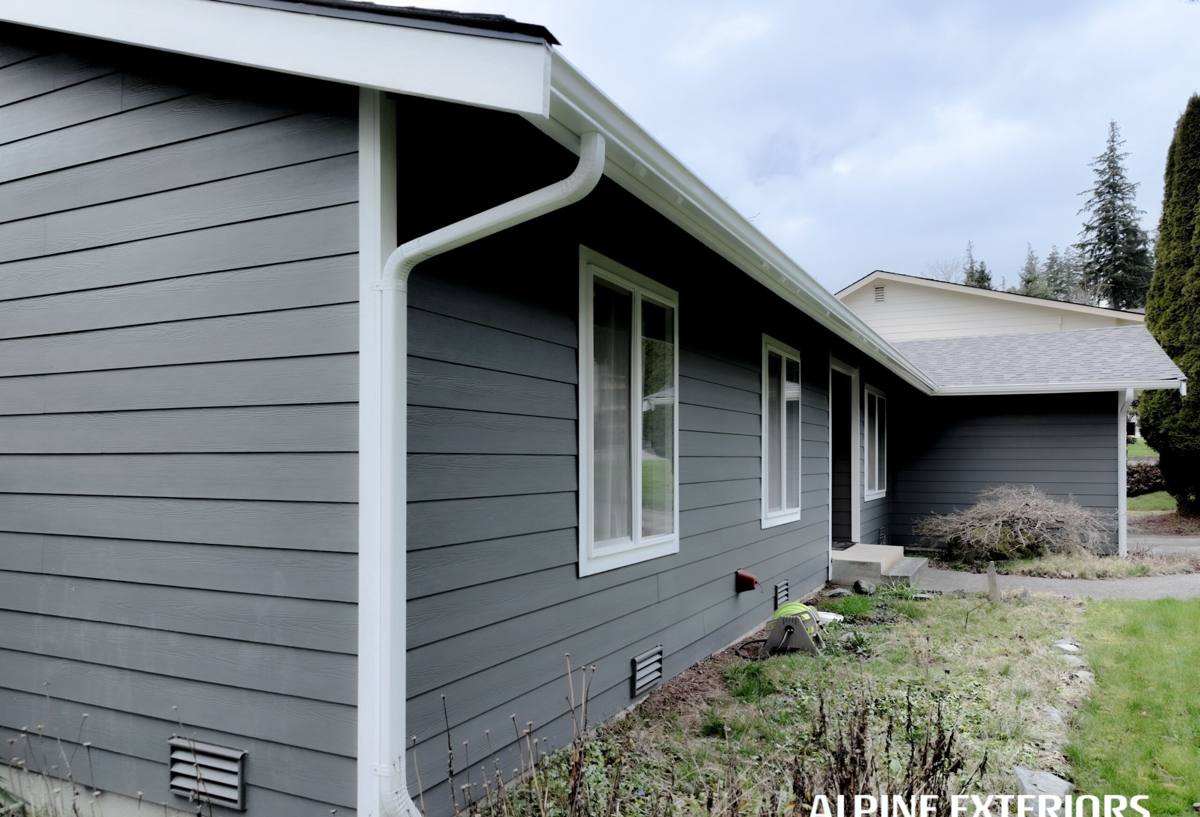
What Birch Point Homes Actually Need From Their Siding
Three things matter more here than in a typical inland Blaine or Whatcom County job:
- Dimensional stability — siding that doesn't swell, cup, or open up its joints as moisture content swings between soaked winter weeks and drier summer stretches.
- A finish that resists salt and UV without constant recoating — south and west walls get strong summer sun on the water; north walls stay damp and grow moss and algae if the surface holds water.
- Correct water management behind the cladding — house wrap, flashing, and drainage gaps that let any moisture that does get past the siding find its way back out, rather than sitting against sheathing.
Get any one of those wrong and the siding may look fine for a couple of years before the real problems — soft trim, staining, paint failure, or rot at penetrations — start showing up.
Why This Isn't Just an Inland Blaine Job with Extra Steps
A siding job three miles inland and a siding job on Birch Point can use the same product and still need different flashing details, different fastener choices, and a different eye for where moss and algae are most likely to establish. Crews who don't regularly work this close to the water tend to treat it like any other Whatcom County job and miss the details that matter most here.
Why We Install Only James Hardie Fiber Cement Here
We don't offer vinyl, LP SmartSide, Cemplank, Allura, or primed wood siding — on Birch Point or anywhere else we work. That's a deliberate standard, not a missing option on a menu.
Vinyl expands and contracts significantly with temperature swings and can warp or crack under wind-driven impact; on a waterfront lot with exposed wind loading, that's a real seam and fastener problem over time. LP SmartSide is an engineered wood product — it performs well when detailed and maintained correctly, but it's still wood-based, meaning cut edges, fastener heads, and any breach in the factory coating are entry points for moisture in a climate that doesn't give siding much time to dry out. Primed spruce and cedar are natural wood products that need active, ongoing maintenance — recoating, caulking, and inspection — to hold up against salt air and constant damp shade, maintenance that's easy to fall behind on.
James Hardie fiber cement is non-combustible, doesn't expand and contract the way vinyl does, and its ColorPlus factory finish is baked on rather than field-applied, which gives it much better resistance to fading and moisture intrusion at the surface than a job-site paint job. It's not maintenance-free, but the maintenance it needs is realistic for a homeowner to keep up with, and the failure modes that plague wood and vinyl in this climate largely don't apply to it when it's installed to spec.
Product Lines Engineered for This Climate
James Hardie builds its siding in climate-specific formulations. The HZ5 line is engineered for regions with significant moisture cycling and freeze-thaw exposure — which describes the Pacific Northwest far better than a generic one-size-fits-all product does. That's the line we spec for Blaine and Whatcom County work, including Birch Point.
What a Correct Installation Involves
The siding panel itself is only part of the system. On a waterfront lot like Birch Point, the details around it matter as much or more:
- A weather-resistive barrier installed with proper shingle-lap sequencing so water sheds down and out, not into seams.
- A rainscreen or drainage gap behind the siding where wall orientation and shading call for it, so moisture that reaches the back of the panel can drain and the wall can dry.
- Flashing at every window, door, and roof-to-wall transition — the points where most real-world water intrusion actually starts.
- Correct fastener type, spacing, and embedment depth per Hardie's published installation specs, not a generalized "siding nailer" approach.
- Proper joint and butt-seam treatment, including sealant only where Hardie's details call for it — over-caulking traps moisture just as badly as under-caulking lets it in.
Skip or rush any of these and you can end up with a wall that looks right for a season or two before problems surface behind the cladding, where they're much more expensive to fix.
Common Problems We See on Waterfront Whatcom County Homes
Most of what shortens a siding job's life on a shoreline property traces back to a handful of recurring issues: caulk used as a substitute for proper flashing, fastener heads left exposed to salt air, siding installed tight against grade or hardscape with no clearance to shed water, and shaded north walls left with no drainage path so moss and algae get a permanent foothold. These aren't defects in the siding material — they're installation shortcuts that show up faster in a marine climate than they would inland.
We flag these because they're the exact details we build into the estimate and the install plan for a Birch Point address before the first panel goes up.
Our Process on a Birch Point Job
- On-site assessment — we walk the exterior, check existing wall condition, note shading patterns, wind exposure, and any signs of past moisture issues.
- Written estimate — scope, product line, color, and a clear breakdown of what's included, with no surprise add-ons once work starts.
- Prep and moisture barrier — removal of failing existing siding, sheathing inspection and repair where needed, and correct installation of the weather-resistive barrier and drainage plane.
- Installation to Hardie spec — panels, flashing, and fastening done to manufacturer detail, not shortcuts.
- Final walkthrough — we go over the finished job with you before we consider it done.
Cost Factors for Birch Point Siding Jobs
Every home is different, but these are the main variables that move the price of a fiber cement job on a waterfront Blaine property:
| Factor | Why It Matters on Birch Point |
|---|---|
| Wall condition underneath | Sheathing or framing repair needed after removing old siding, more common near ground-contact and roof-transition areas exposed to moisture |
| Wind exposure of the lot | Waterfront exposure can call for additional fastening detail and flashing at exposed corners |
| Existing moisture barrier | Whether a drainage gap or rainscreen needs to be added, not just a wrap replacement |
| Trim and detail complexity | Window, door, and roofline transitions are where most labor time and most future leak risk concentrate |
| Product line and color | HZ5 panel profile and ColorPlus finish selection |
Keeping Fiber Cement Siding Performing in a Salt Air, High-Moss Climate
Fiber cement is low-maintenance compared to wood or vinyl, but "low" isn't "none," especially this close to the water. A simple seasonal routine goes a long way:
- Rinse salt residue off exterior walls a couple of times a year, especially after storms with onshore wind.
- Keep gutters clear so runoff doesn't sheet down siding faces and feed moss growth.
- Trim back vegetation that keeps a wall in constant shade and damp — airflow is one of the best defenses against moss.
- Check caulk lines at trim and penetrations annually and have any cracked or missing sealant redone before winter rains set in.
- Have any impact damage or exposed fastener heads repaired promptly rather than left through a wet season.
Why Hiring a Crew That Already Works Birch Point Matters
Siding crews who mostly work drier, inland jobs don't always carry the instinct for where a shoreline home needs extra flashing, drainage, or fastening detail — because they don't see the consequences of skipping it as often. A crew that regularly works Blaine's waterfront neighborhoods has already seen which walls fail first, which details actually matter in this climate, and which shortcuts cost homeowners money down the road. That local track record is worth as much as the product spec sheet when you're picking who touches your home.
If you're weighing a siding replacement or repair on a Birch Point home, we're glad to come take a look and put together a straightforward, no-pressure estimate — no obligation, just an honest read on what your home needs.