 Blaine Siding
 Siding Repair for Bellingham's Climate
Bellingham homes take a specific kind of beating. There's the marine air rolling in off the bay carrying salt, the wind-driven rain that finds its way sideways into places a straight-down rain never would, and a moss season that, on shaded or tree-covered walls, can run most of the year. None of that is unusual for this part of Whatcom County — it's just what siding here has to live with. What it means for repair work is that a crack or a soft spot rarely stays small for long, and a repair that only patches the visible damage tends to be back on our schedule within a year or two.
We do siding repair on Bellingham homes regularly, and the pattern is consistent: by the time a homeowner notices a problem, there's usually more going on behind the siding than what's visible from the yard. Our approach is to find out what's actually happening at the wall before we decide how to fix it, then repair it in a way that holds up through the next several wet seasons, not just until the next inspection.
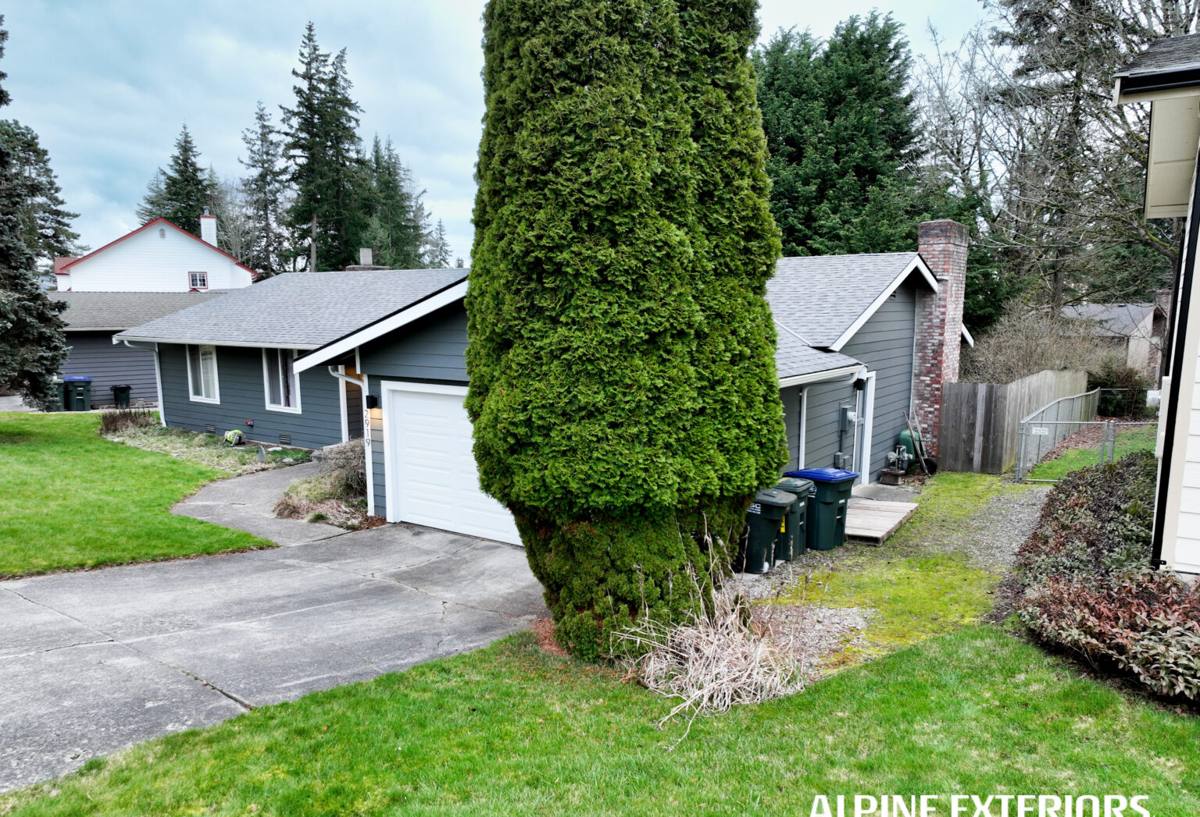
What Bellingham's Climate Does to Siding Over Time
Salt Air and Slow Corrosion
Homes closer to the water deal with steady salt exposure that's hard on fasteners, flashing, and any exposed metal trim. Corroding fasteners loosen their grip over time, which lets siding panels shift, gap, and let water behind them — a slow process that's easy to miss until a section of siding is visibly loose or a panel has pulled away from the wall.
Wind-Driven Rain Finding the Wrong Path
Rain here doesn't fall straight down as often as people from drier climates expect. Wind pushes it sideways and up under laps, trim edges, and joints that were built to shed rain falling vertically, not rain being driven horizontally into a seam. That's often how water gets behind siding that looks intact from a few feet away.
Moss and Prolonged Moisture
Shaded walls, north-facing elevations, and anything under tree cover stay damp longer between rain events, which is exactly the environment moss and mildew need. Moss holding moisture against a wall for weeks at a time accelerates whatever damage is already starting — softened substrate, failing caulk, paint that's lifting at the edges.
Freeze-Thaw Cycling on Damaged Material
Bellingham doesn't see extreme cold often, but the freeze-thaw cycles it does get are enough to widen a crack that's already holding water. Water that gets into a crack, freezes, and expands does real damage even over just a handful of cycles a winter.
Common Siding Problems We Find on Bellingham Homes
- Cracked or chipped siding panels, often at corners, penetrations, or low-impact areas near walkways
- Soft or spongy spots that indicate moisture has already reached the substrate behind the siding
- Gaps or separation at seams and laps where caulking has failed or shifted with the wall
- Moss and mildew staining that's more than cosmetic and points to a wall that isn't drying out between rains
- Loose or pulling-away panels caused by corroded or failing fasteners
- Paint or finish failure concentrated at seams, edges, and fastener heads rather than across the whole wall
- Damage around windows, doors, and other penetrations where flashing has failed or was never installed correctly
Any one of these on its own might be a straightforward fix. The reason we walk the whole wall rather than just the spot a homeowner points to is that these problems tend to show up together — a section of moss staining a few feet from a soft spot is rarely a coincidence, it's usually the same underlying moisture problem showing up in two places.
What a Correct Repair Actually Involves
A siding repair that's done right addresses the cause, not just the visible symptom. That distinction matters more in Bellingham than in a drier climate, because a repair that only replaces damaged material without fixing what let moisture in will fail again, often faster than the original damage took to develop.
| Repair Step | Why It Matters Here |
|---|---|
| Confirm the actual moisture source, not just the damaged panel | Water often travels before it shows — the visible damage isn't always where the problem started |
| Check the condition of the water-resistive barrier behind the removed siding | A compromised barrier lets the same damage return even with new siding installed over it |
| Inspect and correct flashing at nearby windows, doors, or penetrations | Wind-driven rain exploits flashing gaps more aggressively in this climate than in calmer, drier ones |
| Replace damaged material with matching, correctly primed and finished siding | Mismatched material or unsealed cut edges become the next failure point |
| Restore proper fastening, spacing, and drainage clearance | Improper reinstallation reintroduces the same vulnerability the repair was meant to solve |
Skipping any one of these steps is how a repair ends up being temporary. It's also how a homeowner ends up paying for the same section of wall twice within a few years.
Repair or Replace: How We Make That Call
Not every damaged section needs a full re-side, and not every repair is worth doing instead of a broader replacement. A few things tend to tip the decision:
- Extent of the damage — isolated damage on an otherwise sound wall is usually a good repair candidate; widespread cracking, staining, or soft spots across multiple elevations often points to a system nearing the end of its life
- Age and material of the existing siding — older wood-based or engineered wood siding that's already showing moisture damage in one area is likely to show it elsewhere soon, even if it isn't visible yet
- What's behind the siding — if the water-resistive barrier or sheathing is compromised over a large area, patching the surface without addressing that is a short-term fix at best
- How the repaired sections will match — on faded or weathered siding, especially field-painted material, a patch can be visibly obvious even when it's structurally sound
We'll always tell you honestly which side of that line your home is on. A repair that's genuinely appropriate is what we'll recommend — we don't upsell a full re-side when a targeted fix will hold up.
Why We Repair With James Hardie Fiber Cement
We install and repair with James Hardie fiber cement exclusively — we don't work with LP SmartSide, vinyl, Cemplank, Allura, primed spruce, or cedar. That's a deliberate professional standard, not a lack of options. In a repair context specifically, fiber cement has a real advantage: it doesn't absorb and swell with moisture the way wood-based products do, so a correctly executed patch doesn't become a weak point just because it's newer material sitting next to older, weathered material. James Hardie's factory-applied ColorPlus finish also holds color and resists moss growth better than field-applied paint, which matters on a repair where blending new material into an existing wall is part of the job.
Other contractors repair those other products competently, and homeowners who already have them installed aren't wrong to have chosen them. Our decision is about what we're willing to put our name behind going forward, especially in a climate that's this consistently wet.
Our Repair Process
Assessment
We start with a full walk of the affected wall and the areas around it, not just the spot that prompted the call. We're checking for moisture behind the siding, the condition of flashing at nearby openings, and whether the damage is isolated or part of a larger pattern.
Diagnosis and Options
We explain what we found, what caused it, and what the realistic options are — repair, a larger section replacement, or in some cases a recommendation to consider full re-siding if the underlying wall assembly is compromised. You'll know why we're recommending what we're recommending.
The Repair Itself
We remove damaged material, address whatever let moisture in — a flashing gap, a failed barrier, deteriorated fastening — and install matching James Hardie siding to manufacturer spec, with correctly primed cut edges and proper drainage clearance restored.
Final Check
We walk the finished repair with you, point out what we did and why, and let you know if there's anything worth keeping an eye on elsewhere on the wall.
Cost Factors for Bellingham Siding Repair
| Factor | Why It Matters |
|---|---|
| Size and location of the damaged area | Ground-level repairs are simpler than sections requiring ladder or lift access |
| Condition behind the siding | Compromised sheathing or barrier material adds work beyond the visible repair |
| Matching existing siding | Older or discontinued profiles and colors can take more effort to match well |
| Flashing and penetration issues | Repairs near windows, doors, or vents often involve correcting flashing, not just siding |
| Number of separate damaged areas | Multiple isolated repairs across a home add labor even when each one is individually small |
We'll give you real numbers after seeing the specific damage rather than a rough estimate over the phone — two homes with similar-looking damage can have very different underlying causes and repair scopes.
Why Hire a Crew That Already Works Bellingham
Repair work rewards local experience more than new installation does, because diagnosing the cause of damage requires knowing what this specific climate does to a wall over time. A crew that's repaired siding across Bellingham through multiple wet seasons has already seen which orientations fail first because of shade and salt exposure, what moss staining usually means versus what it sometimes hides, and where flashing tends to fail on homes of a given age in this area. That judgment is what keeps a repair from becoming a recurring appointment.
If you've got a section of siding that's cracked, staining, or just doesn't look right anymore, we're happy to come take a look, tell you honestly what we find, and put together a straightforward, no-pressure estimate. There's a form below — reach out and we'll get a time on the calendar.