 Blaine Siding
 Why Decking Fails Differently Around Nooksack
Nooksack sits inland from Blaine, but it shares the same weather system as the rest of Whatcom County: long wet winters, a short dry stretch in summer, and wind off the Salish Sea that carries a fine salt residue further inland than most homeowners expect. On top of that, the shade from mature trees and the region's damp, mild temperatures create ideal conditions for moss and algae to take hold on any horizontal wood surface. A deck here doesn't fail because the homeowner did anything wrong. It fails because it was built or maintained the way you'd build a deck in Arizona or even Seattle proper, without accounting for how much moisture this area actually sees and how long it sits before it dries out.
We've worked on enough decks in this corner of Whatcom County to see the pattern repeat: boards that cup and split within a few seasons, fasteners that back out and rust, and substructures that rot from underneath while the top surface still looks fine. Composite decking solves a real subset of these problems, but only when it's installed with this specific climate in mind. That's the distinction we want to walk through here.
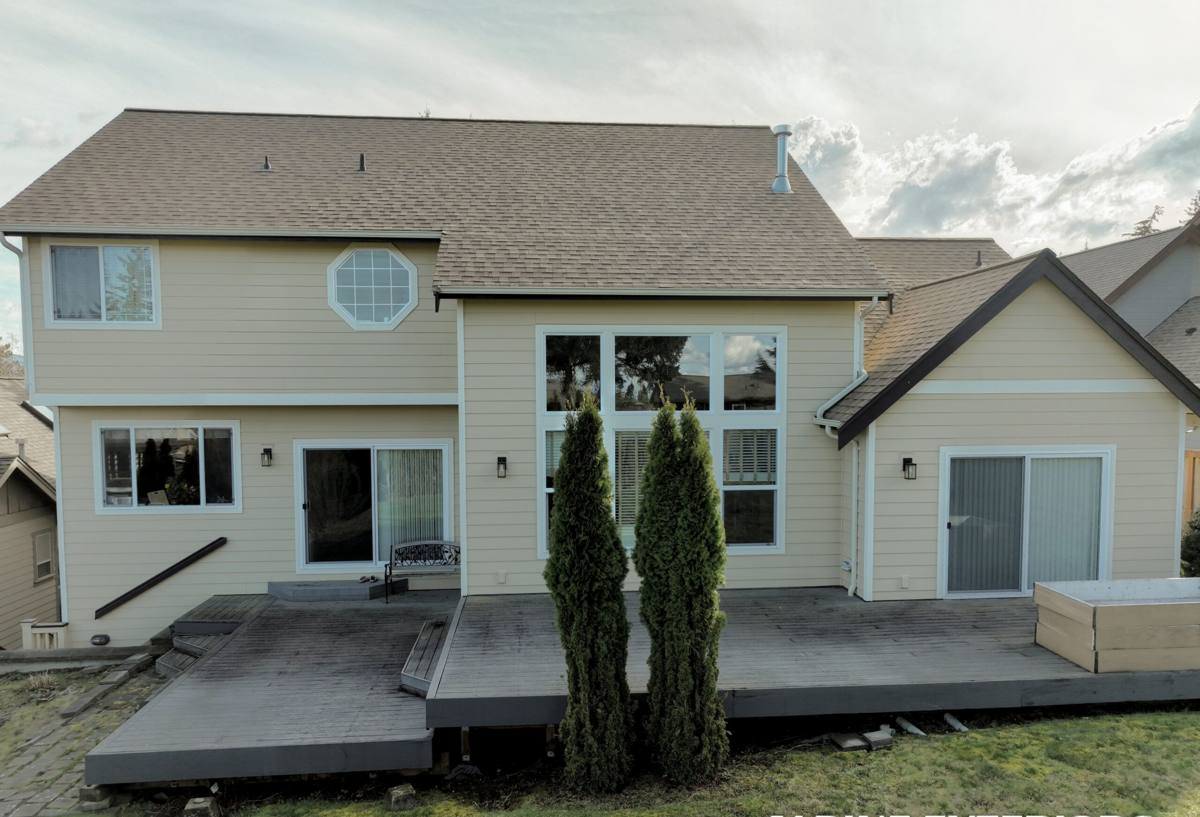
What Composite Decking Actually Fixes Here
Traditional wood decking needs to be sealed or stained on a schedule to keep water out of the grain. In a climate with this much rainfall and this little sun exposure for parts of the year, that schedule slips. Once water gets into unsealed wood and can't dry out fast enough between storms, you get cupping, splintering, and eventually rot. Composite decking doesn't rely on a surface coating to keep water out — the board itself doesn't absorb moisture the way wood does, so it isn't racing the calendar every time it rains.
Capped vs. Uncapped Composite
Not all composite is built the same, and this matters more in a wet climate than a dry one. Capped composite boards have a polymer shell wrapped around a wood-fiber core, which keeps moisture, mold, and staining largely on the surface where it can be cleaned off. Uncapped composite exposes the wood-fiber core at the edges and sometimes the surface, and in a climate that sees moss and standing moisture for months at a time, that exposed core can absorb water, swell, and eventually support mold growth. We install capped composite for this reason — it's a straightforward trade-off between upfront cost and long-term moisture performance, and in this climate the moisture performance wins.
What Composite Doesn't Fix
Composite decking is only as good as what's underneath it. It won't stop moss from growing on the surface — nothing fully does in this climate, though composite is far easier to clean than wood. It won't compensate for a rotted or undersized joist structure. And it won't stop water intrusion at the house if the ledger board and flashing weren't done correctly. Anyone who tells you composite decking is maintenance-free is oversimplifying. It's low-maintenance compared to wood, not zero-maintenance in a climate like this one.
What a Correct Install Involves
The board material is the visible part of the job, but most of the deck's long-term performance comes from what happens before a single composite board goes down.
Substructure and Ledger Flashing
Where the deck ties into the house is the single most common failure point we find on older decks in this area, composite or wood. If the ledger board isn't properly flashed with the right lap and sealing details, water works its way behind it and into the rim joist and wall sheathing — often for years before anyone notices, because the composite surface above hides it completely. We flash every ledger connection to shed water away from the house, not just seal it with caulk and hope.
Joist Protection and Spacing
Composite boards are typically installed over standard pressure-treated joists, and those joists still need protection from the moisture that gets underneath the deck surface. We use joist tape over the top of the framing to keep water off the wood where fasteners penetrate, and we hold board spacing to the manufacturer's spec so there's enough gap for water to drain and air to move underneath. Too tight, and the deck holds moisture against itself; too loose, and boards flex more than they should.
Fasteners and Hardware
Salt-laden air corrodes standard fasteners faster than most homeowners realize, especially anything left exposed at board ends, stair stringers, or railing posts. We use stainless or coated hardware rated for coastal and marine-adjacent exposure throughout the build, not just on the visible surface, because a fastener that rusts and stains a composite board from the inside out is a callback waiting to happen.
Ventilation Underneath
Low decks built close to grade, or decks that enclose the space underneath with skirting, need real ventilation gaps. Without airflow, the ground moisture that's constant here for much of the year has nowhere to go, and it sits against the underside of the deck and the house foundation. We plan skirting and under-deck detailing with airflow in mind rather than treating it as a purely cosmetic finish.
Comparing Your Decking Options for This Climate
| Material | Moisture Behavior Here | Upkeep | Typical Lifespan |
|---|---|---|---|
| Pressure-treated wood | Absorbs water, needs regular sealing to slow cupping and splitting | Annual cleaning, re-stain every 1-3 years | 10-15 years before major repair |
| Uncapped composite | Core can absorb moisture at exposed edges; more prone to mold in shaded, wet spots | Periodic cleaning, watch cut ends | 15-20 years |
| Capped composite | Surface sheds water and resists staining; doesn't rely on a coating | Occasional wash-down | 25-30 years, often longer |
| PVC decking | Fully synthetic, no wood fiber to absorb moisture at all | Lowest of the group | 25+ years |
Cost generally follows the same order, from pressure-treated wood at the low end to PVC at the high end, with capped composite sitting in the middle. For most homes in this area, capped composite is the point where cost, appearance, and real-world moisture performance line up best — which is why it's what we recommend and install most often here.
Moss, Grime, and Drainage: The Nooksack-Specific Problem
Moss doesn't care what your decking is made of. What changes with composite is how easy the buildup is to deal with. Wood decking that grows moss often has the moss growing into the grain itself, so cleaning it means scrubbing and sometimes still leaves the surface roughened and more absorbent than before. Capped composite lets moss and algae sit on the surface rather than in it, so a wash with the right cleaner and a soft brush actually removes it instead of just knocking down the visible growth.
Drainage design matters just as much as the board itself. Decks that sit in shaded corners of a yard, under tree cover, or against a north-facing wall stay damp far longer after a storm than decks with more sun and airflow. We look at how water actually moves across and off a deck during the design phase — board direction, gap spacing, and where the deck ties to grade — because a deck that drains well needs far less cleaning over its life than one that doesn't, regardless of material.
Our Process
We keep the process straightforward and don't push add-ons a home doesn't need.
- On-site assessment. We look at the existing deck or the build site, check the condition of any existing substructure, and note drainage, shade, and exposure patterns specific to the lot.
- Honest scope and quote. We tell you what needs to be replaced versus what can stay, and we quote the job in plain terms — no vague allowances that turn into surprise change orders.
- Structural work first. Ledger flashing, joist repair or replacement, and hardware upgrades happen before any composite board is installed.
- Composite installation. Boards, fascia, and railing go in to manufacturer spec, with attention to spacing, fastening, and ventilation as covered above.
- Walkthrough and cleanup. We walk the finished deck with you, cover basic care for this climate, and leave the site clean.
Questions Worth Asking Any Contractor Before You Sign
- Will you inspect and repair the substructure, or just install boards over what's already there?
- What fastener and hardware grade are you using, and is it rated for coastal exposure?
- Is the ledger board flashing included, or treated as an assumed detail?
- What's the manufacturer's warranty, and does your installation method keep that warranty valid?
- How do you handle drainage and ventilation on shaded or low-clearance sections of the deck?
Living With Composite Decking Here
Care is lighter than wood, but it isn't nothing. A seasonal rinse or light wash before moss gets a foothold keeps the surface looking new far longer than waiting until growth is visible and established. Keeping gutters and nearby drainage clear so runoff isn't dumping directly onto one section of the deck matters more here than in drier climates, since that section will simply never fully dry out between rain events otherwise. Trimming back overhanging branches where practical helps too — less standing shade means less time the surface stays wet after a storm.
Why Local Experience Matters for This Job
A composite deck built to a generic national spec sheet will hold up fine in a lot of the country. It won't necessarily hold up the same way in a Whatcom County winter with months of driving rain, wind carrying salt air off the water, and long stretches without enough sun to dry anything out fully. Knowing which fastener grade actually holds up here, which ledger flashing details matter most given how the rain hits homes in this area, and how much ventilation a given deck design actually needs isn't something you get from reading a manufacturer's install guide once. It comes from having built and maintained decks in these exact conditions, on homes near Blaine and throughout the surrounding county, and seeing what holds up ten years later and what doesn't.
If you're planning a new deck in Nooksack or looking at replacing boards on an existing one, we're happy to take a look and give you a straight answer about what your home actually needs. There's no pressure and no cost to have us out for a free estimate — just a clear look at the job and what it would take to get it right.