 Blaine Siding
 Windows Built for the California Creek Microclimate
California Creek sits close enough to Semiahmoo Bay and the Strait of Georgia that homes here take a different kind of weather beating than houses just a few miles inland. Salt-laden air moves through on a regular basis, wind-driven rain hits window assemblies at angles that flat-lot installations never see, and the shaded, moisture-heavy stretches near the creek corridor keep siding and trim damp longer through the fall and winter. Window installation in this part of Blaine isn't just about swapping glass — it's about getting the flashing, sealants, and drainage details right so the wall behind the window stays dry for the next twenty or thirty years.
We've worked on homes throughout this neighborhood and the surrounding Whatcom County waterfront, so we're not guessing at what holds up here. We know which failure points show up first in salt-exposed openings, and we build the installation around avoiding them.
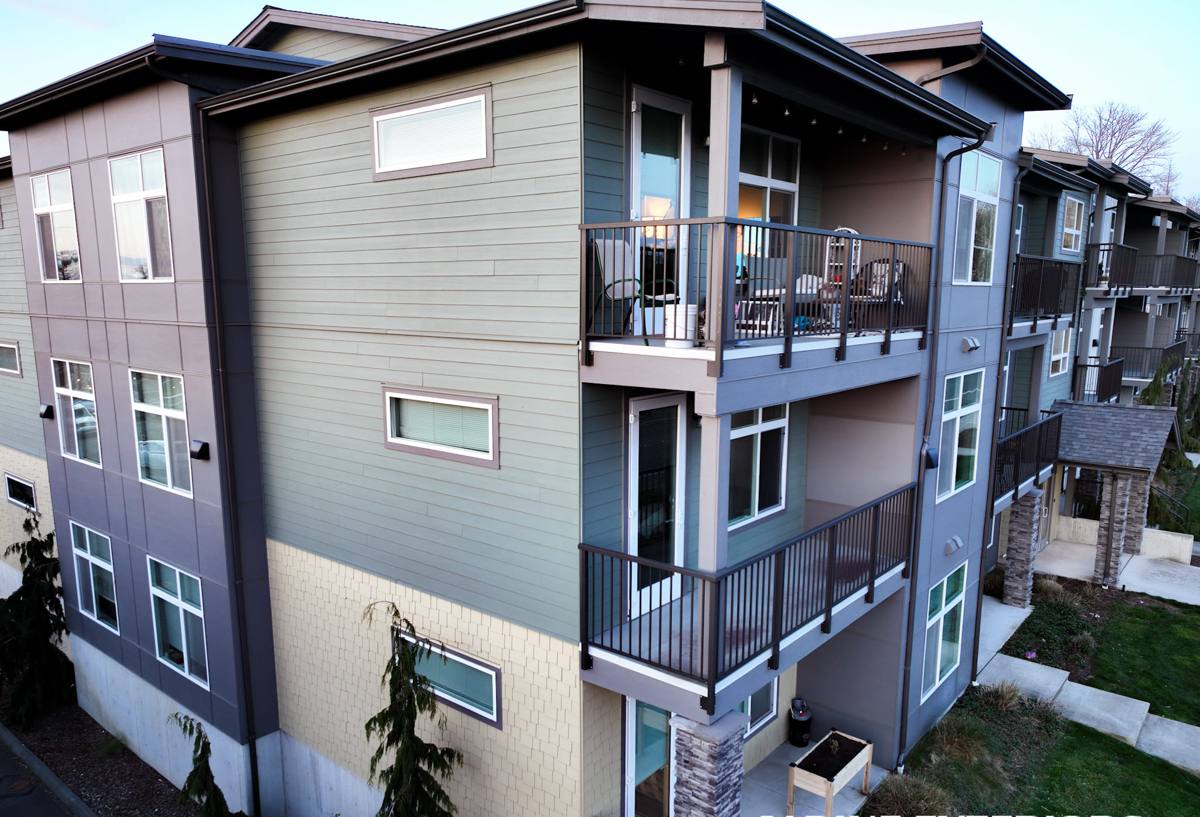
What Salt Air and Driving Rain Actually Do to Windows
It helps to understand the specific mechanisms at work, because they point directly to what a correct installation needs to address:
Salt Air
Airborne salt is corrosive to unprotected metal fasteners, hinges, and some lower-grade window hardware. Over years, it can also degrade certain finishes and accelerate wear on weatherstripping and seals faster than an inland home would experience. This is a materials and hardware question as much as it is an installation question — the window itself has to be rated for coastal exposure, not just the flashing around it.
Driving Rain
Wind off the water doesn't just fall on a window — it pushes rain sideways and upward under sills and around trim. A window that would perform fine in a calm rain can leak in a wind-driven storm if the flashing laps aren't sequenced correctly or if sealant is used to compensate for a gap that should have been mechanically closed instead. This is why installation sequence matters more here than in sheltered parts of Blaine.
Moss and Sustained Moisture
Whatcom County's long wet season means anything that traps water — a poorly sloped sill, a missing weep path, trim that sits flush against siding with no drainage gap — stays wet for extended stretches. Moss and mildew take hold in exactly those conditions, and once moisture is getting behind trim, rot in the surrounding framing is usually not far behind.
What a Correct Window Installation Involves
A proper installation is a sequence, not a single step. Skipping or reordering any of these creates a weak point that often doesn't show itself until a wind-driven storm finds it — sometimes years later.
- Rough opening inspection. We check the framing, sheathing, and existing flashing (if any) for rot, soft spots, or prior water damage before anything new goes in. This is especially important on older California Creek homes where original window details may not have been built for today's exposure.
- Water-resistive barrier integration. The house wrap or building paper has to be cut and integrated with the window flashing in the correct shingle-lap order — upper layers over lower layers — so water is always directed outward and down, never trapped behind the assembly.
- Sill pan flashing. A sloped, sealed sill pan under the window gives any water that does get past the exterior seal somewhere to go besides your wall cavity. This is one of the most commonly skipped steps in budget installations, and it's one of the most important ones for a home in a wind-driven-rain zone.
- Head and jamb flashing. Properly lapped flashing at the top and sides sheds water around the window rather than letting it pool at corners, which is where driving rain tends to concentrate.
- Mechanical fastening, not sealant substitution. Sealant is a backup layer, not the primary defense. Windows need to be fastened and shimmed correctly so the frame stays square and the weatherstripping seals evenly for the life of the window.
- Insulation and air sealing at the perimeter. A gap packed with the wrong material — or left empty — becomes a condensation point and a draft, and in a humid climate like this one, a condensation point is also a mold risk.
- Exterior trim and drainage gap. Trim needs a drainage path behind it, not a flush seal against siding, so any incidental moisture can escape instead of sitting against wood.
Choosing Window Materials for This Exposure
Not every window product performs the same way this close to the water. We talk through trade-offs honestly rather than pushing whatever has the best margin.
| Frame Material | How It Handles This Climate | Maintenance Consideration |
|---|---|---|
| Vinyl | Good moisture and salt resistance; no corrosion risk | Low maintenance; limited color/finish flexibility |
| Fiberglass | Excellent dimensional stability in temperature and humidity swings | Low maintenance; higher upfront cost |
| Aluminum | Strong but prone to corrosion near salt air without a marine-grade finish | Requires a coastal-rated finish and hardware to hold up long-term |
| Wood (unclad) | Attractive but the most vulnerable to sustained moisture and moss-season dampness | Highest maintenance burden in this specific microclimate |
| Wood, clad exterior | Combines interior wood appearance with a protected exterior face | Moderate maintenance; cladding integrity at joints matters |
For most California Creek homes, we steer people toward vinyl or fiberglass for straightforward performance, or clad-wood if the interior look matters and the homeowner understands the cladding needs to be inspected periodically at seams. We're honest about unclad wood in this location — it can work, but it asks for more upkeep than most homeowners want to commit to given the moisture cycle here, not because the material itself is inferior.
Our Process, Start to Finish
On-Site Assessment
We look at existing window condition, framing, current flashing (if visible or accessible), and the specific exposure of each opening — a window facing the prevailing wind and rain gets treated differently in the plan than a sheltered one on the same house.
Product and Scope Discussion
We walk through frame material options, glass packages, and what's actually needed versus what's optional, based on that specific home's exposure and your budget. No pressure toward the most expensive option if a mid-tier product will do the job correctly.
Removal and Opening Prep
Old windows come out carefully to avoid unnecessary damage to surrounding siding and trim. Any rot or compromised sheathing found during this step gets addressed before a new window ever goes in — installing a new window over a bad opening just hides a bigger problem.
Installation
Full flashing and drainage sequence as outlined above, done in the correct order every time, regardless of how small the job is.
Final Weatherproofing and Walkthrough
We check operation, seal lines, and exterior trim before calling the job finished, and we walk the homeowner through what was done and what to expect from the new windows.
Signs a California Creek Home May Need Window Replacement Sooner
- Visible moss or dark staining building up on or around window trim
- Drafts or noticeable temperature difference near windows on windy days
- Fogging or moisture between panes on double- or triple-glazed units, which signals a failed seal
- Soft or discolored trim/siding immediately around the window frame
- Windows that are difficult to open, close, or lock — often a sign the frame has shifted
- Paint or finish that's bubbling, peeling, or chalking faster than the rest of the exterior
- Visible corrosion on window hardware or fasteners
Any one of these on its own isn't necessarily an emergency, but a few of them together usually means moisture is already getting past the current installation.
Why a Local Crew Matters Here
Window installation done by someone unfamiliar with this specific stretch of Whatcom County coastline often looks fine on the day it's finished and starts showing problems two or three wet seasons later — because the flashing detail that works on a sheltered inland lot isn't the same detail that holds up against sustained wind-driven rain off the water. A crew that already works in and around California Creek knows which orientations take the worst of the weather, what the moss and moisture cycle does to trim and siding here, and how to sequence the installation so the wall behind the window actually stays protected. That's not a marketing point — it's the difference between a window that's dry in year one and one that's still dry in year fifteen.
Get a Free, No-Pressure Estimate
If you're planning a window replacement or new installation for a California Creek home, we're happy to take a look, walk through what your specific exposure calls for, and give you an honest, no-obligation estimate. Use the form below to get started.